
Pouch Seal Strength: Selecting the Location and Explaining the Result
Reconcile medical device pouch ASTM F88 seal-strength reports by mapping seal location, support technique, force metric, and failure mode.

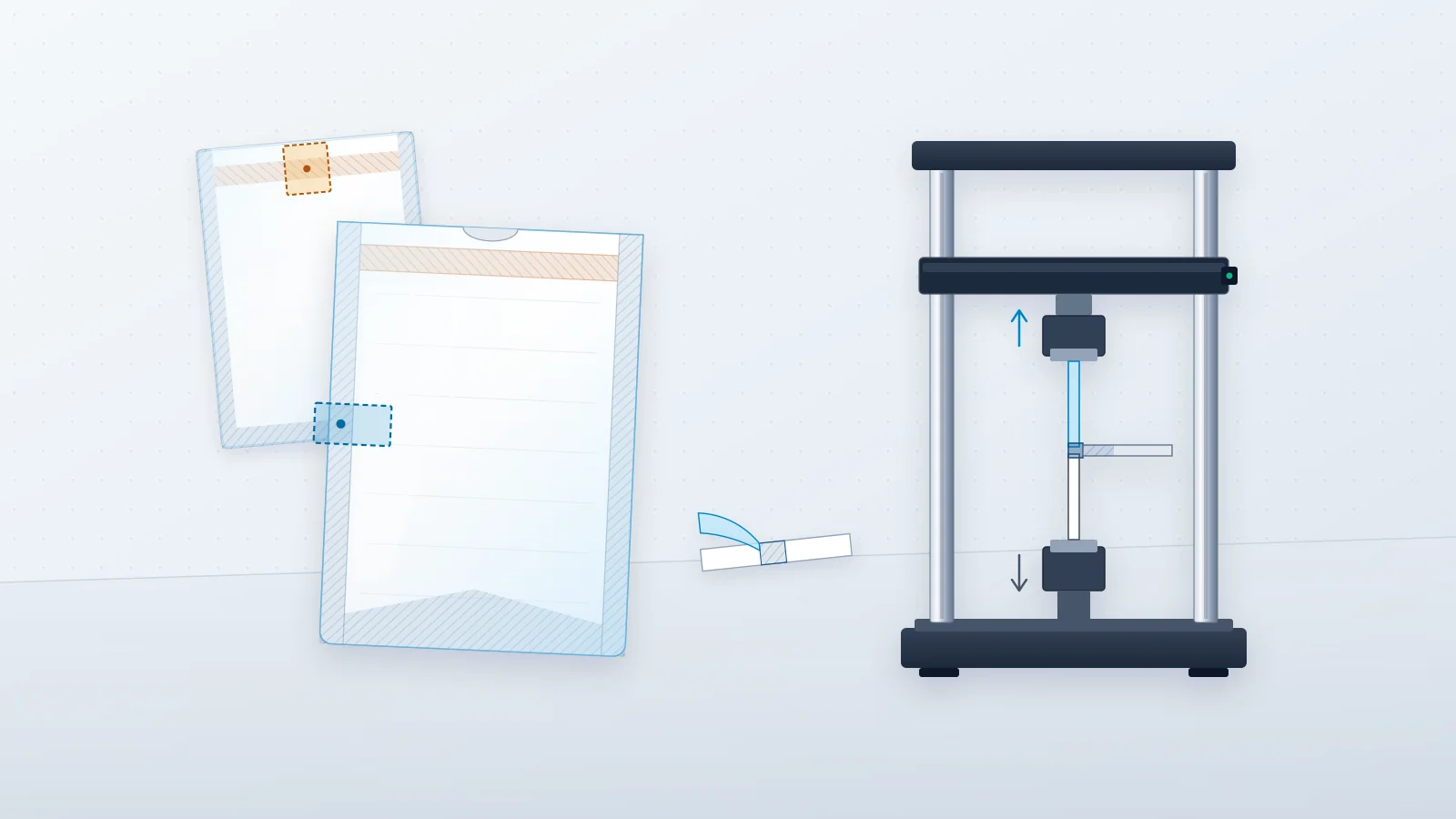
Choose a seal location that answers your approved protocol’s specific evidence question, map every sampled strip back to the pouch drawing, lot, pouch ID, and seal owner, and verify the exact test-method edition and setup before comparing numbers. Two ASTM F88/F88M reports can only be compared when they share justified comparable seal locations, pouch constructions, conditioning, specimen width and pull orientation, tail-support configuration (Technique A, B, or C), grip assignment, force metric (peak versus mean), and observed failure mode. When those conditions differ or are undocumented, quality assurance (QA) should request missing records or method-comparability evidence rather than averaging the numbers or declaring one seal stronger. Just as important, ASTM F88 measures the local mechanical separation force and failure observation of a cut strip; it does not establish whole-pouch barrier integrity, clinical opening usability, or maintenance of sterility.
What the reported seal strength actually describes
As of November 25, 2026, the active edition published by ASTM International is ASTM F88/F88M-23, and the U.S. Food and Drug Administration (FDA) lists complete recognition of that 2023 edition under recognition number 14-596 (entry date December 18, 2023). According to the official public scope (§§1.1–1.5) and FDA’s recognition record, the method measures the mechanical force required to separate a test strip of material containing a seal and identifies the mode of specimen failure. It is inherently a localized strip test, not an assessment of opening an entire sterile pouch or verifying that the complete package is free of channels.
That scope boundary matters immediately when two reports arrive at QA for the same nominal pouch specification. A contract pouch converter may supply qualification or receiving data pulled from a preformed side seal, while an internal packaging laboratory or contract test house reports data from the device manufacturer’s final closing seal after product loading. Both reports can truthfully cite ASTM F88 on their cover sheets, yet they describe different sealing processes, potentially different material orientations, and possibly different support configurations or calculation definitions.
Without reconciling those metadata fields first, QA reviewers risk two opposite errors: either treating discordant numbers from mismatched setups as a sealing-process failure, or pooling non-comparable data into a passing validation summary. The objective of an evidence-led review is to verify whether both reports measured the same physical measurand under the same conditions—and if not, to identify exactly what clarification or bridging evidence is needed.
Select and identify the seal location
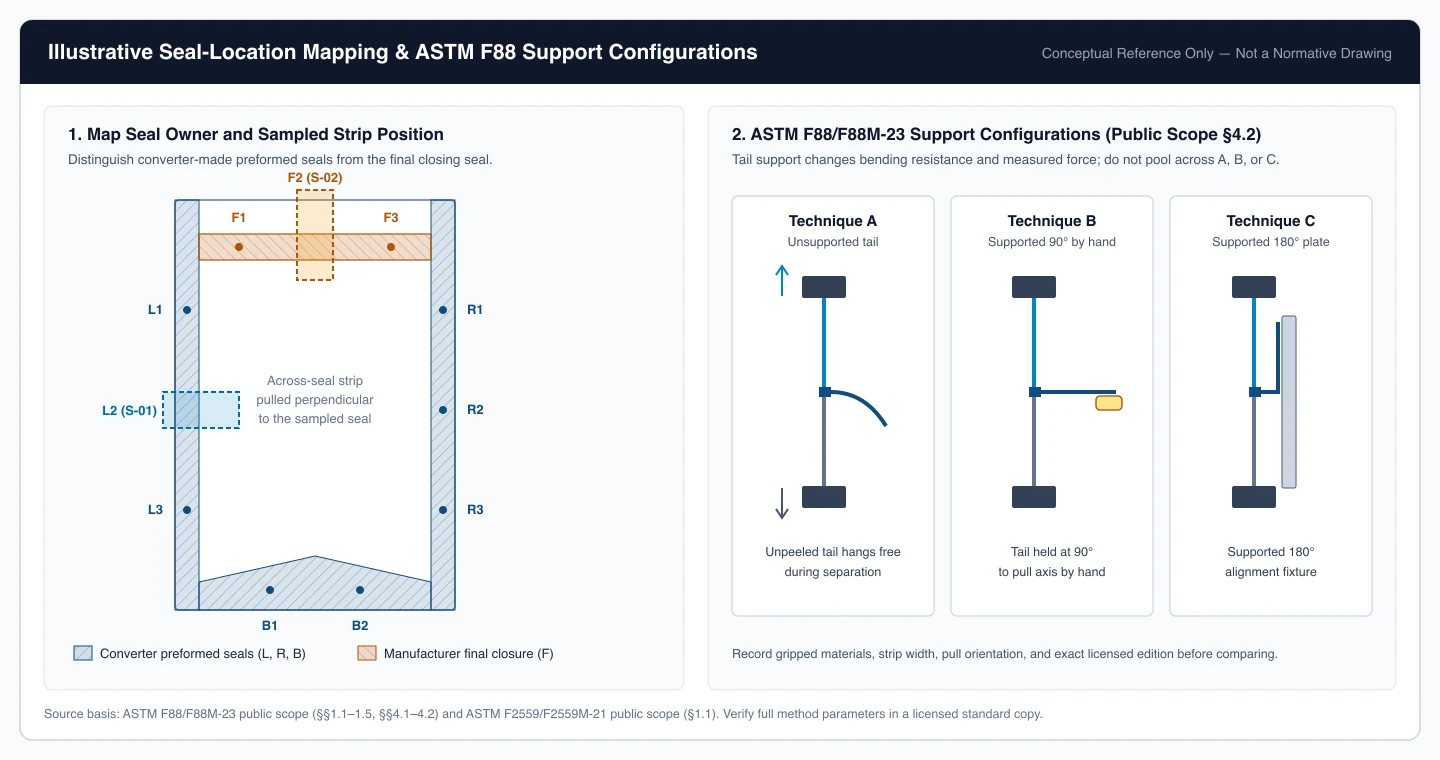
Under the public scope of ASTM F2559/F2559M-21 (§1.1–1.3), preformed sterilizable peel pouches arrive with an unsealed opening end and vary in pouch style and material construction (such as porous-sheet-to-transparent-film combinations). That structure creates two distinct seal-ownership domains on the same package: seals formed by the pouch converter during pouch fabrication (typically left, right, and base or chevron seals) and the final closure seal applied by the medical device manufacturer after device insertion.
Because ASTM F2559/F2559M-21 §§5.2–5.5 distinguishes initial pouch and material qualification from routine production and receipt requirements, and expects the specification to be mutually agreed by pouch supplier and purchaser within a system of validations supporting ISO 11607-1 and ISO 11607-2, a seal-strength report is hard to use unless it identifies the seal owner and ties each tested strip to a numbered position on the approved pouch drawing. A converter’s side-seal result speaks to the converter’s pouch-forming seal and the material lot it came from; on its own it does not show whether the device manufacturer’s sealer produced a uniform final closure on the loaded pouch.
Avoid asserting a universal number of seal locations per pouch. The approved protocol’s evidence question determines which locations are sampled and how many positions are justified. An incoming-receipt check of converter lots may focus on representative converter-made seals; a final-closure sealing study will naturally sample the final closure, using positions the protocol defines across the closure width; aging or distribution studies follow whatever worst-case zones that protocol justifies. None of these is a sampling recipe—the point is that every reported value must say which of these questions it answers. For broader supplier-qualification workflows, see our guide on contract packaging vendor qualification for medical devices.
Specimen-level traceability aligns closely with the reporting principles in FDA’s Non-Clinical Bench Performance Testing guidance (December 2019) (Sections II.A.3–6 and II.B.3–6). While that guidance covers premarket bench-test submissions and expressly excludes sterilization validation, its sample-identification structure provides a clear reporting benchmark for mechanical packaging attributes: record the pouch design and revision, manufacturing or sealing lot, individual pouch ID, unique strip ID, pre-test conditioning (environmental conditioning, aging, sterilization cycles, or distribution exposure), and the exact drawing coordinate before placing any force value into a comparison table.
Unit-level tracking matters even more because ASTM F88 is destructive. ASTM F3263-17(2025) states in §1.3 that it does not give concrete sample sizes for all packaging types and test methods, and a note that explicitly cites F88 heat-seal peel testing explains that test-method validation on the tensile tester should focus on variation in the method rather than in the material—ideally using low-variation material that still covers the force range to be tested. Because two laboratories can never test the same physical strip, a meaningful comparison depends on documented, matched sampling from controlled lot and drawing-location strata rather than unlabelled summary averages.
What makes two F88 test setups comparable?
Even when two laboratories sample strips from the same pouch lot and the same drawing coordinate, differences in specimen support, grip assignment, strip width, or pull orientation can change the measured separation force. The public significance/use text of ASTM F88/F88M-23 (§4.2) states that a portion of the measured force may be a bending component rather than seal strength alone, defines three tail-holding techniques—A, B, and C—and recommends consistent use of one technique throughout a test series. Note 5 adds that some flexible materials move or flip their tail during the test, which can affect the measured strength and should be reported with the results; Note 6 says test-method validation should account for fixtures or alignment plates and for which material is placed into which grip, because both are known to affect results.
| Technique | Tail Support (F88/F88M-23 §4.2, public text) | What the Standard Flags | QA Comparability Rule |
|---|---|---|---|
| Technique A | Unsupported: each tail is secured in opposing grips and the seal is left unsupported during the test. | Part of the force may be a bending component; Note 5 warns that some materials move or flip the tail, which should be reported. | Do not pool with Technique B or C results without documented, justified method-comparability evidence. |
| Technique B | Supported 90° by hand: tails gripped, seal hand-supported at a 90° angle to the tails. | Note 4: excessive lateral hand force may affect results; contact is meant to be loose, only preventing tail movement up or down. | Check that the report describes the hand-support practice and keeps it consistent across the series. |
| Technique C | Supported 180°: for flexible-to-flexible seals, the least flexible tail is typically held flat against a rigid alignment plate in one grip and the more flexible tail is folded 180° over the seal into the opposing grip. | Note 6: fixtures, alignment plates, and which material goes into which grip are known to affect results and belong in method validation. | Keep Technique C data separate from A and B; record the plate or fixture and the grip assignment, and confirm details in the licensed standard. |
Beyond support technique, QA reviewers should verify four setup details that routinely diverge between supplier certificates and internal verification reports:
Grip assignment: Peel pouches commonly pair two different webs—ASTM F2559 notes pouch materials may be porous, nonporous, or a combination—so the two tails of a strip can behave differently. ASTM F88 Note 6 identifies the choice of which material goes into which grip as a known influence on results. Reports should state which web was clamped in the moving grip and which in the stationary grip, and, under Technique C, which tail was held against the alignment plate.
Strip width, units, and pull orientation: Every force value needs explicit units and the tested strip width (for example, newtons for a stated strip width, or force per unit width). Do not rescale values across widths unless your approved specification and validated method support it. Confirm also that both reports cut strips in the same orientation relative to the seal; the CellScale study discussed below describes across-seal pulling as the conventional configuration.
Conditioning, test speed, and licensed edition: Check whether specimens received the same conditioning, sterilization, aging, or distribution exposure and were tested at the grip separation and separation rate specified in the approved protocol. Confirm those procedural clauses directly against a licensed copy of the cited ASTM F88/F88M edition rather than relying on summaries.
Local method validation versus standard-level precision: Under ASTM F3263-17(2025) §4.1, interlaboratory studies performed during standard development are not substitutes for validation at the organization performing the test, and §4.1.1 expects that validation to describe the test equipment, the measurement range, and the rationale for samples and methodology. Each lab’s own validation status is therefore part of the comparability question, not an assumption.
A clear example of how deliberate setup choices limit cross-report comparability appears in CellScale’s expanded F88/F88M-15 application study (pp. 3–8). In that 12-specimen demonstration on a self-sealing pouch material, the instrument manufacturer explicitly noted two important boundaries: the test referenced an older -15 edition rather than the active -23 edition, and the authors intentionally modified specimen orientation to pull along the seal rather than in the conventional across-seal arrangement in order to examine opening behavior. They openly disclaimed full procedural conformity to ASTM F88/F88M-15. For QA reviewers, that transparency illustrates a core rule: a modified setup can be informative for an internal engineering study on one material, yet its numbers are neither standard-conforming F88-23 results nor interchangeable baselines for comparing another lab’s across-seal data.
Read the force and failure observation together
The public significance/use text of ASTM F88/F88M-23 (§4.1, §4.1.1, Notes 1–3) treats the measured force and the observed specimen failure as parts of one result. Section 4.1.1 states that the maximum seal force is important information and that, for some applications, the average force to separate the seal may also be useful and should then be reported as well. The two numbers describe different things: maximum force is the single highest load recorded, while average force depends on the separation window the lab chose to average over (CellScale, for example, averaged the central 80% of its peel response). Comparing one lab’s maximum value with another lab’s average value is not a like-for-like comparison, even when fixture and strip width match, and a report that gives only an average without the maximum is missing information the standard calls important.
Failure observations prevent misreading what the load cell recorded. Note 1 of ASTM F88/F88M-23 explains that seal-strength values may also involve the mechanical properties of the materials forming the seal, because they can deform or elongate during the test, and that the result reflects only the sampled area of the package rather than a user opening the entire pouch. The CellScale application note (p. 7) lists material bending, elongation, tearing, delamination, specimen geometry, and tail-holding technique as influences to consider when comparing results across materials or configurations. A strip that tears through a web or delaminates can therefore record a force that is not a pure measure of the seal interface, while a lower force with clean interface separation may be consistent with intended peel-open behavior. Neither observation is automatically acceptable or unacceptable; the approved specification decides.
QA reviewers should therefore reject two common shortcuts:
Assuming higher force is always better: ASTM F88 §4.1 and Notes 2–3 explain that lower seal-strength specifications typically provide assurance of package closure, while upper specifications—typically limited to seals intended to be peeled by the end user—limit the force needed to open the package. A high number on a peelable seal can be a problem rather than a margin.
Inferring cause or disposition from the number alone: Do not deduce failure mode from a force column, and do not assign an automatic pass/fail disposition to a failure mode without consulting the preapproved pouch specification. When reports show diverging failure observations or unexplained load spikes, request the raw force-displacement curves, post-peel specimen photographs, and deviation records—consistent with FDA’s non-clinical bench-test reporting guidance, which recommends images of the failure mode where testing to failure and description of protocol deviations.
Two-lab report comparison worksheet
Before pooling external converter certificates with internal qualification data—or reconciling conflicting numbers from two contract test labs—QA teams can log both reports side by side in a structured reconciliation worksheet. This worksheet is an original editorial synthesis built from ASTM F88/F88M-23 (§§1.4, 4.1, 4.2), ASTM F2559/F2559M-21, ASTM F3263-17(2025), and FDA’s bench-testing traceability principles; it is not a prescribed ASTM or FDA regulatory form.
| Report / Lab | Protocol & Revision | Pouch Design / Rev & Lot | Pouch & Unique Strip ID | Seal Owner, Seal & Drawing Position | Material / Condition | Standard Edition | Strip Width & Pull Orientation | Support Technique & Grip Orientation | Test Parameters / Analysis Metric | Reported Separation Force & Units | Observed Failure Mode & Curve / Photo Ref | Deviations | QA Review Disposition |
|---|---|---|---|---|---|---|---|---|---|---|---|---|---|
| Lab A (Simulated Example) | Example report A-01 / protocol P-01 rev 2 | Pouch D-01 rev A / lot L-01 | Pouch PCH-01 / strip S-01 | Converter preformed left side seal, mapped position L2 | Not supplied in summary (request conditioning & sterilization state) | Not specified in summary (confirm licensed edition) | 15 mm strip / across-seal | Technique A (unsupported); gripped web assignment not supplied | Peak force (pull rate & plateau rules not supplied) | 3.4 N (hypothetical) | Interface peel observed; example trace A-01 | None noted in summary (request full log) | Clarification required — hold pooling until condition, edition, grips, and rate are confirmed |
| Lab B (Simulated Example) | Example report B-01 / protocol P-02 rev 1 | Pouch D-01 rev A / lot L-01 | Pouch PCH-02 / strip S-02 | Manufacturer final closure, mapped position F2 | Not supplied in summary (request conditioning & sterilization state) | Not specified in summary (confirm licensed edition) | 15 mm strip / across-seal | Technique C (180° supported); gripped web assignment not supplied | Average (mean) force (pull rate & calculation window not supplied) | 3.4 N (hypothetical) | Material tear observed; example trace B-01 | None noted in summary (request full log) | Do not pool with Lab A — different seal owner/position, support technique, metric, and failure mode |
Look closely at what this hypothetical reconciliation reveals. At first glance, Lab A and Lab B appear to agree: both tested a 15 mm across-seal strip from fictional pouch D-01 rev A, lot L-01, and both reported 3.4 N. In reality, almost every underlying determinant of the measurement differs or is missing:
Different seal owner and drawing position: Lab A pulled a converter-formed side seal at mapped position L2 on pouch PCH-01, whereas Lab B pulled the device manufacturer’s final closure at mapped position F2 on pouch PCH-02.
Different support configuration: Lab A ran Technique A (unsupported free tail), whereas Lab B ran Technique C (180° supported), and neither summary documented which material entered the moving versus stationary grip.
Different analysis metric and failure mode: Lab A reported peak (maximum) separation force with clean interface peel, whereas Lab B reported only average separation force with material tear—two distinct physical responses that cannot be averaged. Lab B’s summary also omits the maximum force that F88 §4.1.1 calls important information, so it should be requested.
Missing comparability records and no population inference: Conditioning history, standard edition, pull rate, and deviation logs were omitted from both summaries and must be requested. Moreover, two single-strip rows never support statistical conclusions about lot equivalence or lab proficiency.
flowchart TD
  A["Receive two seal-strength reports"] --> B{"Same protocol, licensed edition, and lot conditioning?"}
  B -- "No or undocumented" --> C["Request missing protocol rev, edition, and conditioning records"]
  B -- "Yes" --> D{"Same seal owner and drawing position?"}
  D -- "No (e.g., side seal vs. final closure)" --> E["Keep datasets separate by seal owner; evaluate against each seal's spec"]
  D -- "Yes" --> F{"Same strip width, orientation, support (A/B/C), and grips?"}
  F -- "No" --> G["Do not pool; require justified method-bridging validation"]
  F -- "Yes" --> H{"Same metric (peak vs. mean) and compatible failure mode?"}
  H -- "No" --> I["Review raw curves, photos, and deviations; investigate mode shift"]
H -- "Yes" --> J["Comparable measurand; evaluate against approved specification and separate integrity evidence"]Strength is not the same as a verified sterile barrier
Even when two ASTM F88 reports are fully reconciled and meet a preapproved mechanical strength specification, a local strip force does not establish that the whole pouch is leak-free. Under the public scope of ASTM F1929-23 (§§1.1–1.3), dye penetration is a separate integrity method intended to detect and locate a leak equal to or greater than a channel formed by a 50 µm wire in edge seals between a transparent material and a porous sheet, and only where the porous material retains the dye long enough. Its significance/use clauses (§§4.2–4.5) explain that it visually detects individual channel leaks, will not indicate many small leaks of the kind found in porous material, is not quantitative, and gives no indication of leak size. Its endpoint is a visual leak observation, not a separation force, and it does not by itself demonstrate every aspect of sterile-barrier performance.
Public premarket filings show how manufacturers separate mechanical strength from leak-detection endpoints in practice. In FDA 510(k) clearance K243179 (cleared June 26, 2025, for a sterilization pouch and roll), the applicant’s non-clinical test table on page 18 of the summary PDF (printed summary page 13) lists separate evidence rows for mechanical seal strength and package leakage:
| Test Row in K243179 Summary (p. 13 / PDF p. 18) | Cited Standard Edition | Distinct Evidence Endpoint | Scope & Transferability Caveat |
|---|---|---|---|
| Seal strength | ASTM F88-2023 | Mechanical strip separation response and failure observation | Applicant-specific criteria in K243179 apply only to that cleared pouch/roll submission and must not be transferred as a general device limit. |
| Dye penetration | ASTM F1929-2023 | Qualitative channel detection in porous/transparent edge seals | Visual detection of dye penetration through seal channels; does not measure peel force or substitute for system-level validation. |
| Vacuum leakage | ASTM D3078-02 | Package leakage under vacuum (applicant’s stated end point: no water penetrates the pouch) | Addresses leakage separately from strip strength; the applicant’s criteria remain specific to that submission. |
Notice the critical regulatory boundary on that example: FDA hosting a submitter’s 510(k) summary does not turn an applicant’s product-specific criterion into a universal benchmark for another medical device. Every terminally sterilized device requires product-specific acceptance criteria justified inside its own sterile-barrier system.
At the system and process level, FDA’s consensus-standard records connect individual strength and integrity tests to ISO 11607-1:2019 including Amendment 1:2023 (recognition 14-594) for materials, preformed sterile-barrier systems, and packaging systems, and ISO 11607-2:2019 including Amendment 1:2023 (recognition 14-595) for forming, sealing, and assembly process validation. Both FDA supplementary sheets note a December 20, 2026 transition date for U.S. declarations referencing the older unamended recognitions 14-530 and 14-531. Those dates and recognitions are specific to U.S. FDA declarations—not automatic proof of conformity or legal adoption in other jurisdictions, and scope caveats apply to aseptically manufactured or drug-device combination products. Above all, neither an isolated F88 force result nor a single F1929 leak test proves sterility or whole-pouch clinical opening usability.
To place individual seal-strength and leak checks into the broader packaging engineering program, explore our existing pillar guides on ISO 11607 medical device packaging validation, medical device shelf-life and stability testing, ASTM D4169 transportation validation, and connecting transport damage complaints to packaging validation.
Before accepting or reconciling the report
Use this final QA disposition sequence before accepting, trending, or rejecting two ASTM F88 seal-strength reports in a design-verification or supplier-qualification file:
Verify the cited edition against a licensed copy and approved specification: Confirm which edition each lab followed (such as ASTM F88/F88M-23 versus an older revision) and check detailed procedural clauses in the licensed standard before accepting any claim of conformity.
Confirm specimen lineage and seal ownership: Map every strip back to pouch design/revision, lot, individual pouch ID, unique strip ID, conditioning and sterilization history, seal owner (converter preformed versus manufacturer final closure), and numbered drawing position.
Lock down geometry, support technique, and calculation rules: Verify identical strip width, pull orientation, tail-support configuration (A, B, or C), gripped web orientation, pull speed, and peak versus mean calculation method before comparing values across labs.
Review failure modes alongside raw curves and deviations: Inspect raw force-displacement traces, specimen photos, and deviation logs; never treat matching numbers with diverging failure modes (such as peel versus tear) as equivalent.
Separate missing-record requests from method-bridging evidence: Issue a targeted clarification request when metadata is omitted; require justified comparability or local method-validation evidence aligned with ASTM F3263 principles whenever setups or locations genuinely differ.
Retain separate integrity, usability, and process-validation evidence: Keep local mechanical strength data paired with material-appropriate leak testing, whole-pouch opening evaluation, and ISO 11607-1/-2 validation records.
Sources
ASTM F88/F88M-23: Standard Test Method for Seal Strength of Flexible Barrier Materials
FDA Recognized Consensus Standards — ASTM F88/F88M-23, recognition 14-596
ASTM F2559/F2559M-21: Standard Guide for Writing a Specification for Sterilizable Peel Pouches
ASTM F3263-17(2025): Standard Guide for Packaging Test Method Validation
FDA Recognized Consensus Standards — ISO 11607-1:2019 including Amendment 1:2023, 14-594
FDA Recognized Consensus Standards — ISO 11607-2:2019 including Amendment 1:2023, 14-595
K243179 — Sterilization Pouch and Roll, 510(k) clearance and submitter summary
Seal Strength Testing Based on ASTM F88/F88M-15 — CellScale expanded application note