
Transport Damage: Connecting Complaint Photos to Packaging Validation
How RA/QA teams investigate medical device transport damage photos, satisfy QMSR and EU MDR complaint rules, and reconcile field damage against packaging validation.

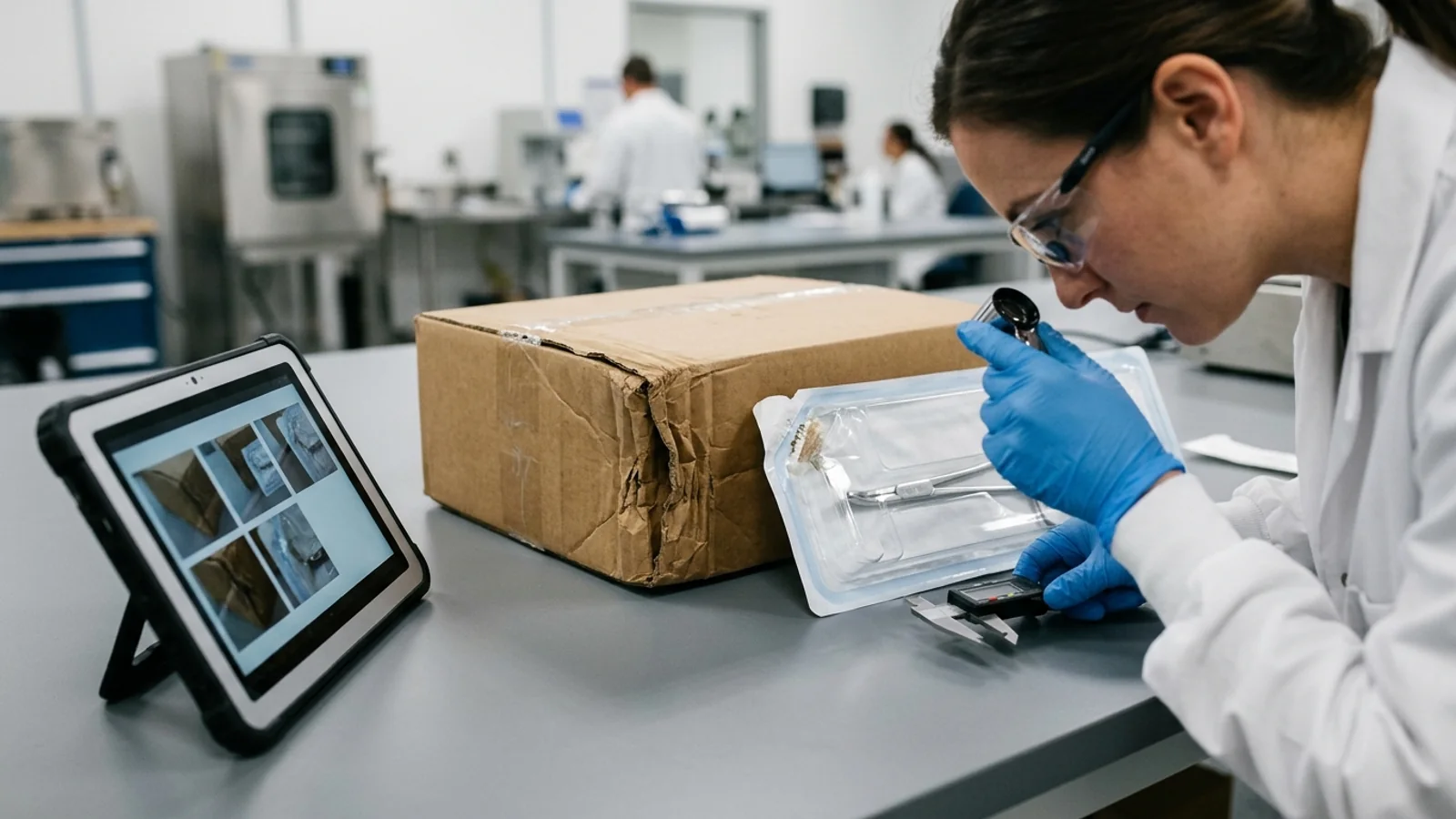
A commercial distributor or hospital receiving dock sends an urgent message containing high-resolution photographs: a corrugated shipping container shows collapsed structural corners and scuffed exterior flaps, and the internal rigid blister tray inside shows a cracked plastic flange and an opened sterile seal. The shipment left your finished-goods distribution warehouse fewer than forty-eight hours earlier. For medical device manufacturers, this situation represents a recurring and high-stakes regulatory crossroad. Operational teams often treat field damage as a routine freight claim, issuing a replacement unit and seeking commercial reimbursement from the freight forwarder. However, within a medical device quality management system, that response creates an immediate compliance gap.
Distributor or hospital photographs do not close an issue; they open a complaint. Under the FDA Quality Management System Regulation, 21 CFR 820.35(a), effective February 2, 2026, any complaint involving the possible failure of a device, labeling, or packaging to meet any of its specifications requires records of the review, evaluation, and investigation. In the European Union, MDR Annex I General Safety and Performance Requirement (GSPR) 7 and GSPR 11.4 address transport and storage performance and the point at which a sterile barrier's integrity must be evident to the user. Importers and distributors have separate handoff duties under Articles 13 and 14. This guide explains what the complaint file has to contain, what the photos can establish, and how to reconcile the photographed unit with the packaging validation file.
What a transport-damage complaint obligates you to record
When field damage photos arrive, the first duty is the complaint record. 21 CFR 820.35(a) applies in addition to ISO 13485:2016 Clause 8.2.2. Finished-device manufacturers exempt from the other CGMP requirements remain subject to complaint files and to the record requirements in 21 CFR 820.35.
For any complaint involving the possible failure of a device, labeling, or packaging to meet any of its specifications, 21 CFR 820.35(a) requires records of the review, evaluation, and investigation. If an investigation was already performed for a similar complaint, another investigation is not required, and the manufacturer documents the justification for not performing one. That justification stands on its own. It is separate from the numbered fields below. Those numbered fields apply to complaints that must be reported to FDA under 21 CFR Part 803, complaints the manufacturer determines must be investigated, and complaints the manufacturer investigated anyway. For that group, the regulation requires these records:
Name of the device: The name of the device.
Date received: The date the complaint was received.
Device identification: Any unique device identifier (UDI) or universal product code (UPC), and any other device identification.
Complainant identity: The name, address, and phone number of the complainant.
Nature and details: The nature and details of the complaint, including whether the report describes outer-carton crush, sterile-barrier damage, labeling damage, or damage to the device itself.
Correction or corrective action: Any correction or corrective action taken. The written justification for skipping a new investigation of a similar complaint is the separate requirement above, and it is recorded when that path is used.
Reply to the complainant: Any reply to the complainant.
Every complaint in that packaging-failure class has a review, evaluation, and investigation record. The seven numbered fields above are the additional fields for the Part 803, must-investigate, and actually investigated group, in the order set out in 21 CFR 820.35(a)(1) through (a)(7): device name, date received, UDI or UPC and any other device identification, complainant name, address, and phone number, nature and details, any correction or corrective action taken, and any reply to the complainant. The investigation narrative holds what the review found. A file that contains only a carrier credit, or that closes a similar complaint without the written justification, is incomplete under 820.35(a).
21 CFR 820.45, which applies in addition to ISO 13485 Clause 7.5.1, requires documented procedures for the integrity, inspection, storage, and operations of labeling and packaging under the customary conditions of processing, storage, handling, distribution, and, where appropriate, use. Before release or storage, where applicable, labeling and packaging are examined for accuracy, including the correct UDI or UPC or other device identification, the expiration date, storage instructions, handling instructions, and any additional processing instructions. Release of the labeling for use, and the results of the labeling inspection used to prevent mixups, are documented under ISO 13485 Clause 4.2.5. A crushed shipper in the field sends the investigator back to those release records and to the approved packaging specification. Burst strength, edge-crush, and seal criteria live in that specification when the manufacturer has defined them.
In the European Union, Annex I GSPR 7 requires devices to be designed, manufactured, and packaged so that their characteristics and performance during intended use are not adversely affected during transport and storage, for example through fluctuations of temperature and humidity, taking account of the instructions and information provided by the manufacturer. GSPR 11.4 requires devices delivered sterile to be sterile when placed on the market and, unless the packaging intended to maintain their sterile condition is damaged, to remain sterile under the transport and storage conditions specified by the manufacturer until that packaging is opened at the point of use. The integrity of that packaging must be clearly evident to the final user. A photograph of a punctured tray or an opened seal is evidence about that last point. It still has to be read with the labeled conditions and the validation file.
Vigilance is a separate decision from opening the complaint. EU MDR Article 2(64) defines an incident as any malfunction or deterioration in the characteristics or performance of a device made available on the market, including use-error due to ergonomic features, any inadequacy in the information supplied by the manufacturer, and any undesirable side-effect. Article 2(65) defines a serious incident as an incident that directly or indirectly led, might have led, or might lead to the death of a patient, user, or other person; the temporary or permanent serious deterioration of a patient's, user's, or other person's state of health; or a serious public health threat. Article 87 requires manufacturers to report serious incidents, with the stated exception for expected side-effects that are documented, quantified, and subject to trend reporting. Damage found at receiving, before use, is ordinarily handled in the complaint and post-market record. A damaged sterile barrier on a device already made available can still be a malfunction under Article 2(64). Whether it is a serious incident, including under the 'might have led' limb, depends on the facts. The photographs record the condition. They do not complete that determination. In the United States, the same file has to support the medical device reporting decision under 21 CFR Part 803, which 820.35(a) ties to the complaint record. This is a decision framework for the file, and it is not a reportability ruling for a specific event.
What the photos can prove and what they cannot
Photographs submitted from the field provide immediate qualitative evidence, but quality engineers must rigorously define their evidentiary boundaries. Relying entirely on visual inspection to assign blame—either assuming the carrier dropped the box or concluding the packaging design failed—is an audit-vulnerable mistake. A defensible quality investigation distinguishes between direct physical observations and inferred environmental stresses.
Photographs can definitively establish specific observable facts:
Visible exterior damage morphology: Diagonal corner creasing, accordion-style side wall buckling, localized impact punctures, torn tape joints, or seam separation.
Unit traceability and label markings: Legible UDI carrier bar codes, lot numbers, expiration dates, carton part numbers, and box manufacturer certificate (BMC) stamps verifying board grade.
Internal package orientation: Dislodged internal dunnage, shifted foam end-caps, inverted inner cartons, or punctured sterile pouches where rigid device tips breached protective barrier film.
Visible seal separation: Macroscopic channel defects, peeling Tyvek lid flanges, or delamination along tray sealing lines.
Conversely, photographs can never prove quantitative physical stresses or transit history. An image cannot establish:
Dynamic impact acceleration: A crease shows that the carton was deformed. It does not measure drop height, the shock the unit received, or whether the drop happened on a sortation line, in a vehicle, or at delivery.
Static and dynamic compressive load: A crushed lower carton does not reveal whether pallet stacking complied with validated limits (e.g., three layers high) or whether an LTL freight carrier stacked a 2,000-pound pallet of industrial hardware directly on top of medical parcels.
Climatic and pressure differentials: Photos do not capture whether high-altitude cargo aircraft decompression expanded sealed pouches, stressing seal perimeters before impact, or whether extreme humidity weakened corrugated board flute stiffness.
Microbial barrier integrity: An apparently intact heat seal in a photograph may harbor micro-channels, pinholes, or sub-visual breaches. When sterility is in question, the returned unit is checked with a laboratory method such as dye penetration (ASTM F1929) or seal-strength testing (ASTM F88).
Because visual evidence is inherently bounded, complaint files must actively gather secondary transit records. As documented in our complaint handling guide, investigators must cross-reference field photographs with bill-of-lading exception notations (driver sign-offs recording crushed cartons at delivery), freight tracking timestamps, electronic data logger readouts, carrier sorting hub records, and physical sample quarantine logs.
The configuration-to-claim-to-evidence map
To determine whether field damage points to carrier mishandling or a packaging validation vulnerability, the investigator must map each physical packaging component against the specific claims documented in the original packaging validation file. Prospective transport testing conducted under ASTM D4169-22 (FDA Recognition 14-576) or ISTA 3A evaluates shipping units against sequential hazard elements representing anticipated distribution environments. The complaint investigation must determine whether the field failure occurred inside or outside those validated parameters.
The following configuration-to-claim-to-evidence matrix provides the framework for reconciling field photographs with engineering design files:
| Packaging Component | Validation Claim & Standard Scope | Field Evidence Photos Provide | Missing Reconciling Evidence Needed |
|---|---|---|---|
| Tertiary Corrugated Shipper | The tested shipper and pack pattern withstood the handling and compression hazards in the named distribution cycle, at the justified assurance level. Burst and edge-crush values, when the manufacturer uses them, belong to the packaging specification. | Corner crush, puncture, seam separation, flute collapse, and the visible impact location. | Proof the received shipper matches the validated board, pack count, and dunnage; carrier exception notes; stacking or loading records. |
| Internal Cushioning & Dunnage | Cushioning was part of the shipping unit tested for that cycle's vibration and handling elements. The claim stops at the levels written in the report. | Displaced inserts, cracked blisters, abraded inner walls, and inner packs that have shifted. | The actual mode and lane, and the vibration or loose-load exposure the report tested. |
| Primary Sterile Barrier | ISO 11607-1:2019, including Amendment 1:2023, is FDA-recognized (Rec. 14-594) for sterile barrier systems intended to maintain sterility until the point of use. The claim is the configuration and the tests recorded in the file. | Visible puncture, channel, peel, wrinkled porous lid, or cracked flange. | Laboratory integrity results on the returned unit, such as dye penetration or seal-strength testing, for residual seal strength and sterility. |
| Distribution Cycle (DC) | Cycle selection follows transport mode. Guidance written to an earlier D4169 edition maps single-parcel air and motor freight up to 150 lb to DC-13, and air-and-truck shipments over 150 lb or on a pallet or skid to DC-12. The cycle named in the report is the claim. | A parcel-carrier label, or stretch wrap and pallet remnants, can suggest which mode arrived. | The bill of lading, service level, and a check that the lane matches the cycle and edition cited in the report. |
| Assurance Level (AL) | Test-lab guidance written to an earlier edition treats Level I as the most severe, Level II as the level most often used, and Level III as the least severe. The claim is the level justified in the protocol with a documented risk assessment. | The depth of a crease is an observation. It is not a drop-height or compression measurement. | The protocol's risk justification and the drop, compression, and vibration levels that were tested. |
| Labeled transport and storage conditions | GSPR 7 requires that transport and storage, including temperature and humidity fluctuations, leave characteristics and performance during intended use unaffected, taking account of the manufacturer's instructions. For sterile devices, GSPR 11.4 requires sterility under the manufacturer's stated conditions unless the sterile packaging is damaged, until that packaging is opened, and requires the integrity of that packaging to be clearly evident to the final user. | Visible crush, water staining, or an opened or punctured barrier shows the condition at receipt. | The labeled storage and handling conditions, any climatic records the claim depends on, and whether those conditions were the ones validated. |
When auditing validation reports against field complaints, quality engineers frequently encounter discrepancies in distribution cycle (DC) selection. Prospective cycle selection is covered in ASTM D4169 transportation testing. Nelson Labs, writing about an earlier edition (D4169-16), describes 18 distribution cycles chosen by transport mode and maps the common small-parcel air-and-truck route, single package up to 150 lb, to DC-13, and maps air-and-truck shipments over 150 lb or unitized on a pallet or skid to DC-12. The cycle named in the validation report is the one to reconcile, and the edition on the report cover controls the numbering. If the report tested pallet loads under DC-12 and commercial teams later broke those pallets into single-parcel courier orders, those parcels encountered manual sortation and conveyor hazards outside the pallet test.
When the validation file relied on ISTA Procedure 3A (the March 2018 overview for parcel-delivery shipments of 150 lb (70 kg) or less), read that overview's limits with the report. The overview states that test levels are based on general data and may not represent any specific distribution system, and that some transit conditions, including moisture, pressure, or unusual handling, may not be covered. The package and product are considered together. A completed 3A test is evidence about the hazards that procedure simulates. The complaint file still compares the actual lane with those hazards. Confirm the current procedure version before using a version-specific detail; the overview used here is the 2018 edition.
Three outcomes: carrier event, validation gap, or unvalidated change
By reconciling field photographs, shipping documents, and the packaging validation report, the investigation inevitably funnels into one of three distinct root cause classifications. Each branch carries distinct quality, regulatory, and commercial obligations.
graph TD
    A["Field damage photos arrive"] --> B["Open the complaint record under 21 CFR 820.35"]
    B --> C["Compare the unit, the lane, and the damage with the validation file"]
    C --> D{"Did the unit and lane match the validated configuration?"}
    D -- "No" --> E["Unvalidated configuration or lane"]
    D -- "Yes" --> F{"Did the documented handling stay inside the tested hazards?"}
    F -- "No" --> G["Out-of-profile handling event"]
    F -- "Yes" --> H["In-profile damage: validation-adequacy investigation"]
    E --> E1["Hold further shipments of that configuration"]
    E1 --> E2["Change control before the next lot ships"]
    G --> G1["Record why no packaging change is justified"]
    G1 --> G2["Carrier claim proceeds as commercial recovery"]
    H --> H1["Corrective action and retest if the file does not cover the lane"]
    E2 --> Z["Record any required reply to the complainant"]
    G2 --> Z
H1 --> ZBranch 1: Out-of-Profile Handling Event (Carrier Mishandling)
In this outcome, the shipped unit and the lane match the validated configuration, and the investigation has evidence that the handling went beyond the hazards that were tested. Examples include punctures that match forklift tines, crushing under a load the compression test never represented, water immersion, or a tripped shock indicator together with a carrier exception note. The indicator and the shipping record are compared with the drop and compression levels in the report. The photograph shows the condition at receipt.
The complaint record cites that comparison: the configuration and lane match the file, and the documented handling exceeded the drop, compression, or vibration levels that were tested and justified. When the protocol used Assurance Level II or III, the comparison is to that tested level. Assurance Level I is the most severe of the three levels, and it is the benchmark when the protocol tested Level I. The file records why no packaging change is justified. A freight claim can proceed in parallel. Payment of the claim is the commercial recovery. The complaint record is complete when the 820.35(a) investigation is complete, including any reply to the complainant that the regulation requires for that file.
Branch 2: In-Profile Damage (Validation Adequacy Gap)
In-profile damage means the unit and the lane match the validated configuration and the damage occurred inside the hazards the report tested. One pattern is a parcel shipment whose outer carton shows only light scuffing while the sterile tray flange is cracked, a porous lid is punctured, or a seal has opened.
This evidence indicates that the original prospective validation under ISO 11607-1 sterile packaging standards or ASTM D4169 may have simulated a narrower set of hazards than the lane produced. The investigation looks for an assurance level that was too mild for the lane the risk assessment described, a missing hazard element such as loose-load vibration, contact between a device feature and the barrier during vibration, or test samples that were not the configuration that shipped. Corrective action, integrity testing of a returned unit, a packaging change, and a new distribution test follow when that investigation shows the current validation does not cover the shipped configuration or the hazards the product is meeting in the field.
Branch 3: Unvalidated Configuration or Lane Mismatch (Change Control Failure)
In many organizations, field damage uncovers an unapproved operational change rather than a design defect. Engineering change control gaps frequently occur when manufacturing or logistics teams implement modifications without notifying regulatory or packaging engineering:
Packaging material substitutions: Switching corrugated box suppliers, reducing board basis weight, altering flute size (e.g., from B-flute to C-flute), or using alternative void-fill dunnage.
Pack count alterations: Altering the primary-to-secondary packaging configuration (e.g., shipping six units per shipper instead of the validated ten-pack), leaving excessive void space that allows internal boxes to collide.
Unvalidated distribution lanes: Transitioning from temperature-controlled refrigerated ground transport to uninsulated commercial parcel air freight, exposing products to cold-temperature embrittlement and altitude pressure differentials without updated testing.
Contract packaging variance: Changes introduced by contract packaging vendors that deviate from validated master packaging records, as explored in our contract packaging vendor qualification guide.
When the investigation shows the damaged units were shipped in a configuration or by a lane the validation file does not cover, quality holds further shipments of that configuration, opens a nonconformance, evaluates the field risk, and runs the change through design and process change control before the next lot of that configuration ships.
Required, recognized, or commercial: separating the evidence types
Regulatory compliance audits often scrutinize how manufacturers categorize transit evidence. Quality leaders must maintain strict boundaries between enforceable statutory regulations, voluntary consensus standards, and commercial dispute mechanisms:
| Evidence Category | Governing Framework | Legal / Regulatory Status | Role in Complaint Resolution |
|---|---|---|---|
| Statutory QMS Mandate | FDA QMSR (21 CFR 820.35, 820.45); EU MDR 2017/745 GSPR 7, GSPR 11.4, Articles 13 & 14. | Enforceable duties. FDA can cite 21 CFR 820.35 and 820.45 on inspection. GSPR 7, GSPR 11.4, and Articles 13 and 14 bind the manufacturers and economic operators those provisions address. | Defines mandatory complaint intake, evaluation, investigation, record-keeping, and economic operator reporting obligations. |
| Recognized Consensus Standard | ASTM D4169-22 (FDA Rec. 14-576) and ISO 11607-1:2019 including Amd. 1:2023 (FDA Rec. 14-594). ISTA Procedure 3A is a separate general-simulation procedure. These two recognition entries do not include it. | FDA recognition identifies a consensus method that may be used in a submission. The D4169 recognition entry describes a laboratory practice for evaluating shipping units against a sequence of anticipated hazards, and states that the practice is not a substitute for material specifications or existing preshipment test procedures. The complaint duty remains 21 CFR 820.35(a). | The validation report supplies the distribution cycle, assurance level, and configuration the investigator compares with the shipment. A passing test describes the hazards that were simulated. |
| Commercial & Financial Recovery | Carrier freight tariffs, bills of lading, freight insurance policies, distributor commercial agreements. | Carrier tariffs, bills of lading, cargo insurance, and supply agreements govern reimbursement between the shipper and the carrier. | Records the financial recovery. The complaint file still contains the 820.35(a) investigation and, where that paragraph requires it, the reply to the complainant. |
A closure note that says only 'the carrier accepted liability and issued a credit' leaves the quality record unfinished. 21 CFR 820.35(a) still requires the review, evaluation, and investigation of a packaging-specification complaint, and, for the complaints in the numbered group above, the specified fields including any reply to the complainant. The credit memo can sit in the commercial file. The investigation has to say whether the unit matched the validated configuration, whether the lane matched the tested distribution cycle and assurance level, and whether the same damage signature is appearing on other lots.
Repeat photos, trend review, and when revalidation is triggered
A single damaged carton is weak evidence that a validation failed. Recurring photographs, sorted by configuration, lane, and damage signature, are the post-market signal. EU MDR Article 88 requires manufacturers to report a statistically significant increase in the frequency or severity of incidents that are not serious incidents, or of expected undesirable side-effects, when that increase could have a significant impact on the benefit-risk analysis and has led or may lead to risks to the health or safety of patients, users, or other persons that are unacceptable when weighed against the intended benefits. The manufacturer specifies how those incidents are managed, and the method and observation period, in the post-market surveillance plan. Complaint trending inside the quality system is broader than that report and includes packaging complaints that never meet the incident definition. The manufacturer sets the trend rules. This article does not set a numeric threshold.
Quality assurance teams must categorize transport complaints across multidimensional metadata:
By packaging lot and component supplier: Tracking whether crushed shippers correlate with a specific corrugated converter or batch of thermoformed trays.
By carrier network and distribution hub: Identifying whether transit failures concentrate within a specific 3PL partner, regional sorting hub, or air cargo lane.
By geographic and climatic zone: Evaluating seasonal failures, such as high-humidity summer transit causing flute softening or extreme sub-zero winter transit causing plastic tray embrittlement, aligning with temperature-controlled distribution controls.
By device SKU and packaging configuration: Monitoring whether specific high-mass devices or products with protruding geometries exhibit disproportionate seal failures.
The manufacturer defines, in its risk-management and post-market procedures, when a damage trend means the current validation claim no longer covers the product being shipped. Packaging revalidation is the usual engineering response when any of the following has changed that claim:
Packaging materials, board grades, adhesive formulations, or sterile-barrier films are permanently modified.
The primary device undergoes dimensional, mass, or geometric changes that alter its center of gravity or puncture risk.
Commercial distribution shifts from the air-and-truck pallet or over-150-lb cycle to single-parcel courier lanes, using the earlier-edition DC-12 and DC-13 map above, or moves onto an air transit lane the report did not test.
PMS data reveals an adverse trend in sterile-barrier breach or macroscopic damage occurring within nominal distribution environments.
Stability or aging studies reveal that accelerated or real-time shelf life degrades packaging shock resistance, as detailed in our shelf-life stability testing guide.
Closing the file means the record contains the review, evaluation, and investigation required by 21 CFR 820.35(a); the seven numbered fields when that paragraph requires them; the comparison of the photographed unit, the actual lane, and the damage signature with the validated configuration, distribution cycle, and assurance level; the outcome (out-of-profile handling, in-profile damage, or an unvalidated configuration or lane); and any reply to the complainant. A carrier payment can be filed beside that record. The payment is the commercial recovery. The quality record is the investigation.