
One Test Report, Several Device Models: Proving Variant Coverage
How FDA guidance and the EU MDR decide which device models one test report covers, and which records justify an untested size or configuration.

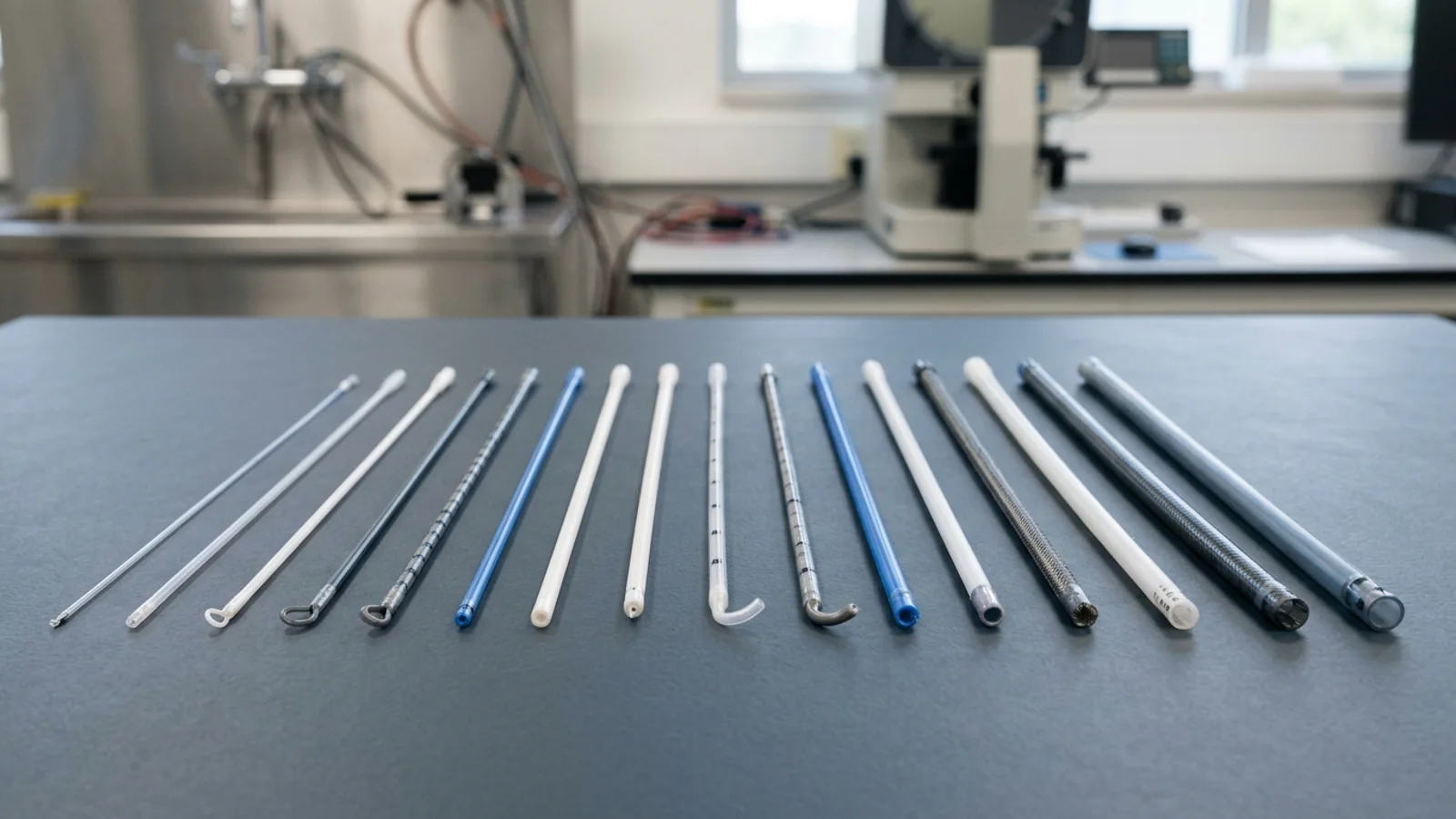
What a test report actually covers
A medical device test report supports the device configuration it identifies and the variants you can connect to it with documented evidence. If a laboratory report identifies a single 4 French, 100 cm diagnostic catheter, that report supports only that tested specimen. It does not automatically extend to 5 French, 6 French, 7 French, or 8 French sizes, nor does it cover a modified variant with an integrated bismuth or barium radiopaque stripe, simply because marketing sells them under the same brand name or catalog family. Regulatory clearance and CE marking are evidence decisions, not commercial assumptions.
When reviewing premarket submissions—such as a 510(k), De Novo request, or an EU MDR technical documentation assessment—regulators evaluate whether the physical specimen placed in the test system truly reflects the patient-contacting realities of the device to be marketed. Under Section V.A and Attachment E of FDA's final guidance, Use of International Standard ISO 10993-1, 'Biological evaluation of medical devices - Part 1: Evaluation and testing within a risk management process' (issued September 2023), a test report should identify the test specimen. When the test article is not the medical device in its final finished form, the guidance recommends a justification in the test report or in the submission. That recommendation is not a statute.
FDA's Biocompatibility Assessment Resource Center restates that recommendation in its test report guidance and its biocompatibility glossary. Attachment E of that guidance says a GLP study report must address the reporting requirements of 21 CFR Part 58, and that every test report should identify the specimen. Those duties describe the study record. They are not the representative-article criteria. Section V.A is what addresses coupons and representative components. A representative test article is appropriate when the finished device cannot be used in the test system. One illustration is a vascular stent delivery system that cannot fit in a standard cell-culture extract vessel. The representative article should then meet the Section V.A sameness criteria:
Identical manufacturing processes: Section V.A says the representative article should undergo the same manufacturing process as the finished device. For an extruded catheter, that means the compounding, extrusion, cleaning, and any other process steps the finished device actually receives, not a generic checklist of every possible process.
Same sterilization, and the condition of use: The guidance calls for the same sterilization process and recommends testing the device in the condition in which it will be used, which can include the final package. Identical packaging material is not a separate sameness element in Section V.A. A packaging or sterilization change that can leave different residuals still has to be evaluated before the report is cited for the changed device.
Identical chemical, physical, and surface properties: The representative article should have the same chemical, physical, and surface properties. Attachment F notes that processing can alter a surface even at the micron or submicron level, and that those alterations should be evaluated when they could change geometry or surface chemistry. That note is an evaluation trigger. It is not a requirement to match every micron-scale measurement before a report can be used.
Identical ratio of component materials: The representative article should have the same ratio of component materials as the finished device. The mass and surface proportions of polymers, metals, colorants, and adhesives presented to the test system should match the patient-contacting configuration being claimed.
Section V.F recommends that components with different contact durations (limited, prolonged, or long-term) be extracted separately for extract-based biocompatibility tests. Combining them dilutes the materials presented to the test system and can miss an agent that separate testing would have found. The guidance's own example is to test implants separately from delivery systems or other kit components. Footnote 40 adds that combining limited-contact components (under 24 hours) is often acceptable with a rationale, while prolonged (24 hours to 30 days) and long-term (more than 30 days) contacts should be assessed separately. An extract that mixes a limited-contact delivery catheter with a long-term implant does not support the long-term contact claim.
How regulators define a model, variant and version
To establish whether a test report extends across a product family, regulatory professionals must first untangle the statutory and administrative vocabulary that defines medical device groupings across the United States and the European Union. Manufacturers routinely conflate three distinct concepts: commercial catalog families, regulatory device identification, and empirical test coverage.
Under U.S. federal labeling regulations, 21 CFR 801.3 defines a version or model as "all devices that have specifications, performance, size, and composition, within limits set by the labeler." The labeler sets those limits. The definition identifies the version or model. It does not decide which members a test report covers. A related UDI duty sits in 21 CFR 830.50(a). The operative sentence is: "Whenever you make a change to a device that is required to bear a unique device identifier (UDI) on its label, and the change results in a new version or model, you must assign a new device identifier to the new version or model."
When submitting a premarket notification, FDA's guidance The 510(k) Program: Evaluating Substantial Equivalence in Premarket Notifications (2014) recommends listing the model numbers and trade names in the submission and explaining the differences among models in the device description and the 510(k) Summary. 510(k) and De Novo submissions, unless exempted, now use FDA's eSTAR Program. On the FDA eSTAR program page, content current as of September 21, 2026, the non-IVD and IVD templates posted for use are Version 7.1. The Device Description section is where the models in the submission are identified. Listing those models identifies the submission. It does not prove that one report covers every listed model.
In the European Union, the grouping architecture centers on the Basic UDI-DI under Regulation (EU) 2017/745. The European Commission UDI Helpdesk describes the Basic UDI-DI as the identifier that connects devices with the same intended purpose, risk class, and essential design and manufacturing characteristics, and as the key used in technical documentation and certificates. A Basic UDI-DI can be associated with one or more UDI-DIs. It does not automatically gather every French size and length into one group, and it does not decide which of those devices a test report covers.
The four coverage paths a report can claim
When an RA/QA engineer sits down to build a technical documentation file or an eSTAR package, each marketed model needs one documented coverage path. A family claim with no specimen identity and no sameness or worst-case rationale does not answer the question FDA's guidance or MDR Annex II actually asks.
Path 1: Direct Finished Device Testing (Direct Specimen Coverage). The marketed model was made in final finished form, packaged and sterilized as it is supplied, and placed in the test system. The report names that model. This is the direct path: there is no representation gap to bridge. Reviewers can still question the method, sample size, and acceptance criteria.
Path 2: Representative Test Article with Documented Process Sameness. The laboratory tested a coupon, plaque, or sub-assembly rather than the complete commercial device. To cite that report for marketed models, the design and development file should contain the Section V.A sameness rationale: same manufacturing and sterilization processes, same chemical, physical, and surface properties, and the same ratio of component materials. Since February 2, 2026, the Quality Management System Regulation no longer uses the term design history file. The corresponding record is the design and development file in ISO 13485:2016, which the QMSR incorporates. Many manufacturers still file that record under the older name.
Path 3: Identical Comparator Supported by Attachment F Statements. An untested model uses the same patient-contacting materials, processing, sterilization, and geometry as a tested or previously marketed comparator, with the same type and duration of contact. Section IV.D says that, to conclude no additional biocompatibility testing is needed, the evidence should show that tissue-contact type and duration, physical form, formulation, processing, component interactions, and storage conditions are the same, or that the comparator is the demonstrated worst case. Attachment F gives example statements for that comparison. The statements say the article is identical in formulation, processing, sterilization, and geometry, and that no other chemicals have been added. The 'with the exception of' qualifiers in Attachment F are for a processing, sterilization, or formulation difference, and they point to scientific information showing that the difference does not alter chemical or physical properties. They are not a shortcut for an untested diameter. Dimensional differences belong on the worst-case path.
Path 4: Demonstrated Worst-Case Comparator (Bracketing Logic). Testing is performed on the extreme boundaries of a product line (e.g., the minimum and maximum sizes, highest pigment concentration, or thinnest wall thickness), and intermediate models are covered through an objective engineering rationale showing that intermediate configurations present lower biological or mechanical stress. Coverage holds only if the boundary testing was explicitly designed to stress the failure mode in question.
The table below details the documentation requirements, applicable endpoints, and regulatory risks associated with each coverage pathway:
| Coverage Path | Primary Evidence Required | Applicable Test Endpoints | Reviewer Vulnerability |
|---|---|---|---|
| Path 1: Direct Testing | Final test report explicitly identifying the exact commercial model number, lot number, and sterilization cycle. | All physical, mechanical, electrical, chemical, and biological evaluation endpoints. | High cost and testing burden if applied to every dimensional variant in an extensive catalog. |
| Path 2: Representative Article | Documented validation report proving identical raw materials, processing aids, cleaning, and sterilization cycle parameters. | Chemical characterization (ISO 10993-18), cytotoxicity (ISO 10993-5), material biocompatibility. | Rejection if the representative article fails to match the component surface-area-to-mass ratio or surface finish. |
| Path 3: Identical Comparator | Attachment F statement that formulation, processing, sterilization, and geometry are identical, or a documented exception for a processing, sterilization, or formulation difference, plus the risk assessment. | Biocompatibility endpoints where the Attachment F comparison holds. It does not transfer a reprocessing validation from ISO 17664. | Invalidated if raw material supplier, pigment concentration, mold release agent, or contact duration differs. |
| Path 4: Demonstrated Worst-Case | Pre-test protocol defining failure criteria, empirical data testing minimum and maximum limits, and bracketing rationale. | Mechanical burst pressure, tensile pull, fatigue life, chemical extractables total mass, kink resistance. | Failure if the worst-case direction reverses across different endpoints (e.g., burst pressure vs. extraction ratio). |
The configuration-to-claim-to-evidence map
The scenario in the opening is a diagnostic catheter family: French sizes 4 through 8, working lengths 65 cm to 110 cm, a radiopaque stripe, an alternate resin supplier, and a hydrophilic coating. A cytotoxicity report and a bench report that name only the 4 Fr, 100 cm clear catheter do not, by themselves, cover that portfolio.
A practical way to show the gap is a Configuration-to-Claim-to-Evidence Map. It assigns each variant to a coverage path and names the record in the Design History File (DHF) that supports the assignment, plus the gap that still needs data. The catalog numbers, dimensions, and material grades below are an illustrative family. They are not test results, a required biological battery, or a form prescribed by FDA or a notified body.
| Marketed Variant / SKU | Physical & Chemical Attributes | Claimed Coverage Path | Documentation that supports the claim | Gaps & Testing Triggers |
|---|---|---|---|---|
| Model C-4100 (4 Fr, 100 cm) | Clear extruded Pebax 5533 shaft, 1.33 mm OD, 0.95 mm ID, EtO sterilized. | Path 1: Direct Finished Device Testing | Final GLP Biocompatibility Report (ISO 10993-5, 10, 23) and Bench Verification Report naming SKU C-4100. | None. Serves as the baseline comparator for the clear catheter family. |
| Model C-6100 (6 Fr, 100 cm) | Clear Pebax 5533 shaft, 2.00 mm OD, 1.45 mm ID, identical resin and processing. | Path 4: Bracketed Intermediate (Dimensional) | Dimensional stack-up analysis; FDA Attachment F statement; burst pressure and flow rate verification reports. | Must verify that tensile joint strength and burst pressure meet specifications across the larger diameter. |
| Model C-8100 (8 Fr, 100 cm) | Clear Pebax 5533 shaft, 2.67 mm OD, 2.00 mm ID, maximum diameter and polymer mass. | Path 4: Demonstrated Worst Case (Exposure Mass & Burst) | Toxicological risk assessment (ISO 10993-17) evaluating maximal patient exposure; mechanical burst test report. | Worst case for total extractables mass and hoop stress; cannot serve as worst case for lumen extraction ratio. |
| Model C-4065 (4 Fr, 65 cm) | Clear Pebax 5533 shaft, identical 4 Fr cross-section, shorter working length. | Path 3: Identical Comparator (Sub-worst case) | Attachment F statement confirming identical cross-section; justification confirming lower total patient contact area. | Must verify torque transmission and kink resistance if shorter length changes clinical handling dynamics. |
| Model C-6100-RO (6 Fr, 100 cm Radiopaque) | Pebax 5533 compounded with 20% Bismuth Oxychloride (BiOCl) stripe. | Path 3 does not apply. Use Path 1 or Path 2 for the modified chemistry. | Chemical characterization (ISO 10993-18); cytotoxicity (ISO 10993-5); sensitization and irritation bridging data. | A radiopaque filler is a formulation change. Attachment F asks for scientific information that the change does not alter chemical or physical properties. If that comparison fails, test the modified device. |
| Model C-6100-S2 (6 Fr, Alternate Resin Supplier) | Pebax 5533 equivalent sourced from Supplier B due to supply chain redundancy. | Path 3 Conditional: Chemical Equivalence Required | Certificate of Analysis (CoA); FTIR spectral overlay; DSC thermal analysis; GC-MS/LC-MS extractables comparison. | If extractable profiles differ or new residual solvents appear, full biological re-evaluation is triggered. |
| Model C-6100-HC (6 Fr, Hydrophilic Coated) | Pebax shaft with photo-cured PVP hydrophilic lubricious coating. | Independent Exposure Category (Separate Testing) | Coating particulate evaluation; hemocompatibility (ISO 10993-4); coating lubricity and durability test reports. | Cannot leverage uncoated catheter data. Surface chemistry and blood contact interactions are entirely distinct. |
The illustrative map splits one product line into several evidence tiers. A dimensional step from 4 Fr to 6 Fr in the same clear polymer can be argued with bracketing and dimensional verification when the worst-case ends were actually tested for that endpoint. A 20% bismuth stripe or a hydrophilic coating is a different surface or formulation, so the identical-comparator statement no longer fits. Submitting the baseline report as if it covered those variants is a common way to draw a 510(k) additional-information request or a notified-body question on Annex II.
Decision logic for model variant coverage
To systematically evaluate whether an existing test report covers a new or untested device variant, engineering and regulatory teams should follow the structured decision workflow shown below. This logic incorporates both FDA guidance expectations and EU MDR Annex II verification mandates:
flowchart TD
    Start["New Device Variant or Untested Model"] --> CheckID{"Is the variant identified by name<br/>in the existing test report?"}
    CheckID -- Yes --> DirectCovered["Path 1: Directly Covered<br/>No bridging justification needed"]
    CheckID -- No --> CheckChem{"Are formulation, processing, cleaning,<br/>and sterilization the same?"}

    CheckChem -- No --> CheckNewChem{"Is difference limited to an additive,<br/>colorant, or raw material supplier?"}
    CheckNewChem -- Yes --> ChemBridge["Perform Chemical Characterization<br/>(ISO 10993-18) & FTIR/GC-MS Bridging"]
    ChemBridge --> ChemMatch{"Do extractables and surface<br/>properties support a written rationale?"}
    ChemMatch -- Yes --> DocPath3["Possible Path 3 if Attachment F<br/>and the risk assessment both hold"]
    ChemMatch -- No --> ReTestBio["New biological testing<br/>for the changed material"]
    CheckNewChem -- No --> ReTestBio

    CheckChem -- Yes --> CheckDim{"Is difference purely dimensional<br/>(size, length, wall thickness)?"}
    CheckDim -- Yes --> CheckBracket{"Does variant fall within demonstrated<br/>worst-case boundary envelope?"}
    CheckBracket -- Yes --> CheckReversal{"Does worst-case direction reverse<br/>for the specific test endpoint?"}
    CheckReversal -- No --> BracketCovered["Path 4: Covered via Bracketing<br/>+ Dimensional Stack-up Analysis"]
    CheckReversal -- Yes --> ReTestEndpoint["Test Endpoint on Specific Model<br/>(e.g., burst pressure or extraction ratio)"]
    CheckBracket -- No --> OutsideBracket["Variant Outside Demonstrated Limits:<br/>Requires New Verification Testing"]
    CheckDim -- No --> ReTestGeneral["Evaluate Functional Impact<br/>& Execute Targeted Verification"]
The diagram is aimed at two recurring errors: repeating biological tests for a dimensional change that already sits inside a demonstrated worst-case range, and treating a catalog family as if it were the evidence.
When worst-case logic works and when it fails
Calling one model 'the worst case' does not cover a family. FDA's examples treat that label as meaningful only when the prior submission objectively tested the ends of the range for the safety and effectiveness risks at issue, and the new size sits inside that range.
The examples that follow are from Deciding When to Submit a 510(k) for a Change to an Existing Device (issued October 2017). They illustrate the 510(k) question: when an intermediate size can stay in the existing file because the ends were shown to be worst case, and when a size outside that range is a new 510(k). They are not a general rule for every bench or biocompatibility report. The 2017 text still cites the former quality system regulation. The filing analysis itself is the subject of the linked device-change article.
The 2 mm and 4 mm illustration: In the main-text discussion of dimension changes, FDA says that if the original device was cleared with two models, 2 mm and 4 mm in diameter, a modified device of the same length with a 3 mm diameter is a change for which a new 510(k) is likely not required. That illustration does not itself walk through Flowchart B. Whether that change needs its own 510(k) is discussed in 21 CFR 807.81(a)(3) device change decisions.
Biliary stent diameters, Appendix A Examples 14.a and 14.b: In Example 14.b, a new stent diameter inside the previously cleared range, with lengths unchanged, was a documentation decision. The prior 510(k) had objectively demonstrated that the smallest and largest diameters were the worst-case scenarios for the safety and effectiveness risks of that stent length, and the B5.1 through B5.4 answers did not trigger a new submission. In Example 14.a, a diameter 2 mm outside the cleared range was a new 510(k) because the risk assessment found significantly increased existing risks, including rupture of the duct and difficulty reaching the deployment area.
Catheter polymer changes, Appendix A Examples 23 and 24: In Example 23.b, changing a catheter from polymer A to polymer B was a documentation decision for the biocompatibility concern when the same manufacturer had already used polymer B, with the same formulation and processing, in another cleared catheter with the same type and duration of contact and the same performance specifications. Example 23.a is a new 510(k) when polymer B appears only in another manufacturer's catheter, because formulation and finishing may differ. Example 24 is a new 510(k) when the same material is molded in one catheter and extruded in the other.
Consider the mathematical and physical mechanisms governing different test disciplines:
Laboratory extraction ratio, not lumen diameter: Table 1 of ISO 10993-12:2021 sets the extraction ratio from sample thickness or mass, with a ±10% tolerance: 6 cm²/mL for thickness under 0.5 mm, 3 cm²/mL from 0.5 mm to 1.0 mm, and 1.25 cm²/mL above 1.0 mm, plus a mass/volume ratio when surface area is not calculated. Amendment 1:2025 should be named when that is the edition in use. The laboratory applies the stated ratio, so a smaller lumen does not by itself produce a more concentrated extract. Where tissue-contacting components have different thicknesses, the standard says the ratio should be justified, and one approach it describes is to base the ratio on the thinnest layer. A separate clinical argument, that fluid inside a smaller lumen contacts more wall area per unit of contained volume, can be written into a worst-case rationale when lumen contents are the exposure of concern. It is not what Table 1 says, and it should not be recorded as 'the smallest model was the worst case for cytotoxicity' without that exposure model.
Total patient exposure: In Section VI.G, Carcinogenicity, FDA's ISO 10993-1 guidance says to consider a patient who might receive multiple devices of the largest size when estimating worst-case exposure. That is an exposure assumption for that assessment, not a rule that the largest model is the worst case for every chemical endpoint, and it is not the chemical-assessment discussion in Section VII. ISO 10993-17 is the separate toxicological risk-assessment standard. A longer, larger catheter can contain more polymer mass, so it can be the higher total systemic dose when release scales with mass. State that assumption in the risk assessment rather than treating the large-model result as coverage of the smaller sizes for every chemical endpoint.
Hoop Stress and Hydraulic Burst Pressure (Mechanical Testing): Under Barlow's formula for internal fluid pressure, hoop stress is directly proportional to internal diameter:
σ = (P · D) / (2 · t), where P is pressure, D is diameter, and t is wall thickness. For catheters with constant wall thickness, the largest diameter experiences the highest hoop stress at a given pressure, so it is the burst worst case only under that constant-wall assumption. Catheter families often change wall thickness with French size, which changes the result. A smaller cross-section can be the lower tensile break load when material and wall are comparable. Kink resistance also depends on wall thickness, durometer, and braid, so it is not assigned to the smallest French size by default.Fluid Shear Stress and Blood Damage (Hemocompatibility): ISO 10993-4 is the standard for selecting blood-interaction tests. It does not assign a worst-case size. For a fixed flow rate, wall shear rate rises as lumen diameter falls, which is a reason to justify the small lumen for mechanical hemolysis when that flow is clinically relevant. The larger lumen presents more foreign surface, which can matter for surface-mediated coagulation. Those are endpoint-specific rationales to write down. They are not findings of the standard.
Do not write 'Model X was the worst-case model for all testing.' The design and development file should say which model was tested for which endpoint, and why: burst, kink, extract concentration, and total systemic exposure can point at different sizes. (Sample size and lot acceptance are a different decision, covered in ISO 2859 acceptance sampling plans for medical devices).
Required evidence, voluntary standard, or commercial assumption
A significant vulnerability in medical device technical files stems from conflating three distinct operational tiers: binding legal mandates, voluntary consensus standards, and commercial assumptions. Regulatory auditors evaluate submissions strictly through the lens of legal authority and recognized scientific consensus.
The three-tier matrix below clarifies the evidentiary weight of common documentation elements:
| Evidence Category | Regulatory & Technical Authority | Evidentiary Value (What It Proves) | Common Fallacy (What It Never Proves) |
|---|---|---|---|
| 1. Specimen Identification & Justification | GLP study reports: the reporting requirements of 21 CFR Part 58, which Attachment E says the report must address. Biocompatibility and chemical-characterization reports: the same Attachment E sections (a recommendation, including for non-GLP reports). EU technical documentation: MDR Annex II Section 6.1. | Identifies the article, lot, and preparation the report actually describes. | Fallacy: Believing that omitting the specimen model number allows the report to be applied to any future catalog addition. |
| 2. Model / Version Definition & DI Assignment | Binding Law: 21 CFR 801.3, 21 CFR 830.50(a); EU MDR Article 27 & Annex VI. | Establishes legal device identity, labeling boundaries, and unique global supply chain traceability. | Fallacy: Assuming that assigning multiple sizes to the same model group or Basic UDI-DI proves empirical safety coverage. |
| 3. Consensus Testing Standards | Voluntary consensus standards. FDA's biocompatibility glossary cites ISO 10993-1:2025 for some terms. Recognition of an ISO 10993 standard can be partial, and the extent is recorded in FDA's Recognized Consensus Standards database. ISO 10993-12:2021 has Amendment 1:2025, so a sample-preparation citation should name the amended edition when that is the text being used. The September 2023 guidance still explains the evaluation framework. | They describe biological evaluation, sample preparation, and test methods. | Fallacy: a declaration of conformity proves which models a report covers. Footnote 73 of the 2023 guidance: the ISO 10993 series specify neither a method nor a test outcome, and do not necessarily include acceptance criteria. |
| 4. Laboratory Quality Accreditation | Voluntary Standard: ISO/IEC 17025:2017 (General requirements for testing and calibration laboratories). | Demonstrates that the test facility operates a competent technical quality system and calibrated equipment. | Fallacy: Believing ISO/IEC 17025 accreditation validates family coverage. FDA explicitly does NOT recognize ISO/IEC 17025 for biocompatibility compliance. |
| 5. Voluntary Conformity Schemes (FDA ASCA) | Voluntary Program: FDA Accreditation Scheme for Conformity Assessment (ASCA). | Allows submission of streamlined Summary Test Reports and Declarations of Conformity from ASCA-accredited labs. | Fallacy: an ASCA summary removes the need to say which models the report represents. ASCA changes the report form. The manufacturer still documents variant coverage. |
| 6. Commercial & Catalog Groupings | Commercial Assumption: ERP/SAP product hierarchies, brand marketing collateral, sales catalogs. | Organizes commercial distribution, price tiers, and inventory tracking for hospital purchasing. | Fallacy: Presenting sales brand names as regulatory evidence. Reviewers grant zero legal standing to commercial product groupings. |
| 7. Supplier Equivalence Letters | Commercial Assumption: Raw material vendor marketing statements, 'Medical Grade' certificates. | Provides raw material chemical baseline data and Certificate of Analysis specifications. | Fallacy: Believing supplier datasheets replace finished device testing. Processing and sterilization alter extractables and surface chemistry. |
Two entries in this matrix deserve special attention from regulatory strategists:
First, the status of ISO/IEC 17025 laboratory accreditation. Medical device manufacturers frequently present an ISO/IEC 17025 certificate from an external testing house as proof that the testing is unassailable. However, as noted in Footnote 30 of FDA's ISO 10993-1 guidance, FDA does not recognize ISO/IEC 17025 for these biocompatibility studies. Item 4 of the same guidance says in vitro or in vivo biological safety tests should be conducted in accordance with recognized GLP regulations. The following paragraph recommends a statement that such studies complied with 21 CFR Part 58, or an explanation of the deviations, when that information is submitted. That recommendation does not turn every bench-verification report into a GLP study. Accreditation shows laboratory competence. It does not show that the specimen represented the models being marketed.
Second, the role of the FDA ASCA Program. Under ASCA, participating laboratories can issue a standardized Summary Test Report or Declaration of Conformity in lieu of a complete 150-page raw data package. While ASCA dramatically streamlines FDA premarket review, it changes the format of the report, not the underlying coverage logic. If the ASCA Summary Test Report names Model A, the manufacturer must still submit the Attachment F documentation statements or bracketing analyses linking Model A to Models B, C, and D.
What the EU technical documentation must show
Under European Union Medical Device Regulation (EU) 2017/745 (MDR), the scrutiny applied to product family coverage is exceptionally demanding. Notified Bodies auditing technical files against Annex II and Annex IX routinely issue major nonconformities when test reports fail to exhibit airtight traceability to every CE-marked catalog number. (For an extensive review of common audit findings, see our analysis of common Notified Body technical file deficiencies).
Annex II of the MDR establishes explicit statutory requirements governing device configurations and verification results:
Annex II Section 1.1(i) — Exhaustive Configuration Listing: The technical documentation must contain 'a description or complete list of the various configurations/variants of the device that are intended to be made available on the market.' A manufacturer cannot maintain 'shadow variants' or unlisted sizes under a general model umbrella.
Annex II Section 1.1(l) — Granular Technical Specifications: The documentation must include 'technical specifications, such as features, dimensions and performance attributes, of the device and any variants/configurations and accessories that would typically appear in the product specification made available to the user, for example in brochures, catalogues and similar publications.' That is the user-facing specification for each listed variant. It is not a separate demand that every lumen diameter carry a tolerance table in a particular format.
Annex II Section 6 — Verification Results and Rationales for Omitted Testing: Section 6 requires the results and critical analyses of the verifications and validation tests undertaken to demonstrate conformity. Section 6.1, in the paragraph after 6.1(a) and 6.1(b), states: "Where no new testing has been undertaken, the documentation shall incorporate a rationale for that decision." Its example is biocompatibility testing on identical materials when those materials were incorporated in a previous version of the device that has been legally placed on the market or put into service. A listed variant with neither results nor that rationale does not meet that Section 6.1 paragraph. The software hardware-configuration sentence, which is inside 6.1(b), is a separate requirement.
Annex II Section 6.1 (Software Hardware Configurations): Inside the software verification and validation bullet of Section 6.1(b), the documentation must address all of the different hardware configurations and, where applicable, operating systems identified in the information supplied by the manufacturer. That requirement applies to the software, not to every catheter size in a hardware-only family.
Fixing a vague report without always re-testing
Legacy reports often name only a family trade name, omit the lot, or never state which French size went into the extract. Finding that gap during a submission or a technical-file review does not by itself mean the study has to be repeated. A practical sequence is a Five-Step Remediation Protocol:
Step 1: Trace the tested lot in the production records. Retrieve the test facility's study file and match the study date to the production records for that lot: bill of materials, drawing revision, and sterilization batch. Under the Quality Management System Regulation effective February 2, 2026, those records are batch documentation. Record the match in an internal Test Article Traceability Memorandum that names the lot, materials, and sterilization batch that were actually studied.
Step 2: Construct Formal Attachment F Documentation Statements. Draft device and component statements in the pattern of Attachment F. State that the comparator is identical in formulation, processing, sterilization, and geometry, and that no other chemicals have been added. When processing, sterilization, or formulation differs, add the qualifier "with the exception of [the processing, sterilization, or formulation change]", and cite the information showing that the difference does not alter chemical or physical properties. That qualifier does not replace a worst-case rationale for an untested diameter.
Step 3: Leverage Chemical Characterization and Toxicological Bridging. Where a variant introduces a minor material modification (such as an alternate resin supplier or a different colorant concentration), execute chemical characterization under ISO 10993-18:2020 (chemical characterization of medical device materials within a risk management process). FTIR, DSC, and extractables screening can support a comparison. They close the gap only when the comparison shows the difference does not alter the chemical or physical properties relevant to the biological risk. They are not a standing substitute for biological testing.
Step 4: Execute Analytical and Mechanical Bracketing. For purely dimensional variations (intermediate diameters and lengths), perform benchtop mechanical verification on critical functional parameters (e.g., tensile joint strength, burst pressure, kink radius) using representative samples. Combine this empirical data with finite element analysis (FEA) or dimensional stack-up models to establish that the untested sizes perform safely between the validated extremes.
Step 5: Identify Non-Negotiable Re-Testing Triggers. Documentation does not bridge every difference. Re-evaluation is required, and new testing is the expected result, when the difference cannot be justified with the sameness or worst-case evidence above. Typical cases are a new body-contact category or a longer contact duration, a new reactive constituent or coating, a surface change that can alter the biological response, and a size outside the range whose ends were actually tested.
By methodically building this evidentiary bridge, medical device manufacturers transform a recurring regulatory deficiency into a structured, audit-proof technical asset. A test report is only as powerful as the documentation connecting it to the devices in the surgeon's hand.