
Does an IP Rating Support a Medical Device Cleaning Claim?
An IEC 60529 IP code shows ingress protection, not disinfectant compatibility. See how IEC 60601-1, FDA and the EU MDR separate the evidence for a device cleaning claim.

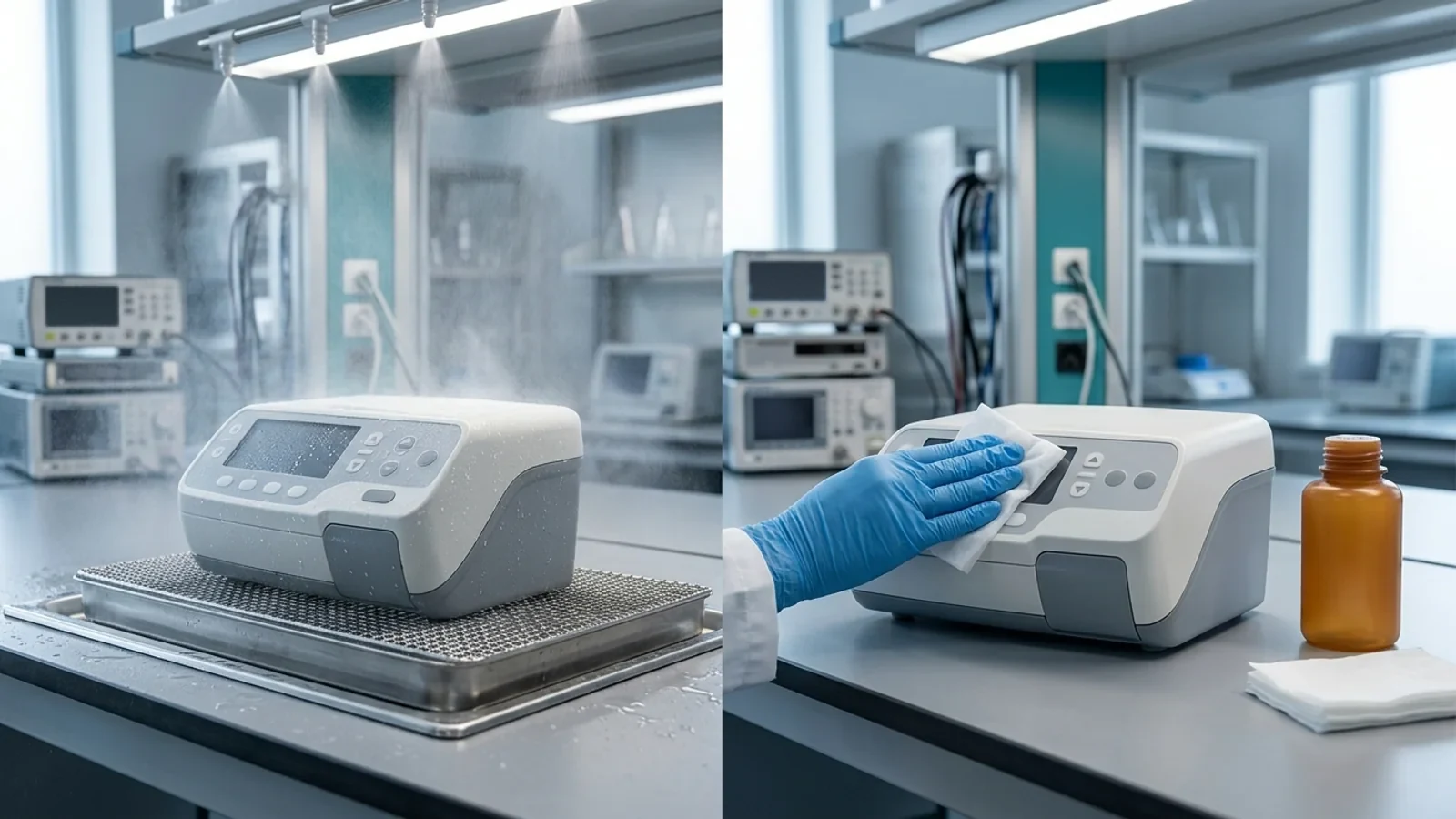
Here is a common late-stage design verification question. A reusable patient monitor will be wiped between patients with a quaternary ammonium and alcohol disinfectant wipe. The enclosure has passed IPX4 testing. Does that rating support the cleaning statement in the instructions for use, or does the team need separate evidence, and if so, what?
The two claims answer different questions. An IP rating describes whether water, delivered in a specific way during a type test, gets inside the enclosure in a harmful way. A cleaning claim describes whether named agents, applied by the method in the instructions for use and repeated across the device's service life, leave its materials, seals, markings and electrical safety intact, and whether the liquid stays out of places it should not reach. This article maps where each question sits in IEC 60529, IEC 60601-1, FDA guidance and the EU MDR, then turns that map into a claim-by-claim evidence table for design reviews. It is written for RA/QA and design engineering teams preparing technical documentation; it is not device-specific legal advice.
What an IP Rating Classifies, and What Its Own Scope Leaves Out
The IP Code is defined by IEC 60529. The current IEC consolidated edition is Edition 2.2 (IEC 60529:1989+AMD1:1999+AMD2:2013 CSV), published 2013-08-29, and the IEC webstore lists a stability date of 2027. In the United States, NEMA publishes ANSI/IEC 60529-2020 as an identical national adoption. Its Clause 1, "Scope and object," says the standard applies to the classification of degrees of protection provided by enclosures for electrical equipment with a rated voltage not exceeding 72.5 kV. The object is to define degrees of protection for three things: protection of persons against access to hazardous parts inside the enclosure, protection of the equipment inside against ingress of solid foreign objects, and protection of the equipment inside against harmful effects due to the ingress of water.
The same clause draws two boundaries that matter for cleaning claims. First, it lists external influences or conditions that sit outside the IP classification and belong to the relevant product standard:
Measures to protect both the enclosure and the equipment inside the enclosure against external influences or conditions such as:
mechanical impacts
corrosion
corrosive solvents (for example, cutting liquids)
fungus
vermin
solar radiation
icing
moisture (for example, produced by condensation)
explosive atmospheres
ANSI/IEC 60529-2020, Clause 1, Scope and object
Second, the scope says the standard "deals only with enclosures that are in all other respects suitable for their intended use as specified in the relevant product Standard and which from the point of view of materials and workmanship ensure that the claimed degrees of protection are maintained under the normal conditions of use." In other words, the IP Code assumes the enclosure materials already suit the conditions of use. It does not test that assumption against disinfectant chemistry. If routine wiping is part of normal use, showing that materials and seals survive it falls to the product standard and the manufacturer's risk management. The IP test result does not already contain that evidence.
Read the second characteristic numeral for what it is: a description of how water was delivered in the type test. The standard's contents list the test arrangement for each numeral:
IPX1 and IPX2: drip box (clauses 14.2.1 and 14.2.2).
IPX3 and IPX4: oscillating tube or spray nozzle (14.2.3 and 14.2.4).
IPX5 and IPX6: a 6.3 mm nozzle (14.2.5) and a 12.5 mm nozzle (14.2.6).
IPX7 and IPX8: temporary immersion between 0.15 m and 1 m (14.2.7), and continuous immersion subject to agreement (14.2.8).
IPX9: high-pressure, high-temperature water jet with a spray nozzle (14.2.9), introduced by Amendment 2.
Take flow rates, durations and acceptance details from the purchased standard rather than from summaries. Every arrangement in that list is a water test. None is designed around a disinfectant formulation, a wiping action, or repeated exposure across a service life, and that gap is what a cleaning claim has to fill.
This does not mean the IP Code forbids a cleaning claim. It defers those conditions to the product standard. For medical electrical equipment, IEC 60601-1 is that product standard.
Where Ingress and Cleaning Split Inside IEC 60601-1 Clause 11.6
For medical electrical (ME) equipment, the product standard that takes up the IP Code is IEC 60601-1 (see our IEC 60601-1 overview). In the current consolidated Edition 3.2 (IEC 60601-1:2005+AMD1:2012+AMD2:2020), Clause 11.6 is titled "Overflow, spillage, leakage, ingress of water or particulate matter, cleaning, disinfection, sterilization and compatibility with substances used with the ME EQUIPMENT." One clause holds several distinct requirements. The standard text is paid, so the summary below follows the clause structure in the official preview and the requirement wording reproduced in a CB Scheme test report for IEC 60601-1. Check the purchased edition before quoting it in your own documentation.
11.6.1, general: the equipment provides a sufficient degree of protection against overflow, spillage, leakage, ingress of water or particulate matter, cleaning, disinfection and sterilization, and compatibility with substances used with the ME equipment.
11.6.3, spillage: the risk analysis identifies the type of liquid, volume, duration and location of the spill.
11.6.5, ingress of water or particulate matter: ME equipment with an IP Code is placed in the least favourable position of normal use and subjected to the IEC 60529 tests. It must then meet dielectric strength and leakage current tests, with no bridging of insulation or electrical components that could cause loss of basic safety or essential performance in normal condition or single fault condition.
11.6.6, cleaning and disinfection: ME equipment, ME systems, their parts and accessories are cleaned or disinfected using the methods specified in the instructions for use, and the manufacturer evaluates the effects of multiple cleanings or disinfections during the expected service life.
11.6.8, compatibility of substances: risks associated with the compatibility of substances used with the ME equipment are addressed in the risk management process.
That split is the core of the answer. 11.6.5 is an ingress check built on the IEC 60529 water tests. 11.6.6 is a cleaning and disinfection check built on the methods the manufacturer specifies in its own instructions for use, and it expects repeated cleaning over the expected service life to be accounted for. A pass under 11.6.5 does not satisfy 11.6.6, and work done for 11.6.6 does not produce an IP classification.
The two streams meet again at the electrical safety tests. In the same test report, the notes to the leakage current table (8.7) and the dielectric strength table (8.8.3) state that those tests are run after the relevant Clause 11.6 tests, including ingress of water, cleaning and disinfection. Cleaning exposure is therefore not only a cosmetic question. Plan the cleaning and disinfection exposure so the same units can go on to the electrical checks that show insulation still performs after the exposure your instructions allow.
The same split in home healthcare equipment
The home healthcare collateral standard, IEC 60601-1-11, mirrors the structure. Its 2010 edition preview lists additional requirements for cleaning, disinfection and sterilization information in the instructions for use at 7.4.7 and additional cleaning and disinfection requirements at 8.1. Additional requirements for ingress of water or particulate matter sit separately at 8.3 (8.3.1 for ME equipment, 8.3.2 for ME systems). The standard also adds requirements for marking the IP classification (7.2), summarizes enclosure ingress requirements by use in an informative table (Table A.1), and normatively references IEC 60529. Take the specific minimum IP levels and current clause numbering from the purchased current edition, not from secondary summaries.
flowchart TD
    RM["Risk management file: IEC 60601-1 11.6.1 and 11.6.8"] --> ING["Ingress stream: 11.6.5"]
    RM --> CLN["Cleaning and disinfection stream: 11.6.6"]
    ING --> ING1["IEC 60529 type test in least favourable position: drip, spray, jet or immersion with water"]
    ING1 --> ING2["Dielectric strength and leakage current checks"]
    ING2 --> ING3["Supports: IP classification, for example IPX4 splash protection"]
    CLN --> CLN1["Agents and method named in the instructions for use"]
    CLN1 --> CLN2["Repeated exposure, justified against expected service life"]
    CLN2 --> CLN3["Material, seal, marking and internal-ingress checks with the actual agent"]
    CLN3 --> CLN4["Dielectric strength and leakage current checks"]
CLN4 --> CLN5["Supports: listed agents, warnings and end-of-life signs in the instructions for use"]What FDA's Reprocessing Guidance Expects for a Cleaning Claim
In the United States, the main reference is FDA's final guidance Reprocessing Medical Devices in Health Care Settings: Validation Methods and Labeling (issued March 17, 2015; Appendix E updated June 9, 2017). It is nonbinding. Its "should" language describes FDA's current thinking, not a legal requirement, but it is the clearest statement of what FDA expects reprocessing labeling and validation to look like. It covers non-critical devices as well as surgical instruments. Among its examples of devices with no direct patient contact that may still become contaminated during patient care are infusion pumps and ventilators.
Several of its recommendations bear directly on whether an IP result can stand in for cleaning evidence:
Cleaning is a distinct process (Section V.A). Cleaning, disinfection and sterilization are "distinctly different processes," and cleaning steps should be validated separately and independently from disinfection or sterilization steps.
Intended use includes chemical exposure (Section VI, Criterion 1). Appropriate reprocessing instructions depend on, among other things, whether the device will be reprocessed with disinfectants or other chemicals that might leave harmful residues or adversely affect device materials or performance if inadequately rinsed.
Compatibility is part of validation (Criterion 3). Whichever method is recommended, the device's compatibility with it should be validated and then stated in the instructions for use. For non-critical devices, manufacturers should consider the ability of the device material to repeatedly withstand disinfectant contact when selecting a disinfectant to validate and recommend, and should consider the products frequently used in health care settings. If a product or class of products can damage the device materials, the label should warn against using it.
Surface cleaning that protects internal parts (Criterion 5.D). If a device's internal components are not contaminated during use but could be damaged by liquids such as cleaning agents or disinfectants, surface cleaning instructions should describe how to clean the device and prevent contact with internal components not designed for liquid contact.
Only validated, compatible agents (Criterion 5.E). Instructions should recommend only the cleaning agents or classes of agents (the guidance names quaternary ammonium compounds as one example) that were used in the cleaning validation, were shown to be compatible with the device, and clean it effectively.
Seams and crevices (Criterion 5.M). Where unsealed seams or crevices could let excess liquid disinfectant reach and damage the interior, labeling should caution users and give specific instructions to prevent it, such as avoiding excess liquid.
Internal compartments (Section VIII.A). For devices with internal compartments not intended to contact clinical soil and fluids, manufacturers should demonstrate that cleaning solutions, rinse water and/or patient materials will not penetrate through incomplete seals, seams or other internal-external contiguous air spaces. If there is a risk of ingress, the cleaning endpoints should be met for every internal surface that becomes contaminated during the use life.
Look at the liquids named in that last item: cleaning solutions, rinse water and patient materials. For reprocessing, FDA frames the ingress question around the liquids that will actually be used, while an IP test is framed around water in a defined test arrangement. FDA does not name a specific test method for this demonstration, so the method is a design decision you need to justify in the validation protocol. Testing with the labeled agent, or with a justified worst case among the agents you intend to list, makes that justification easier to defend.
Two other points from the guidance are easy to miss. The number of simulated use cycles in a cleaning validation "should be scientifically justified" (Section VIII.A). The reuse-life recommendations (Criterion 5.L) ask labeling either to state how many times the device can be reused, based on testing, or to give users a way to tell when it has exceeded its use life. One example is visual inspection with acceptance criteria for deterioration such as corrosion, discoloration, pitting or cracked seals. Both points tie enclosure compatibility to labeling. The guidance also notes that some devices unlikely to be contaminated with pathogens, such as a room vital signs monitor, may not need disinfection at all. If the intended use does call for a disinfectant, though, that agent and its compatibility belong in the validated instructions.
The guidance predates the Quality Management System Regulation. FDA's notice at the front of the guidance PDF explains that the QMSR took effect on February 2, 2026, incorporates ISO 13485:2016 by reference, and no longer uses terms such as "Design History File" and "Device Master Record." Map the guidance's documentation recommendations to the current QMSR rather than to the legacy terms.
Field Evidence: Disinfectant Wipes Degrade Device Plastics
Wipe chemistry has already damaged devices in the field. In Medical Device Alert MDA/2013/019 (issued 27 March 2013), the UK MHRA warned that detergent and disinfectant wipes can damage plastic surfaces of medical devices if they are not compatible with the surface material. MHRA and Health Facilities Scotland had received incident reports of wipes that degraded plastic surfaces and affected device performance and integrity. The alert names these device types:
tympanic thermometers
patient monitors
infusion pumps
dialysis fluid filters
peritoneal dialysis transfer sets
infant warmers
The alert gives two reasons the damage matters: damaged surfaces may compromise the ability to decontaminate the device adequately, and they may interfere with device function. Its actions are aimed at users. Users should ensure wipes are compatible with the device, always follow the manufacturer's decontamination instructions, look for signs of damage, and report inadequate decontamination instructions to MHRA and the manufacturer. The alert also notes that failing to follow the manufacturer's decontamination instructions may be considered off-label use, and it suggests pre-purchase questionnaires to check compatibility.
Now read the alert from the manufacturer's side. Hospitals are told to follow your decontamination instructions and to report you if those instructions are inadequate. If your instructions name an agent class that degrades the housing, or say nothing about which agents are compatible, users are left without a compatible process to follow. The alert reports incidents, not incidence rates, and it is more than a decade old. Even so, the failure mode it describes, wipe chemistry attacking device plastics, is one an IP test never exercises.
Home-Use and EU Requirements
FDA home-use design considerations
FDA's Design Considerations for Devices Intended for Home Use (final guidance issued November 24, 2014; corrected August 8, 2016) puts both streams into design. Section V.B (Contaminants) says the risk that the device could be affected by contaminants such as household chemicals should be mitigated as much as possible by designing the device to minimize the ingress of fluids, solids and airborne particles that would affect operation. Section V.I (Fluid Exposure) asks manufacturers to consider what the device can safely tolerate under fluid spills or submersion, and how much fluid exposure it can take without affecting safe use. Section VII notes that design control requirements apply to the device's cleaning, disinfection and sterilization procedures.
Section IX.C (Hygienic Maintenance) adds a practical constraint. Home users lack easy access to professional cleaning and disinfecting supplies, so home use devices should ideally be designed to be cleaned, disinfected or sterilized with readily available supplies and simple techniques, with the complete cycles and methods described in the labeling. For its approach on that topic, the guidance points back to the 2015 reprocessing guidance. For a home-use product, the agent list in the instructions for use is a design input as well as a labeling choice: you need to show compatibility with the agents a lay user can realistically be expected to have.
EU MDR Annex I, Section 23.4
In the EU, Regulation (EU) 2017/745 Annex I, Section 23.4 lists what the instructions for use must contain. Three points apply directly. The linked text is the regulation as originally adopted, so confirm the current consolidated text before citing it in a submission.
23.4(i): details of any preparatory treatment or handling before or during use, including the levels of disinfection required to ensure patient safety and all available methods for achieving those levels.
23.4(k): where relevant, details of the nature and frequency of preventive and regular maintenance, and of any preparatory cleaning or disinfection.
23.4(n): if the device is reusable, information on the appropriate processes for allowing reuse, including cleaning and disinfection, and information to identify when the device should no longer be reused, such as signs of material degradation or the maximum number of allowable reuses.
Point (n) is where enclosure compatibility evidence becomes visible to a reviewer. Before you can tell users when material degradation means a device should no longer be reused, you need to know what degradation looks like after repeated exposure to the agents you list, and roughly when to expect it. An initial IP type test cannot answer that. Our GSPR checklist guide shows how to map this kind of evidence in an Annex I matrix. Our article on reusable device cycle limits covers when to claim a fixed number of cycles and when to use end-of-life criteria instead.
Decision Table: Which Claim Needs Which Evidence
The table below is an editorial framework, not a list of tests mandated by FDA or IEC. It pairs common enclosure and cleaning statements with the evidence that can support each one, and shows where an IP result alone falls short.
| Claim in labeling or marketing | What the claim asserts | Evidence that can support it | Where the expectation comes from | Why the IP result alone falls short |
|---|---|---|---|---|
| Splash-resistant enclosure (for example, IPX4) | Splashing water from any direction does not enter in a harmful way | IEC 60529 type-test report for the declared numeral, device in its least favourable position of normal use, followed by dielectric strength and leakage current checks | IEC 60529 clause 14.2.4; IEC 60601-1 11.6.5 | It is the right evidence for this claim, but it says nothing about agent compatibility or repeated exposure |
| Protected against temporary immersion (for example, IPX7) | Temporary immersion within the standard's depth range does not cause harmful ingress | IEC 60529 immersion type test (temporary immersion between 0.15 m and 1 m) plus the IEC 60601-1 electrical follow-up | IEC 60529 clause 14.2.7; IEC 60601-1 11.6.5 | Immersion in water does not show that a disinfectant soak or wipe leaves materials, seals and markings intact; do not imply soaking in cleaning solution unless that method is itself validated |
| Compatible with named hospital disinfectant wipes | Repeated wiping with the listed agents does not damage materials or impair safety or performance | Agent-specific compatibility protocol: named or justified worst-case agents, the IFU wiping method and contact time, a justified exposure count, then inspection, function and electrical safety checks | IEC 60601-1 11.6.6 and 11.6.8; FDA reprocessing guidance Criteria 3 and 5.E | The IP Code leaves corrosive solvents and similar influences to the product standard, and its tests use water |
| Cleaning liquid does not reach internal components | Liquid applied as instructed does not penetrate seams, crevices or internal compartments | Ingress demonstration with the cleaning solutions themselves, applied as the IFU instructs; cautions and use instructions in labeling where seams are unsealed | FDA reprocessing guidance Section VIII.A and Criteria 5.D and 5.M | FDA frames this demonstration around cleaning solutions, rinse water and patient materials, not the IP water arrangement |
| Surfaces can be cleaned of clinical soil | The cleaning method removes clinically relevant soil to predetermined endpoints | Cleaning validation with clinically relevant artificial soil, worst-case conditions and at least two quantitative test methods | FDA reprocessing guidance Section VIII.A | IP tests measure ingress, not soil removal |
| Suitable for reuse over the expected service life | Repeated cleaning does not degrade the device before end of life, and users can tell when to stop | Cumulative exposure data supporting either a reuse limit or inspection criteria for material degradation, reflected in the IFU | IEC 60601-1 11.6.6; EU MDR Annex I 23.4(n); FDA reprocessing guidance Criterion 5.L | An IP type test does not cover cumulative exposure to cleaning agents |
Building the Cleaning-Agent Evidence Plan
Neither FDA nor IEC 60601-1 prescribes a single named test for enclosure compatibility, so the protocol is yours to design and justify. The steps below are an editorial checklist drawn from the requirements above. Set your own acceptance criteria from your risk analysis and essential performance.
Fix the agent list first. Decide which agents or classes of agents the instructions for use will name. FDA's guidance asks you to consider the products frequently used in health care settings, or readily available supplies for home use. Test each listed agent, or justify a worst-case grouping in the protocol. Any agent class shown to damage the device becomes a labeled warning.
Use the method the instructions describe. Apply the agents the way users will: the same wipe format or application, the same contact time, the same drying step. FDA advises instructing users to follow the disinfectant's EPA label contact times as well as the device labeling, so the protocol should reflect both.
Justify the exposure count. IEC 60601-1 11.6.6 asks the manufacturer to evaluate the effects of multiple cleanings over the expected service life, and FDA asks that simulated use cycles be scientifically justified. One transparent approach multiplies cleaning events per day by days of use per year by expected service life in years. For a hypothetical monitor cleaned 4 times a day, 365 days a year, over a 7-year expected service life, that gives 4 × 365 × 7 = 10,220 cleaning events. Those inputs are placeholders. Take yours from the intended use, expected service life and use environment, and record any margin you add and why.
Check the right things afterward. Inspect for the kinds of deterioration FDA lists for reuse-life criteria, such as discoloration, pitting or cracked seals, and confirm markings remain legible (see our article on label durability under cleaning exposure). Confirm function and essential performance, and repeat the dielectric strength and leakage current checks that IEC 60601-1 runs after the Clause 11.6 tests. Where the risk analysis shows a path for liquid to reach internal compartments, include the ingress demonstration with the cleaning solution itself.
Write the results back into labeling. Name only the agents that passed, warn against classes that damaged the device, explain how to avoid excess liquid at unsealed seams, and state either a reuse limit or the signs that mean the device should be withdrawn (EU MDR 23.4(n); FDA Criterion 5.L).
Re-run the relevant parts when the inputs change: a new housing resin or supplier, a changed seal or gasket design, a new agent added to the instructions for use, or a longer expected service life. Each of those changes affects either the material side or the chemistry side of the compatibility evidence, even when the IP classification is unaffected.
A higher IP code does not automatically give you a design that is easier to clean. A design consultancy's guidance on water ingress notes that sealing a device to a high IP level can create small crevices at the seals where bioburden can build up, and that sealing methods such as ultrasonic welding or adhesives bring their own validation work. Choose the IP level for the real exposure in use, then treat cleanability and agent compatibility as separate design inputs.
You will also find industry content that describes IP testing as verifying that seals, gaskets and enclosures can withstand repeated exposure to liquids during cleaning. That goes beyond what IEC 60529 itself covers. Its water tests classify ingress protection, and its scope defers protection against corrosive solvents and similar conditions to the product standard.
Finally, keep enclosure compatibility separate from soil-removal cleaning validation. Soil-removal validation asks whether the cleaning method removes clinically relevant soil to predetermined endpoints; FDA's Section VIII describes worst-case protocols with artificial test soil and quantitative test methods. Enclosure compatibility asks whether the device survives the chemistry and the method. A device that is cleaned and disinfected usually needs both, and one agent list should drive both. Our guides on cleaning validation for reusable surgical instruments, reprocessing instructions in the IFU, ISO 17664 reprocessing validation and design verification versus validation cover the adjacent steps.
Back to the IPX4 Patient Monitor
For the team with the IPX4 patient monitor and a quaternary ammonium and alcohol wipe, the evidence file needs two separate packages. The first is the IPX4 type-test report with the IEC 60601-1 11.6.5 electrical follow-up. It supports the splash claim and needs no change. The second is a compatibility package for the named wipe or wipe class. It covers the IFU wiping method and contact time, a justified number of exposures over the expected service life, and post-exposure inspection, function and electrical safety checks. If any seam could let liquid reach internal components, it also includes an ingress check with the wipe liquid itself. Those results set the agent list, the warnings and the end-of-life signs in the instructions for use. Both packages meet in the risk management file under 11.6.1 and 11.6.8, and neither substitutes for the other.