
Battery Runtime Claims: Record the Workload Behind the Number
A practical evidence table linking medical device battery runtime claims to operating workload, battery service age, and alarm conditions, with FDA source boundaries.

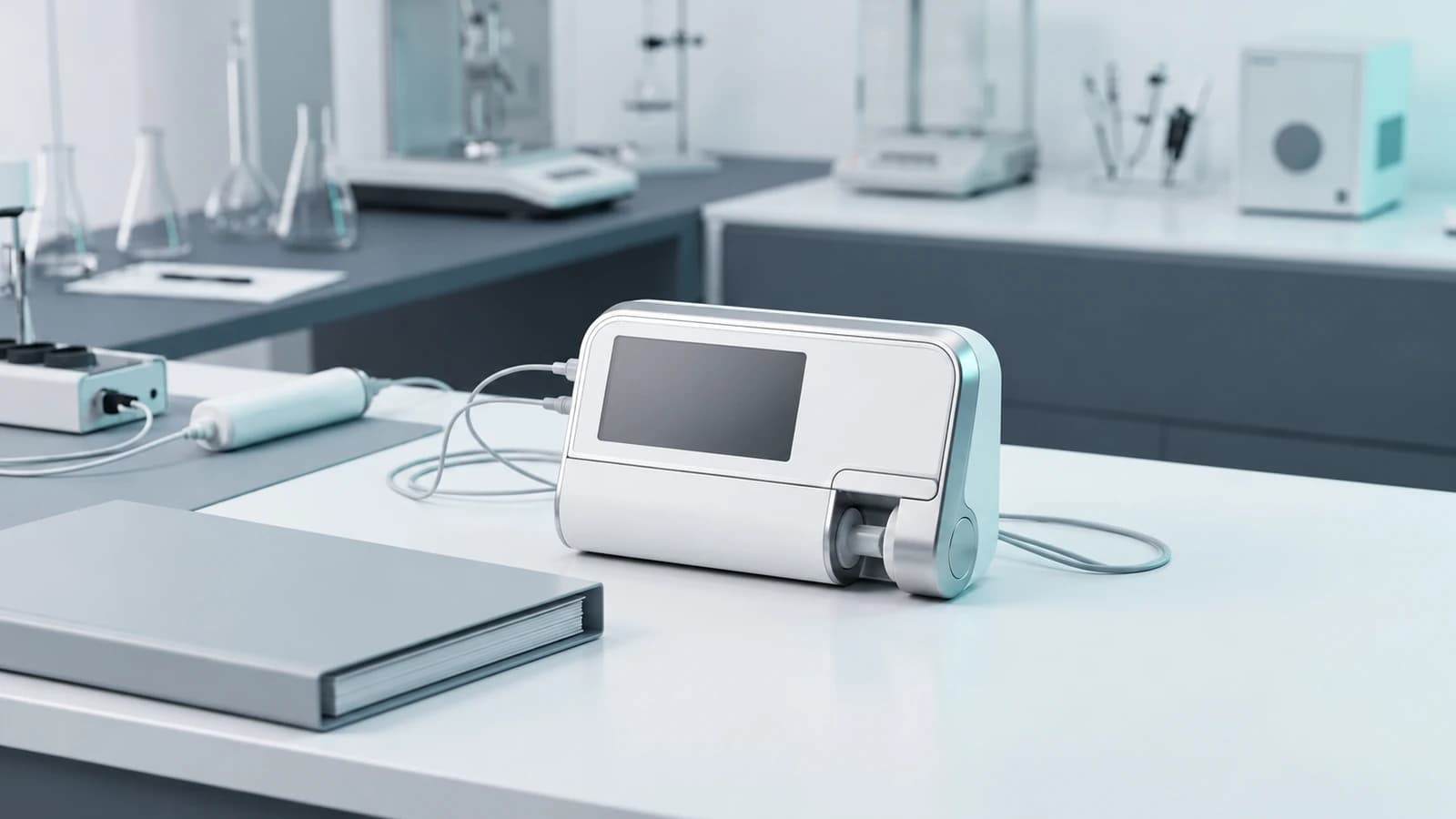
A runtime number is a labeling claim first
Suppose an infusion pump draft label promises eight hours on a fully charged battery, but the supporting test used a new pack at one delivery setting with alarms inactive. That result may be useful evidence for that configuration. It does not, by itself, establish the same duration for other workloads, batteries later in service, or periods with alarm activity. The immediate manufacturer decision is whether to substantiate a broader claim or limit the wording to supported conditions. Start by writing down what the number promises, then connect that promise to the operating profile, battery condition, and alarm behavior in the test record. The example is hypothetical; it is not performance data for a marketed pump.
For devices submitted through the U.S. 510(k) pathway, 21 CFR 807.87(e) requires proposed labeling and advertising that describe the device, intended use, and directions. Paragraph (f) requires data supporting the comparison with similar devices; energy use is one possible element of that information, rather than a separate mandatory runtime test for every device. Paragraph (l) requires a statement of belief that the submission is accurate, truthful, and complete in material respects. Our practical inference is to reconcile the runtime wording with its supporting evidence before submission. Section 807.87 is a submission-content rule, not a universal battery qualification protocol.
The FDA QMSR overview confirms that the revised quality-system regulation became effective February 2, 2026 and incorporates ISO 13485:2016. Keep the runtime evidence within the applicable design and development records. FDA’s transition note in the atherectomy guidance PDF explains that the QMSR no longer uses the former Design History File terminology and points to ISO 13485 Clause 7.3. Neither public source supplies a universal runtime test matrix.
What the public standards records establish
The publisher’s scope for IEC 60601-1-11:2015 covers basic safety and essential performance of medical electrical equipment and systems in the home healthcare environment, whether operated by lay users or trained personnel. The page also identifies the consolidated version with Amendment 1:2020. That establishes the context in which a home-use runtime claim may need assessment; the scope page does not provide the detailed battery clauses needed to design or assess a test.
The IEC 60601-1-8:2006 publisher page describes requirements and tests for medical electrical alarm systems, including priorities, signals, and control states. It identifies a consolidated version with Amendments 1:2012 and 2:2020. This is an alarm-system reference, not evidence that a particular device has a specified operating duration or energy reserve.
The FDA recognition record lists ANSI/AAMI HA60601-1-11:2015 including AMD1:2021, recognition 19-47, with complete recognition and an entry in Recognition List 058 dated May 30, 2022. The record identifies the U.S. standard as a modified adoption of the IEC publication. Keep the IEC amendment date and U.S. amendment date distinct. Complete recognition describes the extent of recognition of that standard; it does not establish that a device complies, or that recognition alone makes use mandatory.
Only public scope and recognition information was checked for this article. We have not reviewed the full licensed standard texts and therefore make no claim that the entire IEC 60601 series lacks device-specific duration requirements. Before choosing acceptance criteria, identify and review the applicable general, collateral, and particular standards and the recognition conditions relevant to the submission. A familiar standard number cannot substitute for that applicability assessment.
flowchart TD
 A["Define the runtime claim"] --> B["Record operating workload"]
 A --> C["Record battery age and starting charge"]
 A --> D["Record alarm conditions"]
 B --> E["Compare evidence with the claim boundary"]
 C --> E
 D --> E
E --> F["Resolve gaps before finalizing labeling"]Record the workload behind the number
In Section VII.E.2 of FDA’s home-use guidance, FDA recommends that instructions describe operating duration or procedure capacity alongside power-source service life. Translating that recommendation into a usable engineering record means describing what the device was doing while the clock ran. The workload questions below are our suggested way to expose the assumptions behind a duration claim. Select the items relevant to the actual product; they are not a required subsystem checklist or measured ranking of energy consumption.
| Workload dimension | Record for the tested configuration | Question for the claim review |
|---|---|---|
| Therapy or measurement mode | Mode, settings, relevant load, accessories, and transitions exercised during the run. | Does the label imply that the same duration applies to modes or loads outside this record? |
| User interface | Display settings, sleep behavior, and the pattern of operator interaction represented. | Is the tested interaction pattern consistent with the use scenario behind the claim? |
| Connectivity and sensing | Enabled functions, communication pattern, and monitoring configuration, where present. | Were functions available during battery use omitted from the test, and is the omission justified? |
| Environment and use sequence | Temperature and other relevant conditions, active and idle intervals, and any required preparation. | Which intended conditions does the result cover, and which remain untested or require separate evidence? |
Avoid inventing a universal nominal, heavy, and worst-case three-test package. Instead, distinguish the profile that supports a typical-duration statement from profiles used to evaluate limiting conditions. Explain why each selected profile represents the intended use or a relevant risk. A label may need different qualifications for different modes. Conversely, several modes might be covered by a justified representative profile. The record should expose that reasoning rather than force every device into an arbitrary number of scenarios.
Define the end of the reported duration. Elapsed time until the screen goes dark is not necessarily the same as time during which the specified function remains available. Record the functional endpoint and the event that stops the clock, then use consistent terms in the report and labeling. These are evidence-record recommendations, not quoted standard clauses. For protocol structure, acceptance criteria, and execution records, use the design verification test protocol guide; the decision here is which claim conditions that protocol needs to represent.
Battery age is part of the claim
Starting charge and service age answer different questions. A fully charged battery may be new or may have been in service for some time. A runtime statement that specifies full charge but says nothing about the service-life assumption leaves the reader without that distinction. Record both, including how the condition of the test battery was established. Do not infer coverage of an entire replacement interval solely from a new-pack result.
The FDA peripheral vascular atherectomy guidance, Section IV.I, recommends battery performance characterization, including life testing under worst-case use. It also discusses self-discharge during storage, the possible effects of sterilization on batteries within sterile systems, and maintaining sterility when replacing a battery during a procedure. Those recommendations concern peripheral vascular atherectomy devices. They illustrate questions to consider where relevant; they are not general battery requirements for every infusion pump, ventilator, or monitor.
For the proposed evidence record, name the service-life boundary associated with the runtime claim and the evidence used to represent it. If the claim is intended to apply through a replacement interval, assess whether the tested battery condition represents that interval. If it applies only to a newly installed pack, make that restriction visible and evaluate its suitability for the intended use. The sources reviewed here do not establish a universal residual-capacity percentage, cycle count, or accelerated-aging method. Select and justify those details for the device rather than copying a vendor benchmark.
Treat storage history as a separate entry where it matters to the use scenario. Record whether the pack was recharged immediately before the run or tested after a specified storage period. A storage-readiness claim and a fully charged operating-duration claim need different explanations, even if both concern the same battery. Keep the actual preparation history with the result so that later reviewers can distinguish a test assumption from a user instruction.
Alarms must be represented in the runtime evidence
Section VII.E.8 of the home-use guidance recommends that high- and medium-priority alarm signals be perceptible in home environments and addresses risks from degraded alarm connections. It refers readers to IEC 60601-1-8. These recommendations make alarm operation relevant to the use scenario; they do not provide a standard alarm-current allowance or a universal reserve duration.
Our evidence-record recommendation is to state which alarm functions were enabled, which signals actually occurred, and their timing during the runtime assessment. A run with no triggered alarms may support a clearly defined normal-operation profile. It cannot, without further justification, establish performance during a different profile with alarm activity. Equally, requiring a continuous high-priority alarm throughout every runtime test would impose a scenario that may not fit the device. Select scenarios from the intended use and risk analysis and record the reason for including or excluding them.
Identify what happens to the intended function during each selected alarm condition. The device may continue a function, suspend it, or enter another defined state. Describe the relevant behavior without assuming that continuing therapy during every alarm is safe. This also prevents a misleading comparison between time powered on and time delivering the labeled function. Any assessment of alarm effectiveness should address the applicable requirements separately; a duration measurement alone does not demonstrate that an alarm is usable or perceptible.
For low-battery warnings, record when the warning appeared and what operating conditions followed. FDA’s home-use guidance recommends advance recharge or replacement notification where possible. It does not specify a generic thirty-minute therapy reserve or a terminal alarm duration. If the manufacturer defines remaining operating time after a warning, connect that statement to its own evidence, endpoint, and user instructions. Avoid presenting an assumed reserve as measured performance.
The rated-runtime evidence table
Use one row for each materially different runtime promise. The table below is an editorial decision structure assembled from the source boundaries discussed above. It is not a dataset, an FDA-named form, a prescribed test suite, or evidence that any device passes. Replace the prompts with actual configuration identifiers, results, record references, and justified limitations. Each row should let labeling and engineering reviewers reach the same understanding of what the duration means.
| Claim being substantiated | Operating profile record | Battery age and charge record | Alarm-condition evidence | Source context and review decision |
|---|---|---|---|---|
| Typical operating duration on a fully charged battery | Identify the operating mode, relevant settings and loads, active and idle intervals, enabled functions, environment, and endpoint used for the result. | Identify the pack and preparation method; state whether it was new or representative of a defined service condition. Full charge alone does not describe age. | Identify enabled alarm functions, any signals exercised, their timing, and the rationale for the selected profile. | Home-use guidance VII.E.2 motivates explaining duration and service life. Decide whether the proposed wording stays within the evidence; this row is our implementation suggestion. |
| Operating duration intended to apply through a replacement interval | Link the claimed interval to the relevant operating profiles and explain why their evidence covers the proposed use. | Record the service boundary, how test packs represent it, and the supporting condition or aging records. Select no generic capacity threshold from this table. | Identify alarm behavior represented at that battery condition, including any defined low-battery warning response. | Home-use service-life advice and atherectomy battery-life recommendations inform the question. Apply the latter only within their device-family scope; justify broader engineering use. |
| Continued operating duration after loss of primary power | Record the intended function, workload, transition conditions, and duration endpoint for the backup-power scenario. | Record the initial available charge and service condition assumed at the power-loss event, rather than silently assuming a new full pack. | Record the applicable power-loss and battery-warning behavior and the operating state during the reported interval. | Home-use guidance VII.E.5 addresses continued use and backup duration. Review whether outage wording and user actions match the demonstrated conditions. |
| Procedure capacity or readiness after a stated storage period | Define a procedure or the readiness function and the sequence represented; do not silently convert a storage period into active runtime. | Record storage conditions and history, recharge or replacement assumptions, and the battery condition at the start of use. | Identify relevant startup, status, and subsequent use alarms; explain which are outside the claim. | Home-use guidance discusses procedure capacity; atherectomy guidance addresses self-discharge and shelf life. Decide whether this needs a separate claim and evidence record. |
Keep traceability practical. A row can point to a controlled report rather than repeat every measurement. Record the label version, configuration, report reference, result, deviations, and unresolved limits alongside the chosen profile. An empty cell is a question to resolve, not permission to assume favorable conditions. In particular, do not write that an alarm profile or service-life condition is covered unless the referenced evidence actually addresses it.
Applying the table to the eight-hour example
For the hypothetical pump, first enter the existing new-pack test without broadening its meaning. Record the actual delivery setting, functions enabled, battery preparation, environment, and endpoint. Mark alarm activity as absent if none occurred. The next question is whether the proposed eight-hour wording promises more than that result demonstrates. This review can reveal a labeling qualification or an evidence gap without inventing the outcome of further tests.
Next, compare the claim with intended modes, the battery replacement interval, and relevant alarm scenarios. Give each gap an explicit disposition: supported by other evidence, requiring additional assessment, or addressed by a justified change to the claim. A broader test campaign is not automatically the answer to every gap. A narrower claim may be appropriate, but only if the resulting labeling and device still meet intended-use and safety needs. Changing words cannot resolve an unmet design requirement.
Finally, have the labeling owner and engineering owner check the same completed record. The labeling owner checks what a user is being promised. The engineering owner checks what configuration and conditions the evidence covers. Keep the reasoning for representative conditions and omitted scenarios visible. This is the main benefit of the table: it makes the connection between the claim and its limits reviewable without suggesting that every reviewer expects an identical test matrix.
Backup power, outages, and the IFU
Section VII.E.5 of the home-use guidance recommends disclosing continued use after a power-supply failure and expected operation on a provided backup source. Section VII.E.2 also addresses charging during use and replacement instructions where applicable. These are recommendations for the home-use context, not guarantees that every device supports uninterrupted battery transfer or operation while charging.
For a backup-duration statement, distinguish the charge condition assumed when power fails from the fully charged condition used for an ambulatory rating. If those assumptions differ, the evidence and explanation should show the difference. Where a user action affects the duration or availability of the function, connect the instruction to the demonstrated scenario. Do not imply that an untested charger, replacement battery, or operating mode is covered by a generic battery claim.
Duration evidence and recovery behavior answer related but separate questions. This article asks how long the specified function is available under recorded conditions. Which settings, state, and essential functions need to survive an interruption is addressed in the medical device power-recovery article. Keep those analyses connected where needed, while avoiding a blanket claim that every device must transfer power without a restart.
Reassess runtime evidence when the battery changes
A change to the power source should reopen the link between the existing runtime claim and its evidence. Section V of the atherectomy guidance discusses AC-to-battery conversion as a change that could affect safety and effectiveness through different failure modes and limited use time. In its device-family context, it identifies changes generally requiring a new 510(k). That example does not determine the submission outcome for every battery supplier, chemistry, or capacity change in other devices.
21 CFR 807.87(g) addresses supporting data in submissions involving significant changes that could affect safety or effectiveness. It is not a battery-change decision tree. Assess the applicable submission trigger separately for the actual modification. Our runtime-specific recommendation is to identify which prior profiles and battery assumptions remain representative, which need reassessment, and whether the label needs revision. A capacity increase alone does not prove that every old runtime condition remains covered.
Keep the change record specific: what changed, which evidence is retained, the reason it remains applicable, and any new evidence needed for the claim. Supplier qualification and battery safety have their own scope, covered in the battery cell sourcing guide and IEC 62133 battery safety guide. Neither a supplier certificate nor a safety test report automatically establishes the labeled duration under the device’s workload.
Limits, dates, and how to stay current
The home-use guidance was issued November 24, 2014 and corrected August 8, 2016. Its older standards citations and quality-system terminology need to be read in that historical context.
The atherectomy guidance was issued May 20, 2021 and includes a QMSR transition note. Its battery recommendations remain device-family examples, rather than requirements for all battery-powered medical devices.
The IEC references were checked at publisher scope level. No unseen clause, device-specific minimum duration, reserve period, or battery aging threshold is asserted here.
The eCFR is an authoritative but unofficial electronic rendering. The linked section was checked on October 17, 2026; the displayed Title 21 currency date was October 15, 2026.
The examples and tables contain no measured device results, approval predictions, or comparative runtime benchmarks. The regulatory discussion is U.S.-focused; IEC publication does not establish adoption in another market.
Review the evidence record when the operating modes, enabled functions, alarm behavior, battery configuration, service interval, or labeling promise changes. Also recheck relevant guidance revisions, standard editions, and FDA recognition status before relying on them in a new submission. Keep the review focused on the practical decision: which duration is supported, under which conditions, and which limits must be resolved before the claim is finalized.