
Malaysia MDA: 2,462 Establishments, 23% Expiry Cliff, J&J at 58% Renewal
Malaysia MDA 49,198-row device dataset reveals 2,462 establishments with top-20 concentration at 18.7% and 11,438 devices expiring by end 2027. Data-driven establishment selection insights.

Executive Summary
Malaysia's Medical Device Authority (MDA) requires every company involved in importing, distributing, or storing medical devices to hold a valid Establishment Licence under Section 15 of the Medical Device Act 2012 (Act 737). These establishments are the gateway through which every foreign device enters the Malaysian market. Choosing the right one — and understanding their workload and renewal timing — matters more than most manufacturers realize.
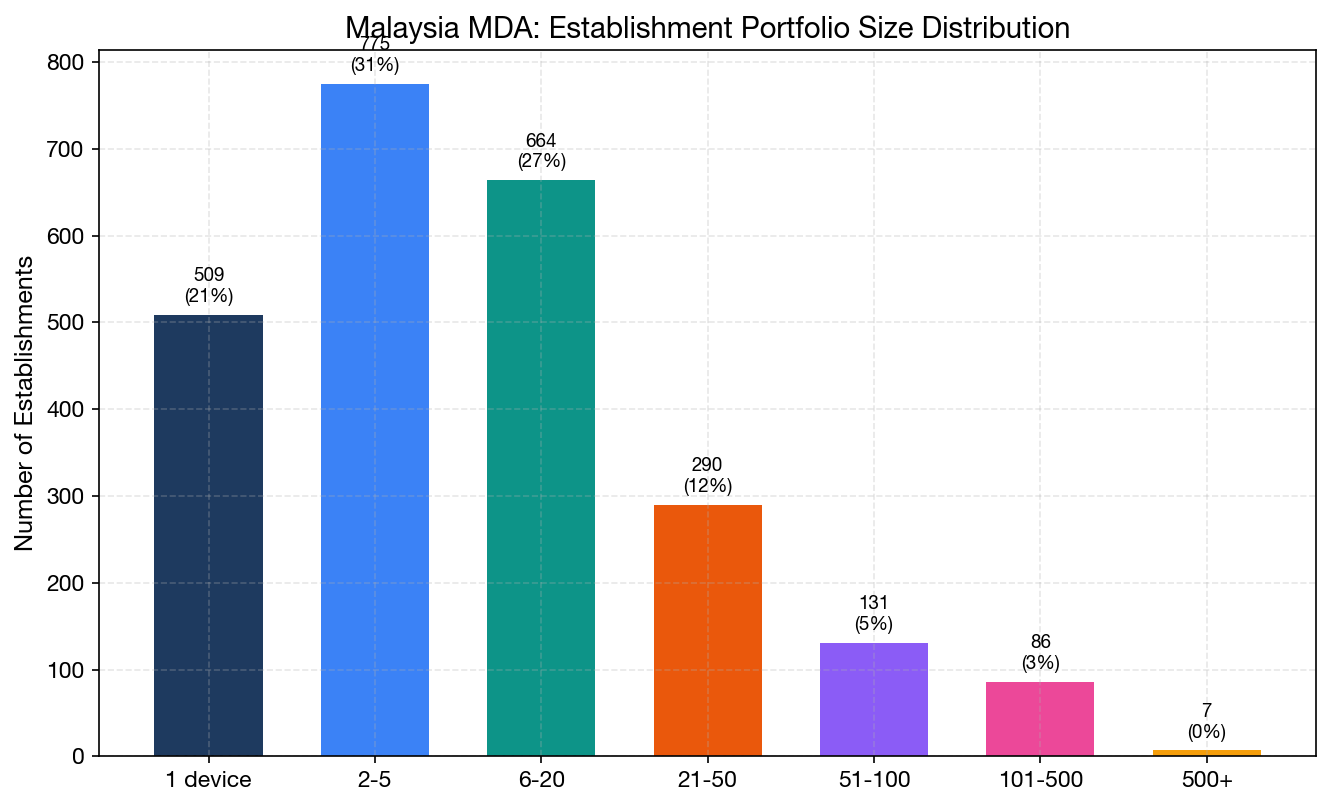
Our analysis of the MDA registered device database (extracted 5 June 2026, 49,198 device listings) reveals a market with 2,462 unique establishments but significant concentration: the top 20 establishments hold 18.7% of all device registrations, while 509 establishments (20.7%) manage only a single device. Perhaps most critically, 11,438 devices (23.2%) have registrations expiring by the end of 2027, with major establishments like Johnson & Johnson Malaysia facing a 57.9% near-term expiry rate and Siemens Healthcare at 40.4%.
This article quantifies the establishment landscape, maps the expiry-risk concentrations, and offers practical guidance for manufacturers evaluating local partner selection and renewal planning.
Data Source and Method
Source: Malaysia MDA public registered device database
Analysis sample: Malaysia MDA registered-device public extract dated 5 June 2026 (49,198 device rows)
Analysis date: 6 June 2026
Computed using: MedDeviceGuide analysis of the MDA public extract
Key fields:
establishment_name,device_name,registration_no,validity_date,source_termsLimitations: The dataset captures registrations visible in the MDA register as of the extract date. Some recent submissions or renewals in progress may not yet appear. Validity dates represent the registration period, not market authorization status.
Registration Route Distribution
The source_terms field indicates the registration route or device classification tier for each entry:
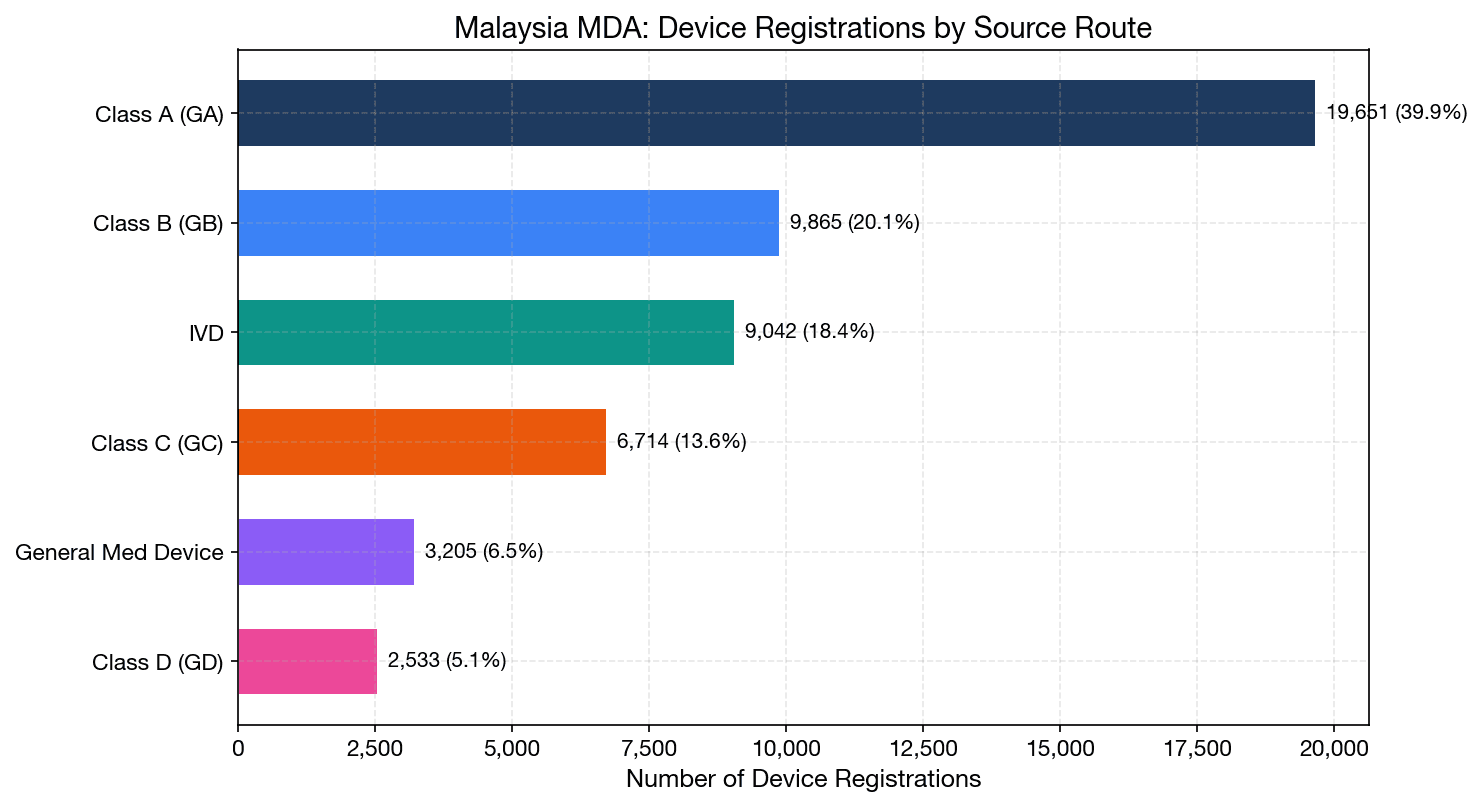
| Route | Devices | Share |
|---|---|---|
| Class A (GA) | 18,596 | 37.8% |
| Class B (GB) | 9,544 | 19.4% |
| IVD | 9,033 | 18.4% |
| Class C (GC) | 6,578 | 13.4% |
| General Medical Device (GMD) | 3,108 | 6.3% |
| Class D (GD) | 2,339 | 4.8% |
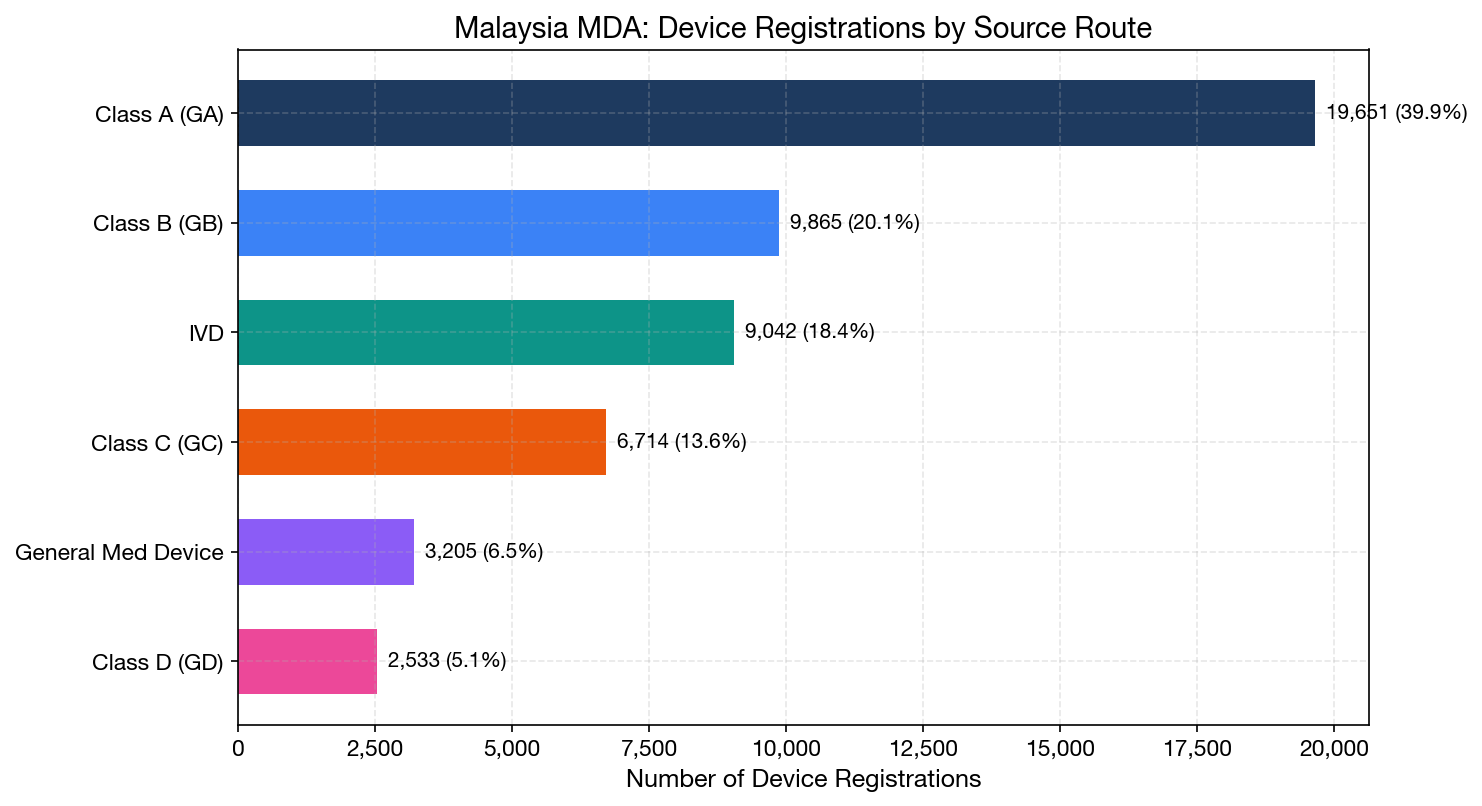
Class A devices (low risk, self-declared conformity) dominate at 37.8%, consistent with Malaysia's large consumable and low-risk device market. IVD products represent a significant 18.4%, reflecting Malaysia's diagnostic infrastructure investment. Higher-risk Class C and D devices together account for 18.2%, requiring Conformity Assessment Body (CAB) assessment before MDA registration.
Establishment Concentration
The MDA database lists 2,462 unique establishments managing the 49,198 device registrations. The distribution shows moderate concentration:
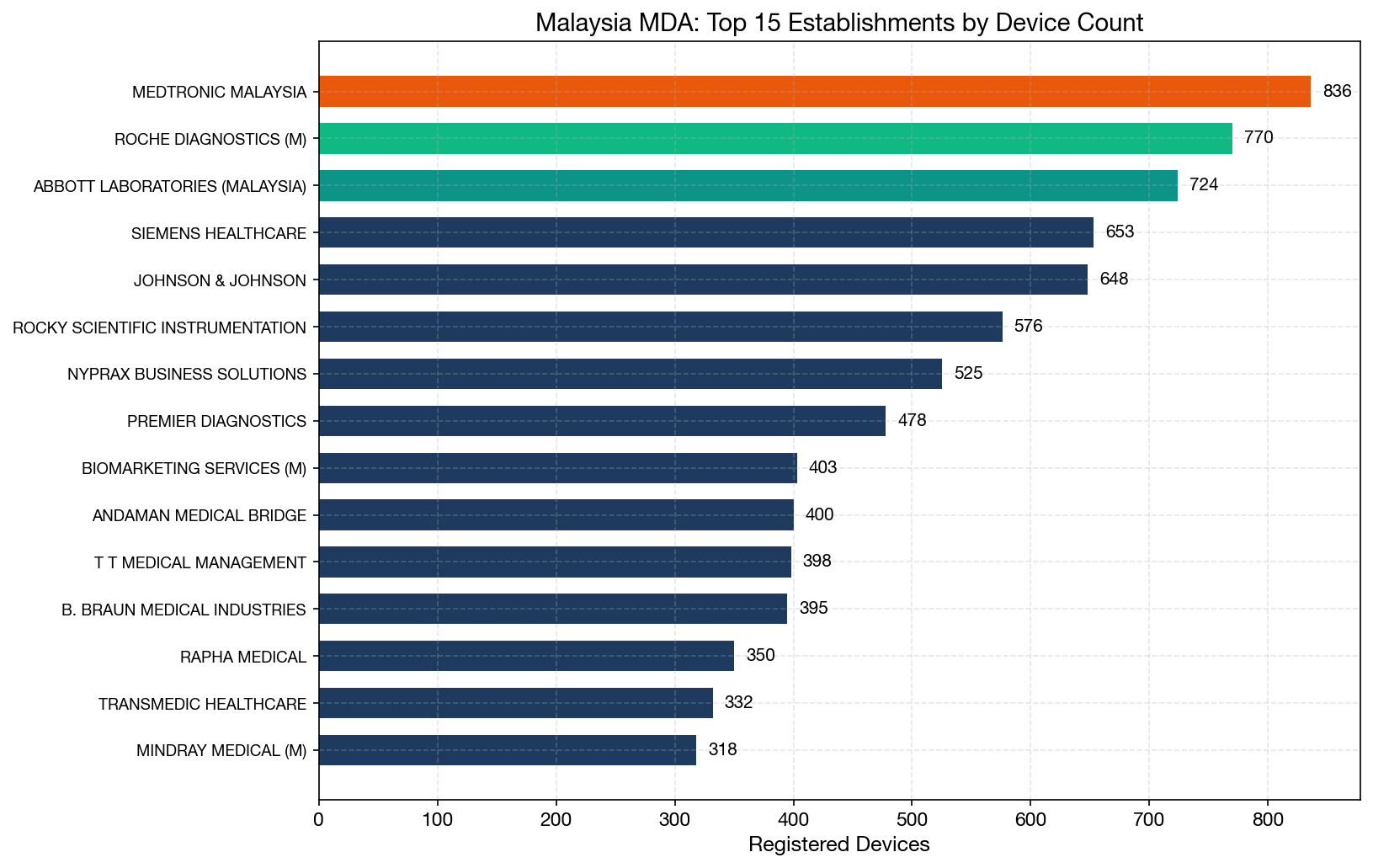
Top 15 Establishments by Device Count
| Establishment | Devices | Share | Expiring by 2027 |
|---|---|---|---|
| Medtronic Malaysia | 836 | 1.7% | 325 (38.9%) |
| Roche Diagnostics (M) | 770 | 1.6% | 100 (13.0%) |
| Abbott Laboratories (Malaysia) | 724 | 1.5% | 68 (9.4%) |
| Siemens Healthcare | 653 | 1.3% | 264 (40.4%) |
| Johnson & Johnson | 648 | 1.3% | 375 (57.9%) |
| Rocky Scientific Instrumentation | 576 | 1.2% | 88 (15.3%) |
| Nyprax Business Solutions | 525 | 1.1% | 143 (27.2%) |
| Premier Diagnostics | 478 | 1.0% | 66 (13.8%) |
| Biomarketing Services (M) | 403 | 0.8% | 100 (24.8%) |
| Andaman Medical Bridge | 400 | 0.8% | 93 (23.2%) |
| T T Medical Management | 398 | 0.8% | — |
| B. Braun Medical Industries | 395 | 0.8% | — |
| Rapha Medical | 350 | 0.7% | — |
| Transmedic Healthcare | 332 | 0.7% | — |
| Mindray Medical (M) | 318 | 0.6% | — |
Concentration Metrics
| Metric | Value |
|---|---|
| Top 5 establishments | 3,631 devices (7.4%) |
| Top 10 establishments | 6,013 devices (12.2%) |
| Top 20 establishments | 9,198 devices (18.7%) |
| Single-device establishments | 509 (20.7% of all establishments) |
The top 5 establishments are dominated by large multinational subsidiaries — Medtronic, Roche, Abbott, Siemens, and Johnson & Johnson — which maintain their own Malaysian entities rather than relying on third-party distributors. This is characteristic of Malaysia's regulatory environment, which requires an establishment licence for any entity placing devices in the market, encouraging large multinationals to operate directly.
The 509 single-device establishments (20.7%) suggest a long tail of small importers or specialty distributors handling niche products, a pattern common in ASEAN markets.
Validity-Date Risk Patterns
Malaysian device registrations carry a standard 5-year validity period (average observed: 1,825 days / 5.0 years). The expiry distribution reveals a clear risk pattern:
Expiry Year Distribution
| Expiry Year | Devices | Share |
|---|---|---|
| 2026 | 3,004 | 6.1% |
| 2027 | 8,434 | 17.1% |
| 2028 | 13,734 | 27.9% |
| 2029 | 10,773 | 21.9% |
| 2030 | 8,525 | 17.3% |
| 2031 | 4,644 | 9.4% |
| 2032 | 84 | 0.2% |
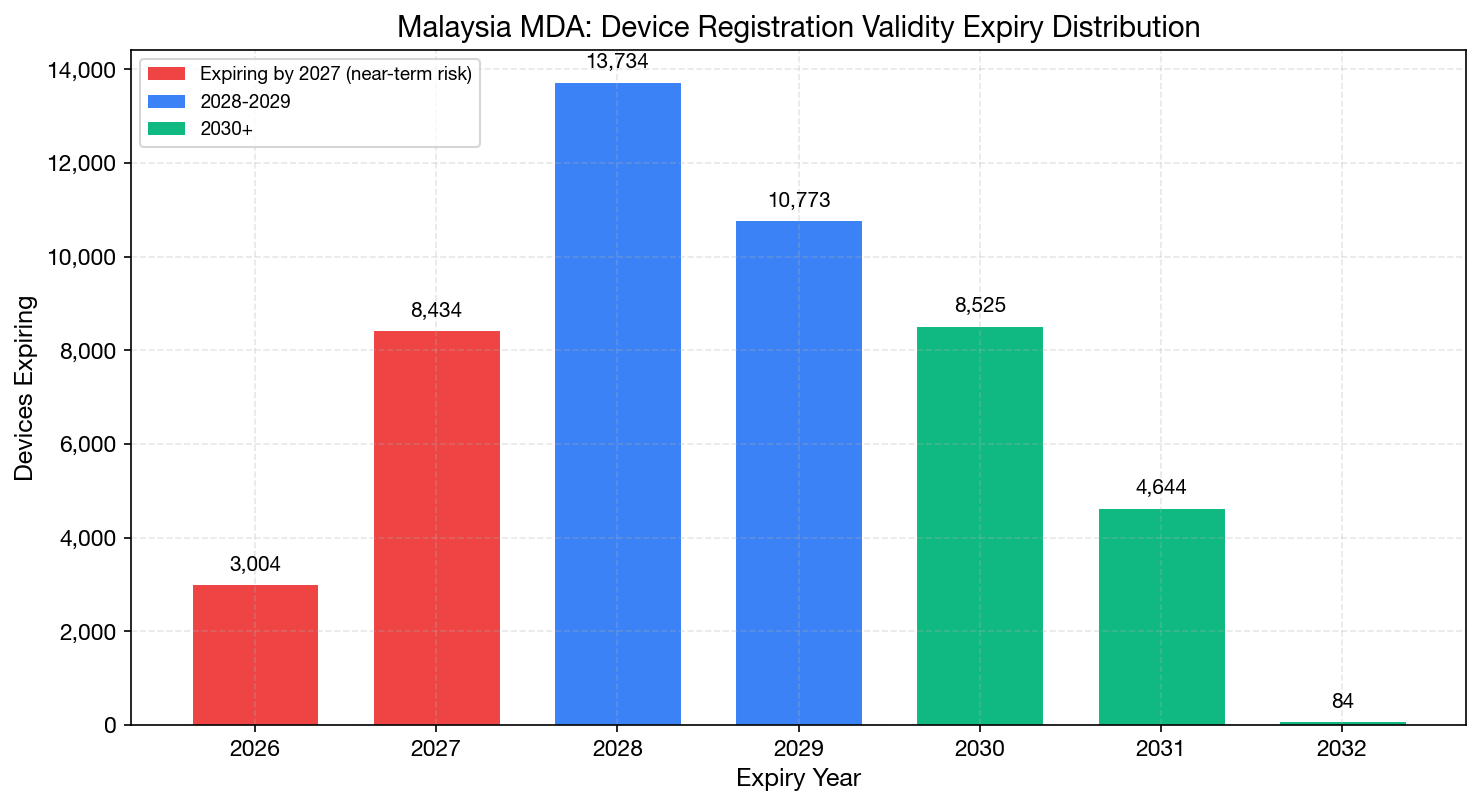
The 2028 peak (13,734 devices, 27.9%) corresponds to the surge of registrations that followed MDA's operational maturity around 2023, when the agency's MeDC@St system reached full capacity and backlog clearance accelerated.
Near-term risk: 11,438 devices (23.2%) expire by the end of 2027. These require renewal submissions well in advance — MDA advises establishments to submit re-registration applications at least one year before the expiry date via MeDC@St 2.0+. Since 13 July 2026, files that already sit inside that window may use the Automated Re-Registration Route if every eligibility gate is met; a pending Change Notification still blocks the button.
Establishment-Level Expiry Risk
The risk is not evenly distributed across establishments. Some of the largest holders face disproportionate renewal pressure:
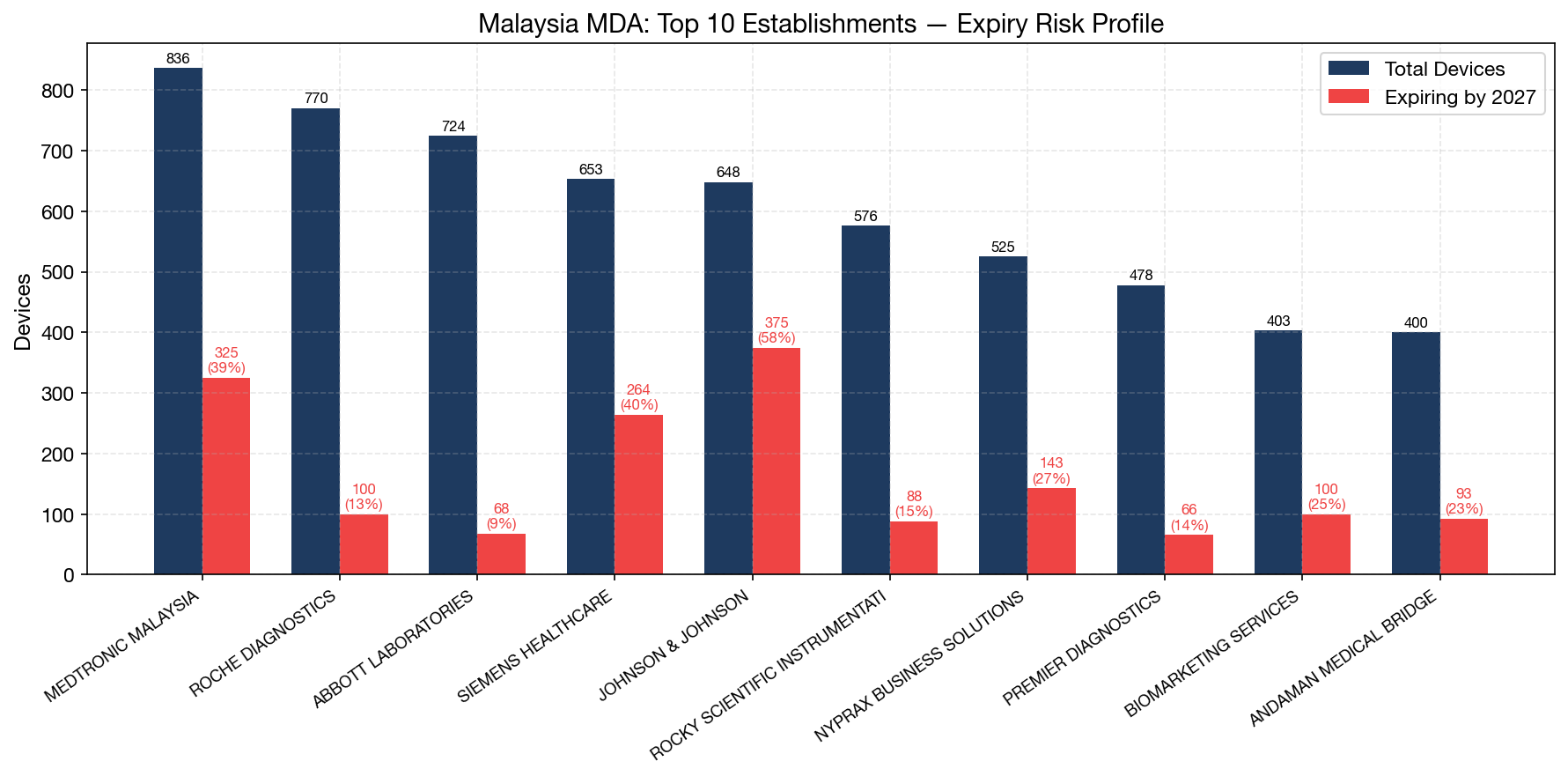
| Establishment | Total | Expiring by 2027 | Risk Rate |
|---|---|---|---|
| Johnson & Johnson | 648 | 375 | 57.9% |
| Siemens Healthcare | 653 | 264 | 40.4% |
| Medtronic Malaysia | 836 | 325 | 38.9% |
| Nyprax Business Solutions | 525 | 143 | 27.2% |
| Biomarketing Services (M) | 403 | 100 | 24.8% |
| Andaman Medical Bridge | 400 | 93 | 23.2% |
| Roche Diagnostics (M) | 770 | 100 | 13.0% |
| Premier Diagnostics | 478 | 66 | 13.8% |
| Rocky Scientific Instrumentation | 576 | 88 | 15.3% |
| Abbott Laboratories (Malaysia) | 724 | 68 | 9.4% |
Johnson & Johnson Malaysia stands out with 57.9% of its 648 registrations expiring by 2027, suggesting a large portfolio registered in a batch around 2022 that will need coordinated renewal. Siemens Healthcare faces a similar pattern at 40.4%.
Concentration Curve
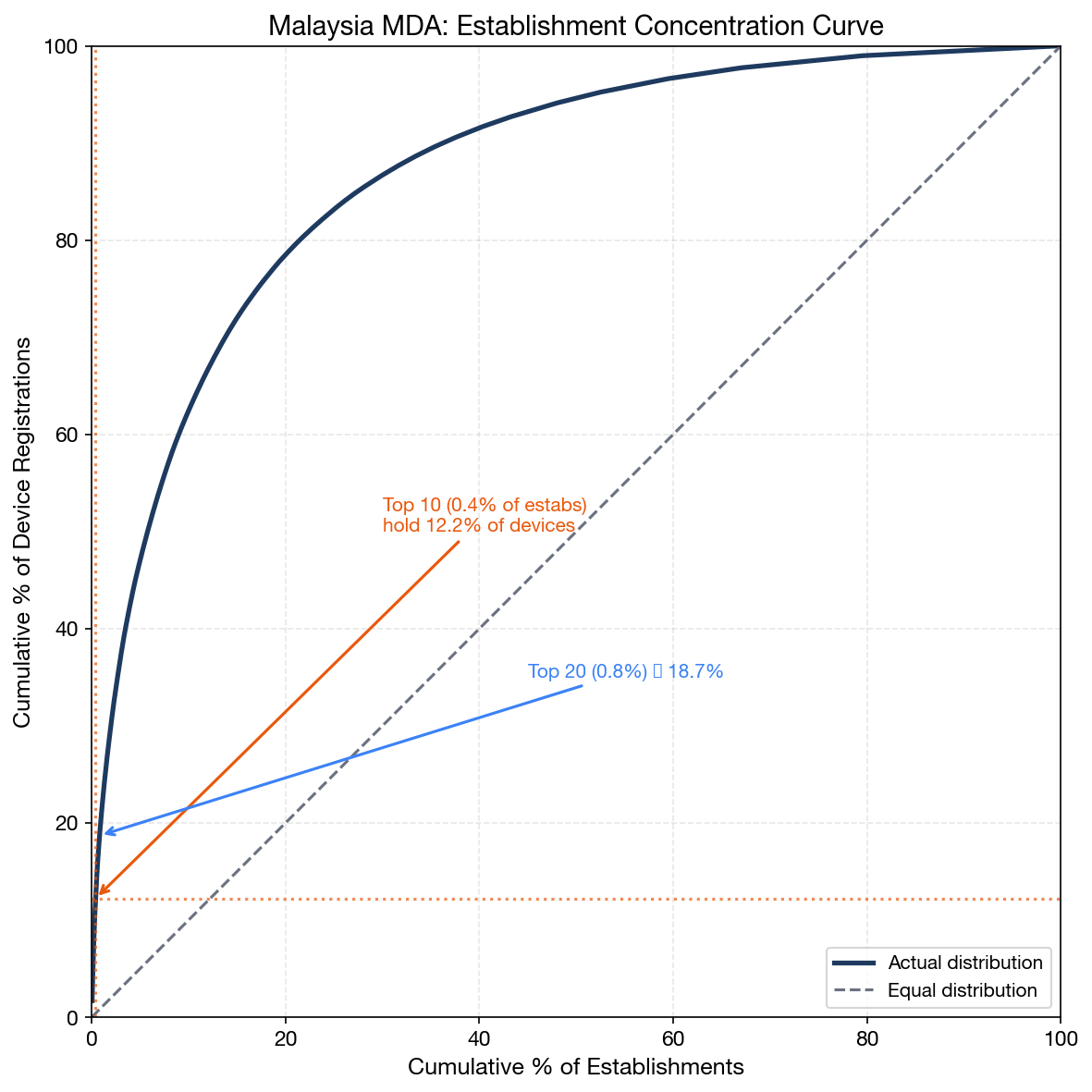
The Lorenz curve shows that the establishment market is moderately concentrated — less concentrated than Saudi Arabia's AR market (where the top 20 hold 35%) but more concentrated than an equal distribution. The top 0.8% of establishments (20 entities) hold 18.7% of all registrations, while the bottom 20.7% (509 single-device establishments) hold just 1.0%.
Practical Implications for Manufacturers
1. Evaluate Establishment Renewal Capacity
When selecting a Malaysian establishment (whether a subsidiary, authorized representative, or distributor), ask about their renewal workload in 2027. Establishments handling large renewal surges may have limited bandwidth for new registrations during those periods.
2. Consider Timing Around the 2027-2028 Renewal Wave
With 22,168 devices (45.1%) expiring in 2027-2028, MDA's MeDC@St system and CAB assessors will face peak capacity pressure. Submitting new registrations or renewals well in advance of this window is advisable.
3. MDA Circular Letter No. 1/2026 Adds Procurement Compliance
Effective 28 January 2026, MDA's Circular Letter No. 1/2026 classifies successful procurement tenderers as "establishments" under Act 737, requiring them to hold establishment licences. This broadens the definition of who needs a licence and may increase the establishment count going forward.
4. Aesthetic Device Designation (June 2026)
The Medical Device (Designated Medical Devices) Order 2026, effective 1 June 2026, brings aesthetic devices (lasers, HIFU, liposuction devices) under MDA regulation. Manufacturers in this space will need to identify establishments capable of handling these newly regulated product categories.
5. Singapore Reliance Route Changes the Establishment Equation
Since 1 March 2026, devices registered on Singapore's SMDR can use the Verification Route for Malaysian registration, reducing CAB review from 60 to 30 working days. This may encourage establishments that already operate across both markets.
Method Notes
All counts are based on deduplicated device listings. A single device model may appear multiple times if registered under different establishments or with different validity periods.
The
source_termsfield may include compound entries (e.g., "GA|GB") indicating multi-class registrations; these were counted under each applicable route.Expiry dates were extracted from the
validity_datefield format "DD/MM/YYYY - DD/MM/YYYY".Establishment names were used as-is from the database; minor variations in entity naming (e.g., "SDN BHD" vs "SDN. BHD.") may cause slight undercounting of the largest holders.
Data source: Malaysia MDA registered-device database; analysis by MedDeviceGuide, run date 2026-06-06.