
Korea MFDS: J&J, Medtronic, Stryker Dominate High-Risk Device Imports
Korea MFDS data shows 13,117 licence holders manage 273,672 registrations. Top 20 holders control 14.4%. US firms dominate Class III/IV imports at 30.4%.

Executive Summary
South Korea's medical device market is one of the largest in Asia-Pacific, regulated by the Ministry of Food and Drug Safety (MFDS). Foreign manufacturers entering Korea must work with a local Korea Licence Holder (KLH) — a domestic entity that holds the MFDS registration and acts as the regulatory point of contact.
Our analysis of the complete MFDS device database (extracted 5 June 2026) and licence holder summary dataset reveals:
13,117 licence holders manage 273,672 device registrations across 136,487 active items
72.2% of all licence holders have fewer than 10 registrations — the market has a very long tail
The top 20 licence holders control 14.4% of all registrations, with J&J Medical Korea (4,100), Stryker Korea (3,989), and Shinheung (3,943) leading
For Class III/IV (high-risk) imported devices, the United States is the dominant source country at 30.4% of import volume
J&J Medical Korea, Medtronic Korea, and Stryker Korea together hold nearly 1,000 Class III/IV import items — making them the most important import channels for high-risk medical devices in Korea
Data Source and Method
Sources: MFDS medical device registration database and licence holder summary
Analysis samples:
MFDS device registration extract dated 5 June 2026 (273,672 rows)
MFDS licence-holder summary extract dated 5 June 2026 (13,117 holder summary rows)
Scope: All items with status
정상(active/normal) in the device database; all holders in the licence holder summaryAnalysis date: 6 June 2026
Computed using: MedDeviceGuide analysis of MFDS public extracts
The MFDS Device Registry at a Glance
| Metric | Value |
|---|---|
| Total device entries (all statuses) | 273,672 |
| Active items (정상) | 136,487 |
| Unique licence holders | 13,117 |
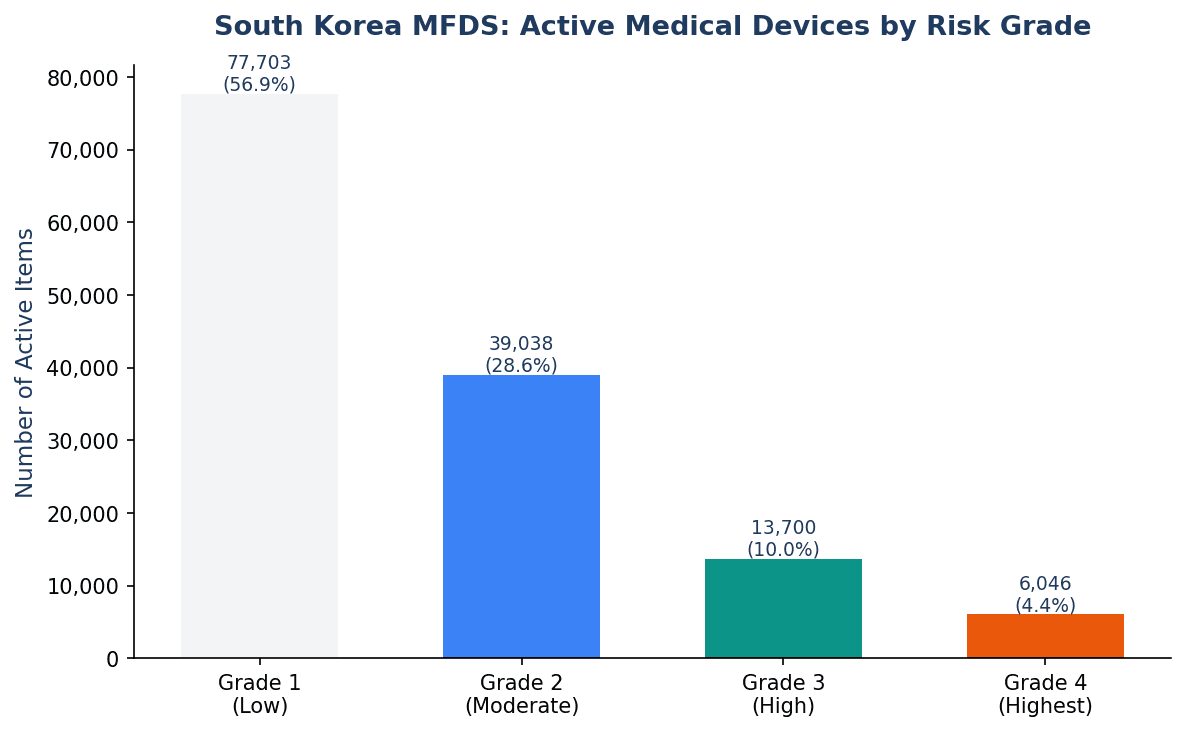
| Class I (low risk) | 77,703 (56.9%) |
| Class II (moderate) | 39,038 (28.6%) |
| Class III (high) | 13,700 (10.0%) |
| Class IV (highest) | 6,046 (4.4%) |
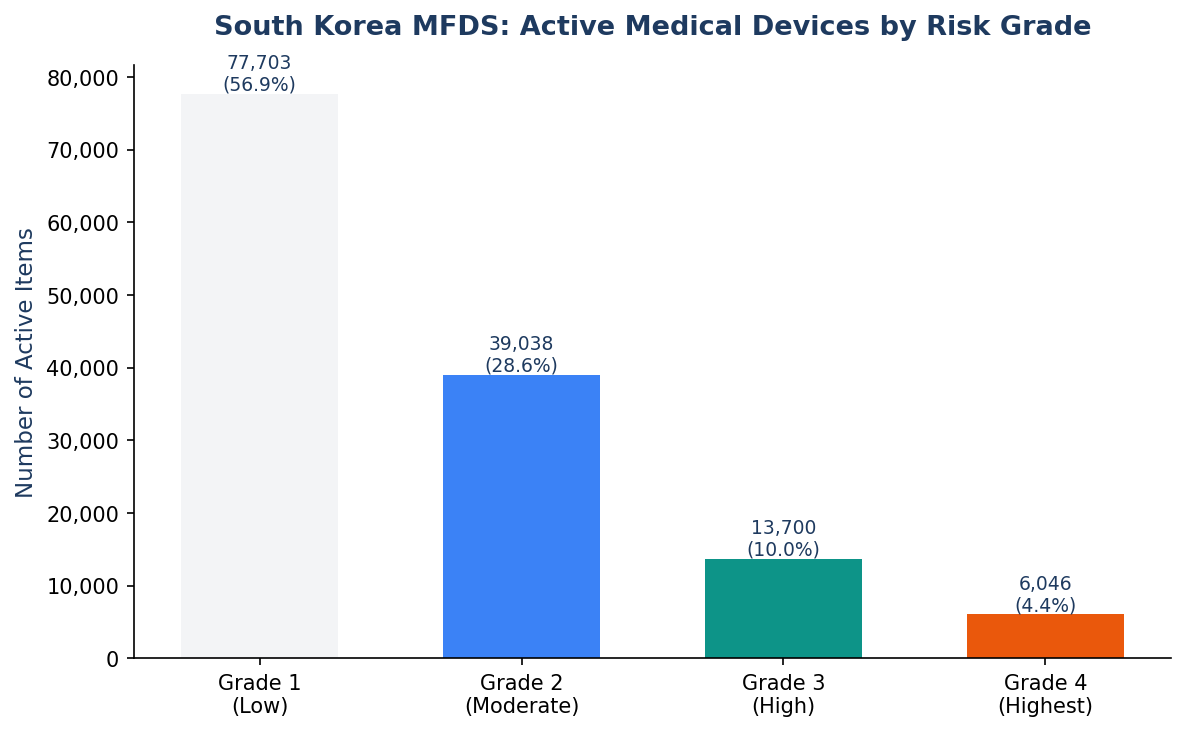
Korea uses a four-tier classification system (Classes I–IV) broadly aligned with the GHTF/IMDRF framework. Class III and IV devices require MFDS pre-market approval. KGMP (Korea Good Manufacturing Practice) certification is required for Class II, III, and IV devices.
Industry Type Split
Active items break down by industry (registration) type:
| Industry Type | Class III/IV Items | Share |
|---|---|---|
| Manufacturing (제조업) | 10,445 | 52.9% |
| Import (수입업) | 4,782 | 24.2% |
| IVD Manufacturing (체외진단제조업) | 3,262 | 16.5% |
| IVD Import (체외진단수입업) | 1,226 | 6.2% |
| Other | 31 | 0.2% |
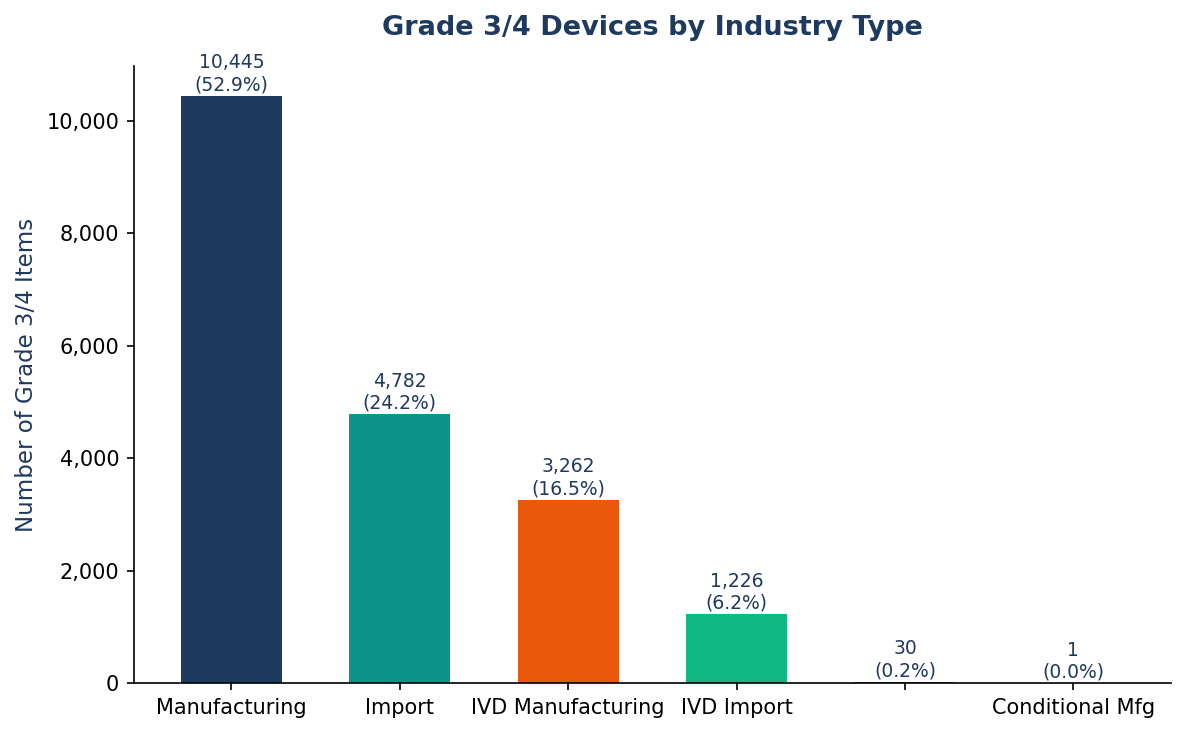
Just over half of Class III/IV items are domestically manufactured. Import registrations account for 24.2%, and IVD (both domestic and imported) account for an additional 22.7%.
Foreign Source Countries for Class III/IV Imports
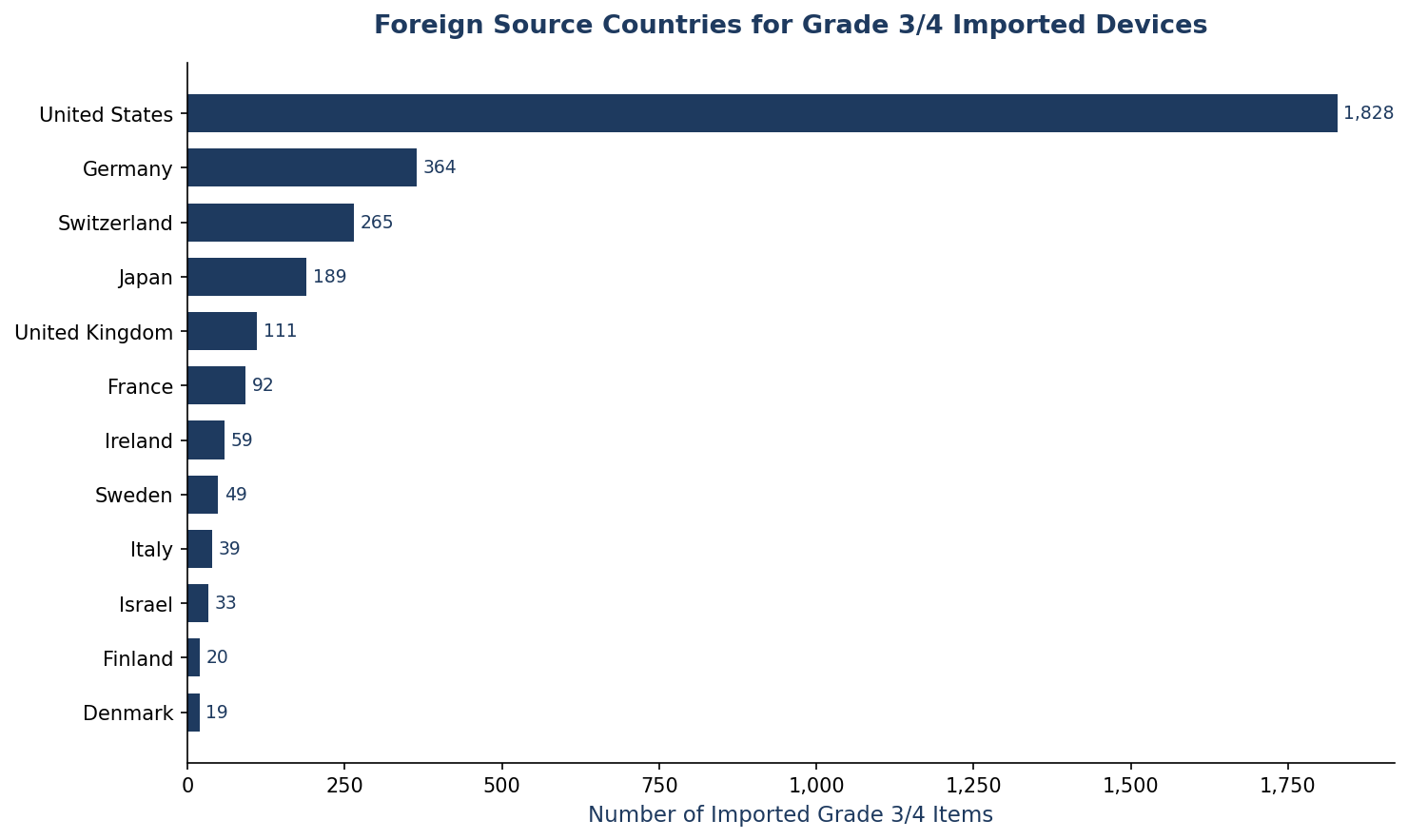
Among the 6,008 Class III/IV imported items (import and IVD import combined) where a source country is recorded:
| Rank | Country | Class III/IV Import Items | Share of Imports |
|---|---|---|---|
| 1 | United States | 1,828 | 30.4% |
| 2 | Germany | 364 | 6.1% |
| 3 | Switzerland | 265 | 4.4% |
| 4 | Japan | 189 | 3.1% |
| 5 | United Kingdom | 111 | 1.8% |
| 6 | France | 92 | 1.5% |
| 7 | Ireland | 59 | 1.0% |
| 8 | Sweden | 49 | 0.8% |
| 9 | Italy | 39 | 0.6% |
| 10 | Israel | 33 | 0.5% |
The United States is the dominant source country for high-risk device imports into Korea, accounting for nearly one-third of all Class III/IV import items. Germany (6.1%) and Switzerland (4.4%) are distant seconds, driven by their strong orthopaedic and cardiovascular device sectors.
Notably, 47.2% of Class III/IV imports have no source country recorded in the extract, suggesting the data field is not consistently populated. The figures above represent only items with a recorded source country.
Top Import Licence Holders for Class III/IV Devices
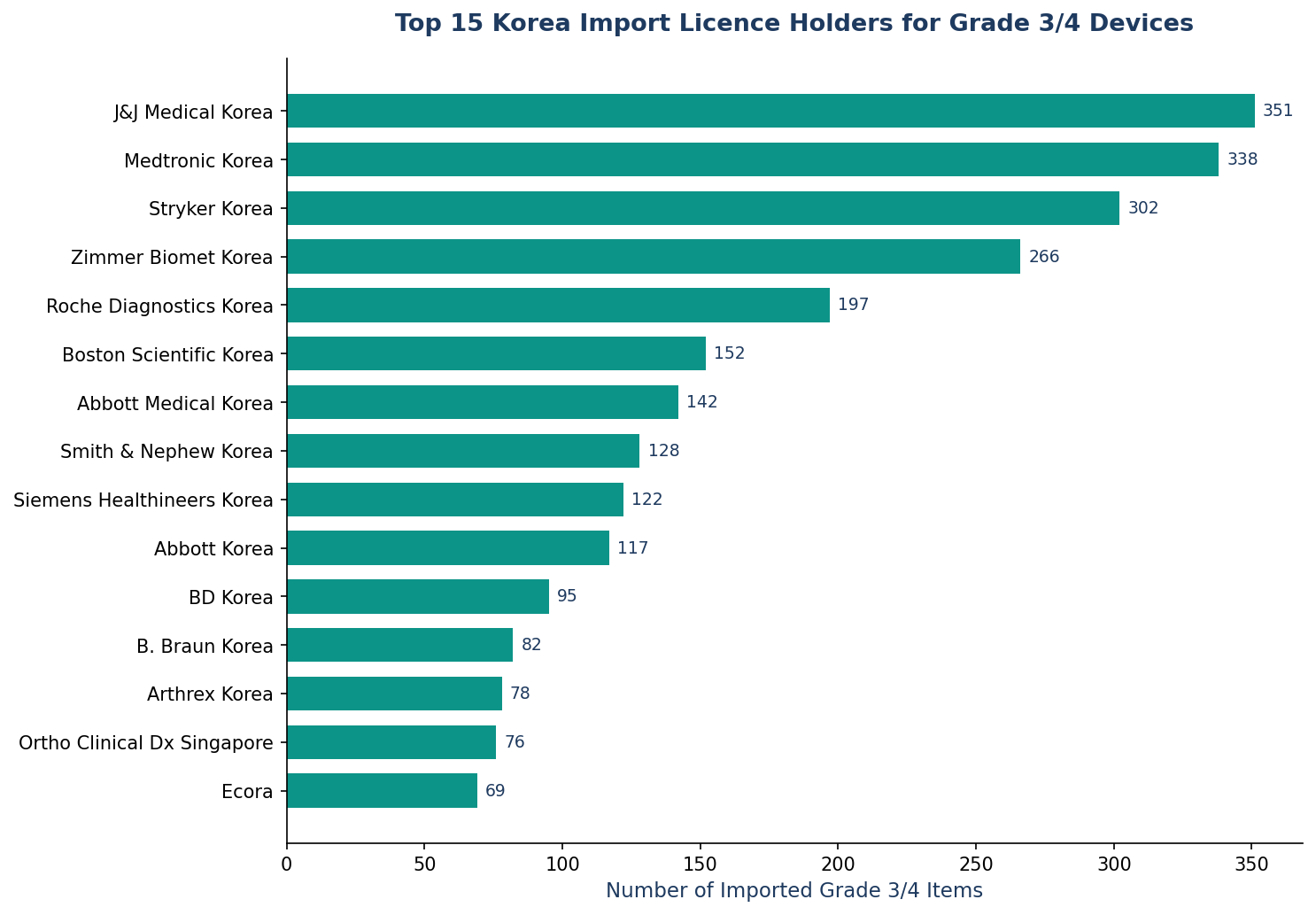
| Rank | Licence Holder | Class III/IV Import Items | Parent Company |
|---|---|---|---|
| 1 | J&J Medical Korea | 351 | Johnson & Johnson |
| 2 | Medtronic Korea | 338 | Medtronic |
| 3 | Stryker Korea | 302 | Stryker |
| 4 | Zimmer Biomet Korea | 266 | Zimmer Biomet |
| 5 | Roche Diagnostics Korea | 197 | Roche |
| 6 | Boston Scientific Korea | 152 | Boston Scientific |
| 7 | Abbott Medical Korea | 142 | Abbott |
| 8 | Smith & Nephew Korea | 128 | Smith & Nephew |
| 9 | Siemens Healthineers Korea | 122 | Siemens |
| 10 | Abbott Korea | 117 | Abbott |
| 11 | BD Korea | 95 | Becton Dickinson |
| 12 | B. Braun Korea | 82 | B. Braun |
| 13 | Arthrex Korea | 78 | Arthrex |
| 14 | Ortho Clinical Dx Singapore | 76 | — |
| 15 | Ecora | 69 | — |
The top 15 import licence holders are almost entirely Korean subsidiaries of major multinational device companies. The orthopaedic sector again dominates — J&J (DePuy Synthes), Stryker, Zimmer Biomet, and Smith & Nephew together account for over 1,000 Class III/IV import items.
Abbott appears twice (Abbott Medical Korea: 142; Abbott Korea: 117), reflecting separate registrations for different product divisions (medical devices vs. diagnostics).
Licence Holder Concentration
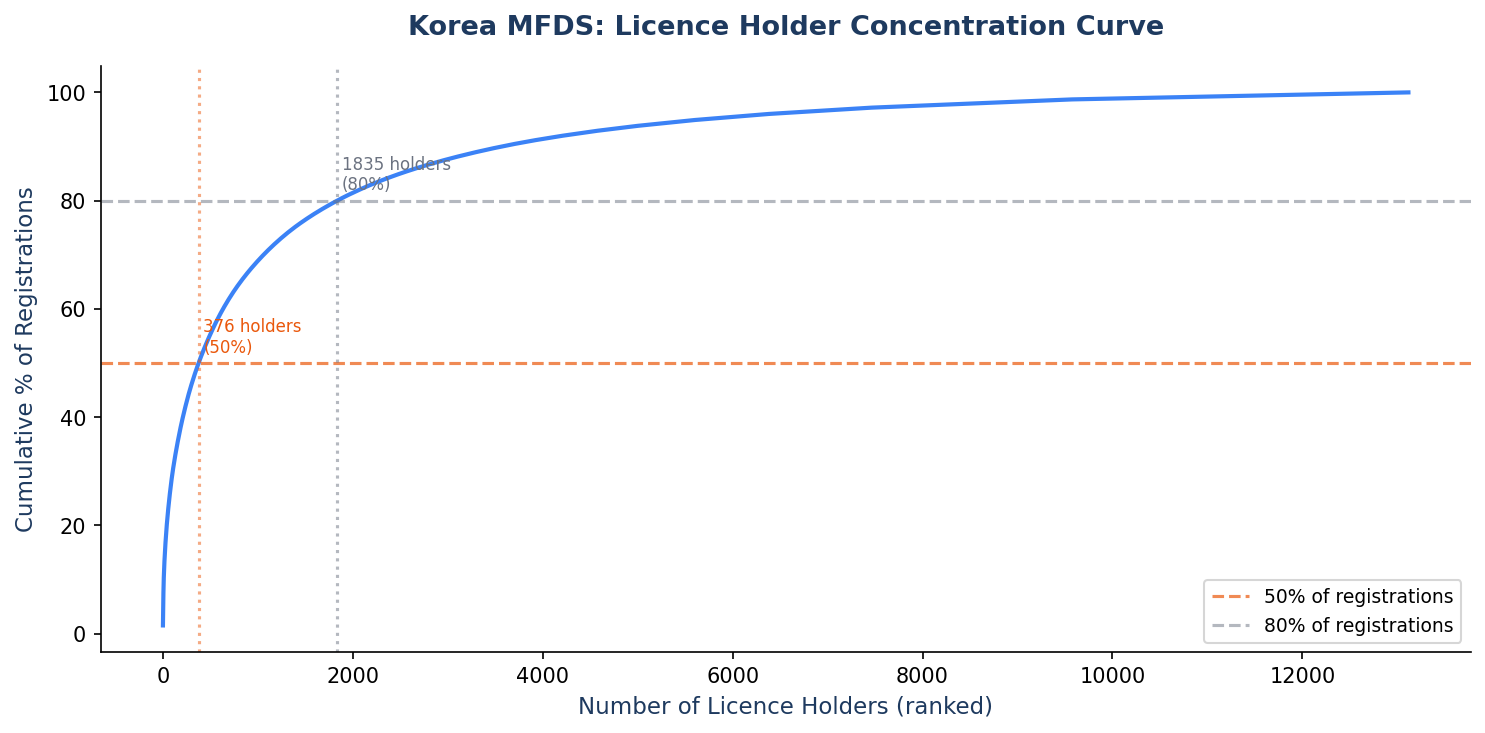
| Concentration Metric | Holders | Share of All Registrations |
|---|---|---|
| Top 5 | 5 | 6.5% |
| Top 10 | 10 | 10.4% |
| Top 20 | 20 | 14.4% |
| Top 50 | 50 | 21.8% |
| Long tail (<10 registrations each) | 9,468 | — |
The concentration curve shows that:
~700 licence holders control 50% of all registrations
~2,500 licence holders control 80%
The remaining ~10,600 holders share the bottom 20%
This is a moderately fragmented market. Unlike Australia (where 200 sponsors control 50% of ARTG entries) or the EU notified body market (where a handful of bodies hold most certifications), Korea's KLH landscape is spread across thousands of entities, many of which are small domestic distributors or manufacturers with limited portfolios.
Top 20 Licence Holders by Total Registrations
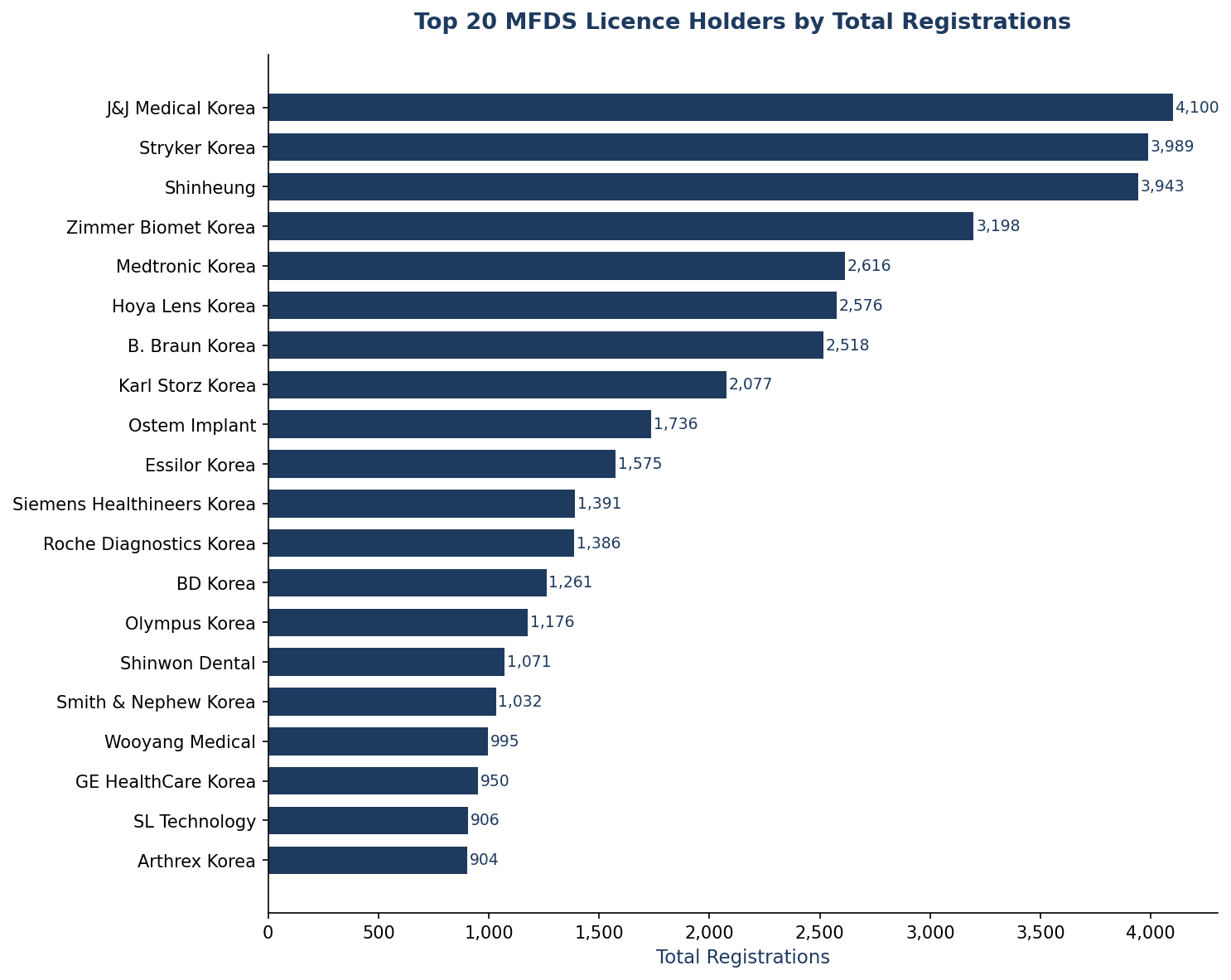
| Rank | Licence Holder | Total Registrations | Unique Items |
|---|---|---|---|
| 1 | J&J Medical Korea | 4,100 | 403 |
| 2 | Stryker Korea | 3,989 | 366 |
| 3 | Shinheung | 3,943 | 478 |
| 4 | Zimmer Biomet Korea | 3,198 | 239 |
| 5 | Medtronic Korea | 2,616 | 512 |
| 6 | Hoya Lens Korea | 2,576 | — |
| 7 | B. Braun Korea | 2,518 | 404 |
| 8 | Karl Storz Korea | 2,077 | 253 |
| 9 | Ostem Implant | 1,736 | 301 |
| 10 | Essilor Korea | 1,575 | — |
Shinheung (rank 3) is a notable domestic Korean manufacturer and distributor with 3,943 registrations spanning both manufacturing and import activities — one of the few large domestic licence holders that is not a multinational subsidiary.
Medtronic Korea leads by unique items (512 distinct registered products), even though it ranks 5th by total registrations. This suggests Medtronic's portfolio is more diverse but has fewer variant/model registrations per product compared to J&J or Stryker.
Practical Implications
For Foreign Manufacturers Entering Korea
KLH selection is a strategic decision: Unlike the EU authorised representative model (where EC Reps are often interchangeable regulatory agents), Korea's KLH structure means the licence holder actually holds the registration. Changing KLH requires a formal transfer process. Choose a partner with financial stability, regulatory competence, and long-term commitment.
Subsidiary vs. independent KLH: The data shows that most large foreign manufacturers establish Korean subsidiaries as their KLH (J&J Medical Korea, Medtronic Korea, etc.). Smaller manufacturers typically use independent Korean distributors or regulatory service providers. The choice affects control over regulatory decisions, import logistics, and pricing.
Class IV domestic lean: Of the 6,046 active Class IV items, 4,006 (66.2%) are domestically manufactured and 1,856 are imported (1,773 via standard import + 83 IVD import). While domestic manufacturing still dominates the highest-risk tier, the import share (30.7%) is not negligible — it reflects established import channels for implantable and life-sustaining devices through the major multinational subsidiaries listed above. Manufacturers of Class IV devices should factor in the KGMP certification requirement and the longer MFDS review timeline when planning Korea market entry.
MFDS Notice 2026-6 impact: Korea's MFDS issued Notice 2026-6, comprehensively revising the Regulation on Medical Device Approval, Notification, and Review (effective 26 January 2026). Combined with updated Medical Device GMP Regulations (February 2026), these changes strengthen regulatory expectations across the device lifecycle. Manufacturers entering Korea should ensure their technical documentation and quality management systems align with the new requirements.
For Market Intelligence Teams
The top 15 import holders account for the vast majority of Class III/IV import volume. Any competitive analysis of the Korean high-risk device market should start with these entities.
US-based manufacturers dominate imports (30.4%), but Chinese manufacturers are notably underrepresented in high-risk categories — only 9 Class III/IV import items from China. This may change as more Chinese manufacturers obtain KGMP certification.
Domestic Korean manufacturers (Ostem Implant, Shinheung, etc.) hold significant registration volumes, indicating a strong local manufacturing base — particularly in dental and general medical devices.
Method Notes
All figures are computed from MFDS device and licence holder extracts dated 5 June 2026.
"Active" items are those with
ITEM_STATE = '정상'(normal/active status).Import source countries are derived from the
MNCLT_NTN_CD_NMfield (country of medical content origin). 47.2% of Class III/IV imports have this field empty.Licence holder data aggregates the
row_countfield from the holder summary file. Each holder entry may span multiple industry types (e.g., both manufacturing and import).Classifications follow Korea's Medical Device Act risk classification (Classes I–IV).
Sources
MFDS (Ministry of Food and Drug Safety, South Korea) medical device registration database. Public data extract, 5 June 2026.
MFDS licence holder summary data. Public extract, 5 June 2026.
MFDS Notice 2026-6: Revised Regulation on Medical Device Approval, Notification, and Review (effective 26 January 2026).
MFDS Medical Device GMP Regulations (updated February 2026).
MedDeviceGuide analysis of MFDS public extracts, run date 6 June 2026.