
KIMES 2026: 977 Exhibitors, 78% Korean, Surgical Leads — Korea Export Push
KIMES 2026 exhibitor analysis: 977 companies, 78% Korean, surgical devices lead at 259 exhibitors, 94% export-ready. China tops international pavilion with 81 companies.

Executive Summary
The Korea International Medical & Hospital Equipment Show (KIMES) is the largest medical device exhibition in South Korea, held annually at COEX in Seoul. KIMES 2026 (19-22 March 2026) hosted 977 exhibiting companies across 41,952 m² of exhibition space, attracting 72,507 visitors from 39 countries. It is both the primary domestic showcase for Korea's medical device industry and the gateway for international companies seeking Korean distribution partners.
Our analysis of the KIMES 2026 exhibitor database (977 companies with detailed profiles) reveals that 78.1% of exhibitors are Korean domestic companies, with surgical devices (259 exhibitors), hospital supplies/consumables (206), and rehabilitation/physical therapy (191) as the top three product categories. Perhaps most striking for export watchers: 94.1% of Korean exhibitors maintain English-language company descriptions, signaling strong export orientation. China led the international contingent with 81 exhibitors (37.9% of all international companies).
This article maps the exhibitor landscape, quantifies the domestic vs. international split, and identifies what the category distribution reveals about Korea's medtech export positioning.
Data Source and Method
Source: KIMES 2026 official exhibitor directory, scraped and enriched from exhibitor detail pages
Analysis sample: KIMES 2026 exhibitor directory extract dated 5 June 2026 (977 exhibitor rows with detail profiles)
Official event statistics: 1,447 exhibiting companies (official KIMES figure includes co-exhibitors and sub-brands); 977 in our dataset represent primary exhibitors with fetched detail pages
Analysis date: 6 June 2026
Computed using: MedDeviceGuide analysis of the KIMES exhibitor directory extract
Key fields: Company names (English/Korean), booth data, product categories (JSON-encoded), addresses, English descriptions
Limitations: The dataset covers 977 out of ~1,447 official exhibitors (67.5%). Companies without detail page data or with incomplete profiles may be underrepresented. Category assignments are self-reported by exhibitors.
Domestic vs. International Split
| Origin | Exhibitors | Share |
|---|---|---|
| South Korea (domestic) | 763 | 78.1% |
| International | 214 | 21.9% |
| Total | 977 | 100% |
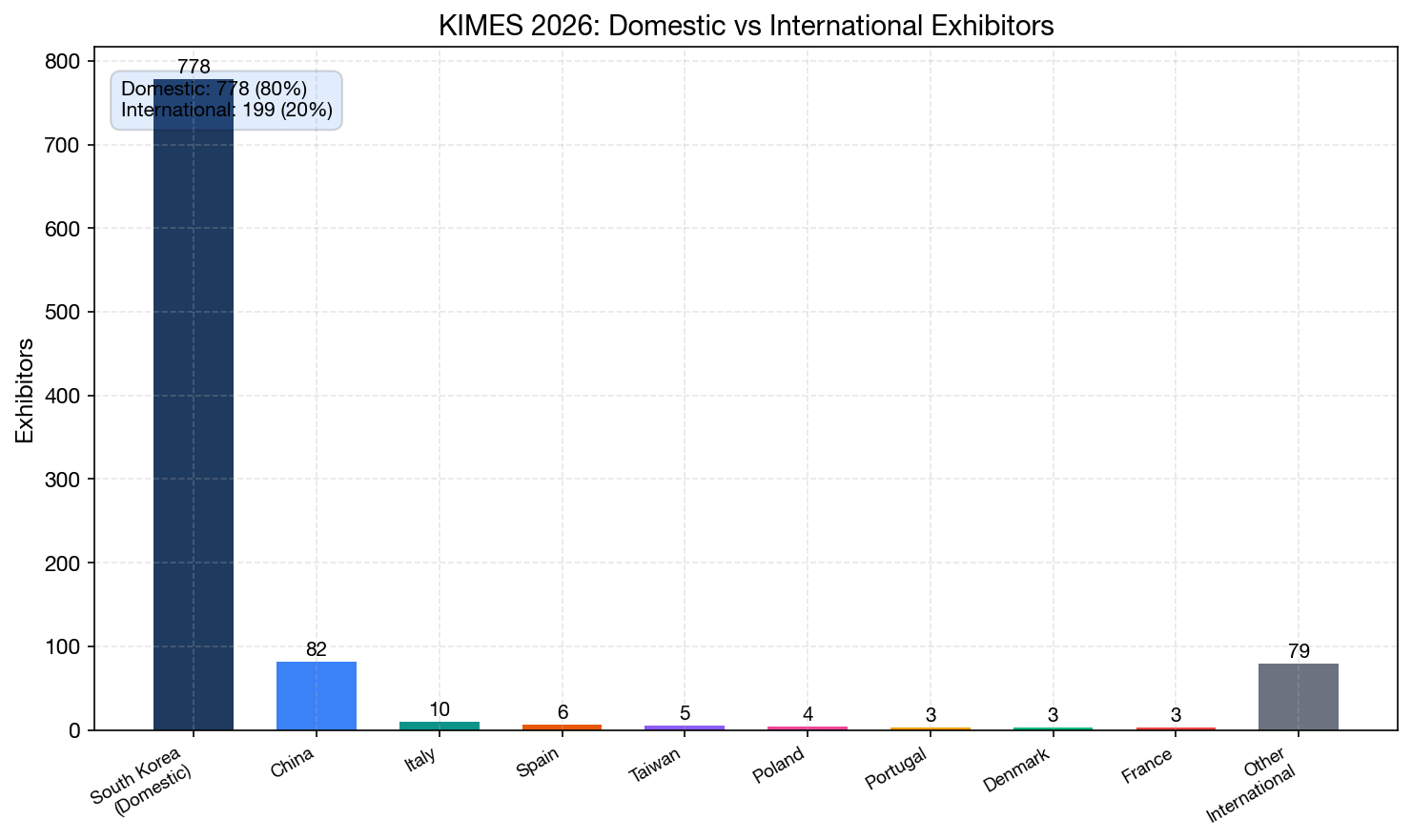
Among international exhibitors, the top countries of origin:
| Country | Exhibitors | % of International |
|---|---|---|
| China (combined) | 81 | 37.9% |
| Italy | 10 | 4.7% |
| Spain | 6 | 2.8% |
| Poland | 4 | 1.9% |
| Denmark | 3 | 1.4% |
| Portugal | 3 | 1.4% |
| France | 3 | 1.4% |
| Taiwan | 2 | 0.9% |
China's dominance of the international pavilion (81 exhibitors, 37.9%) is notable and reflects China's aggressive push into the Korean medical device market. With the Korea-China Free Trade Agreement reducing tariffs on many medical device categories, Chinese manufacturers — particularly in consumables, imaging, and rehabilitation equipment — are targeting Korea's growing device market directly.
Product Category Distribution
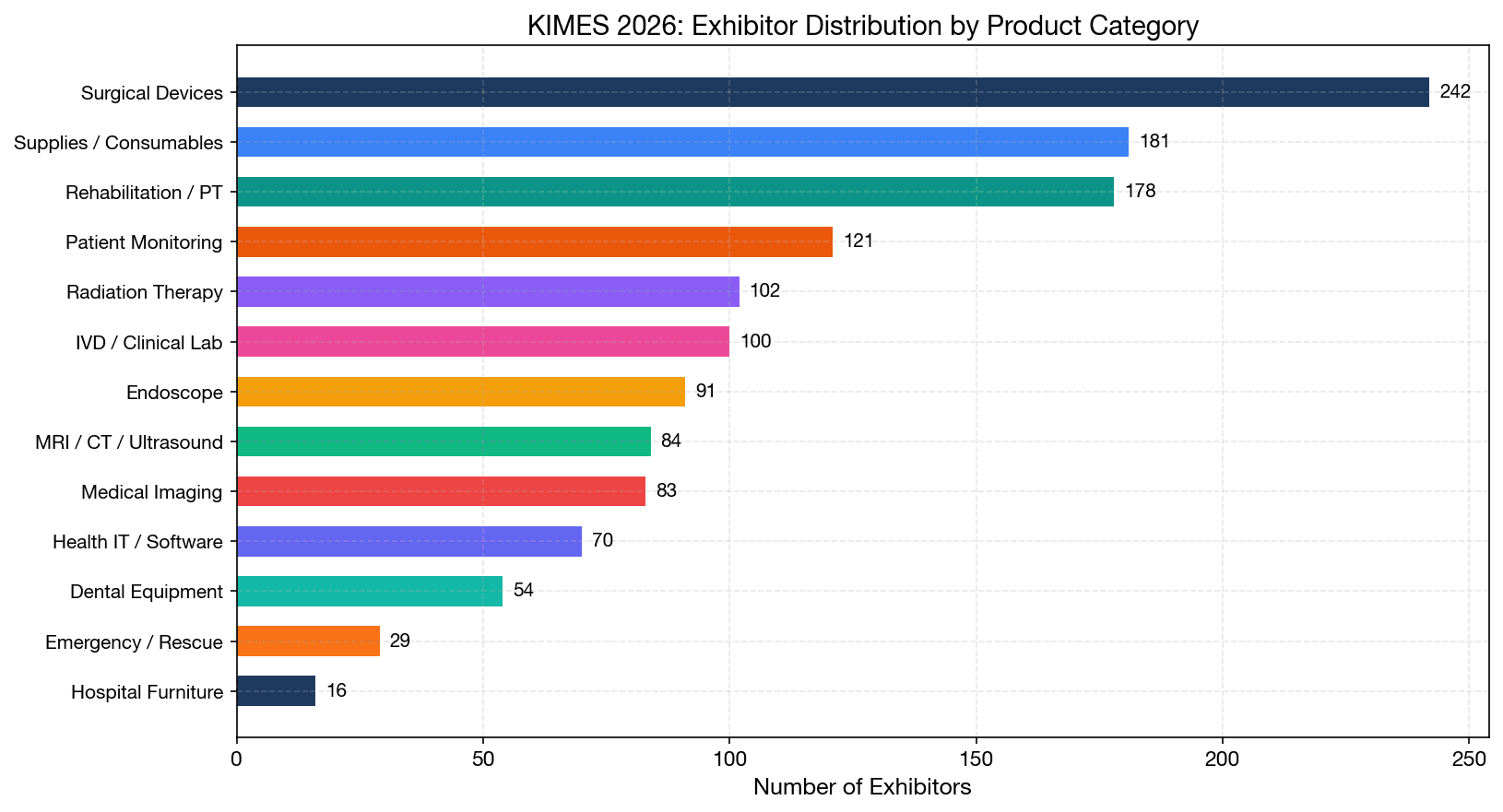
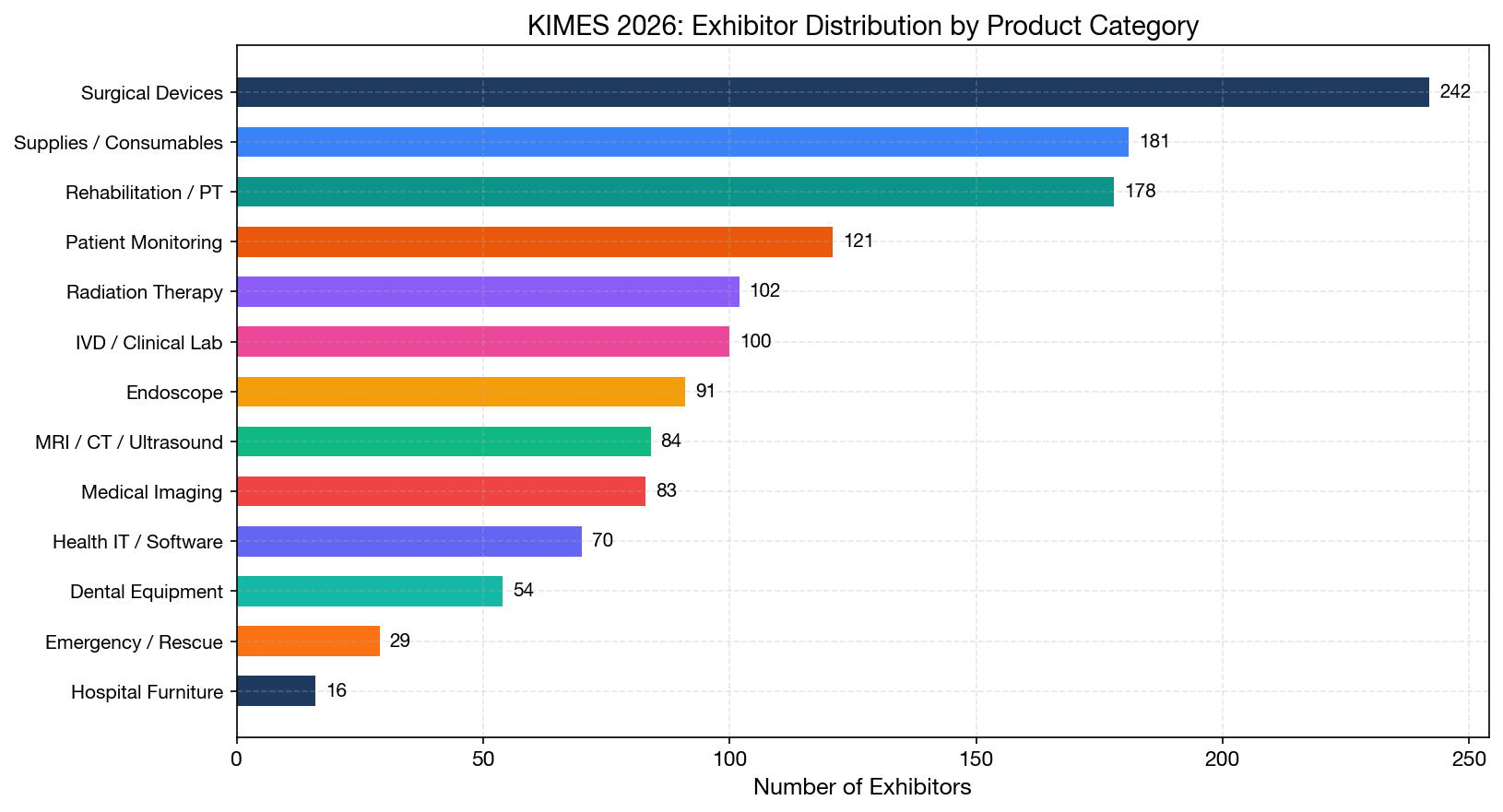
KIMES uses a structured 13-category system for exhibitor self-classification. Exhibitors may select multiple categories, so totals exceed 977:
| Category | Exhibitors | Share |
|---|---|---|
| Surgical Instruments / Devices | 259 | 26.5% |
| Hospital Supplies / Consumables | 206 | 21.1% |
| Rehabilitation / Physical Therapy | 191 | 19.5% |
| Patient Monitoring / Vital Signs | 135 | 13.8% |
| Radiation Therapy / Nuclear Medicine | 120 | 12.3% |
| Medical Imaging / Radiology | 113 | 11.6% |
| IVD / Clinical Lab | 111 | 11.4% |
| Endoscope | 105 | 10.7% |
| MRI / CT / Ultrasound | 103 | 10.5% |
| Health IT / Software | 79 | 8.1% |
| Dental Equipment / Supplies | 69 | 7.1% |
| Emergency / Rescue | 37 | 3.8% |
| Hospital Furniture / Facility | 16 | 1.6% |
Key Observations
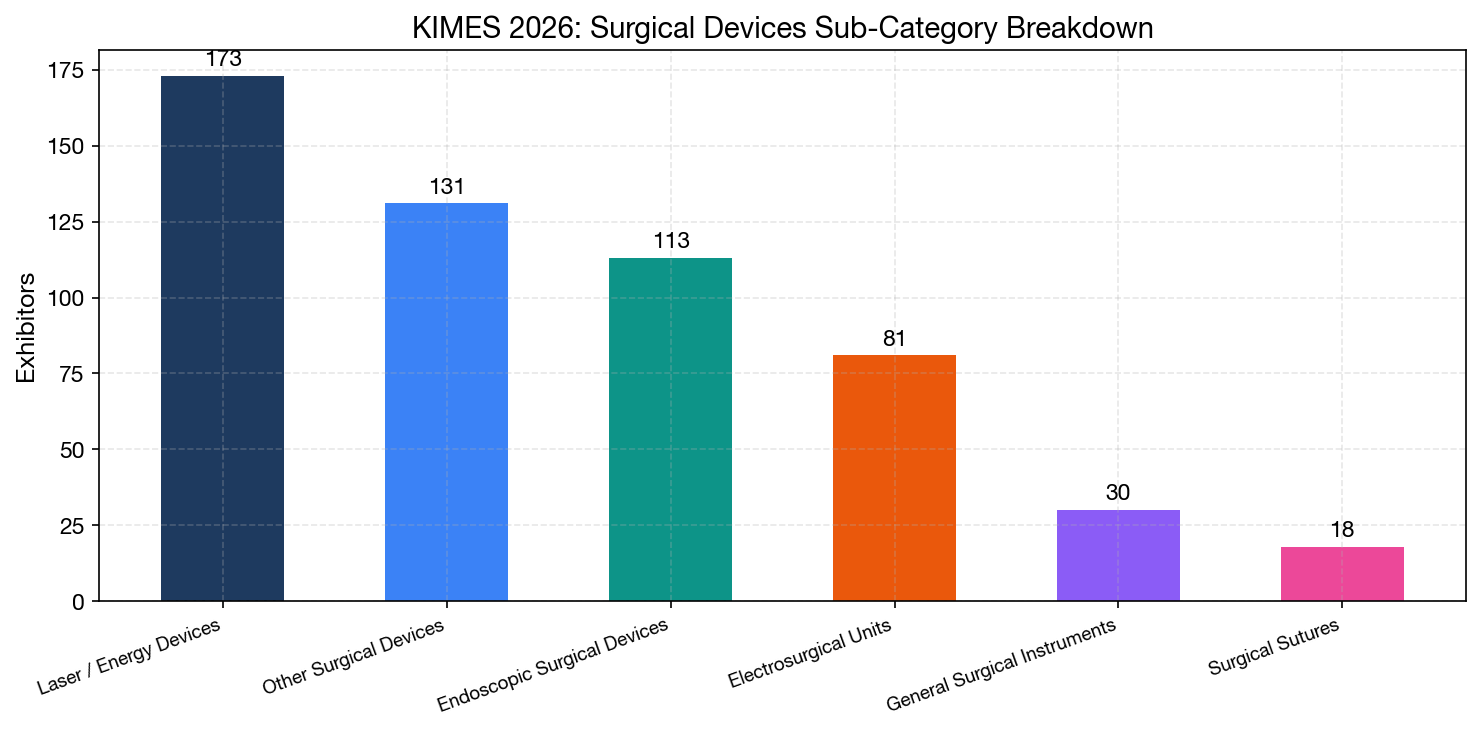
Surgical devices lead at 259 exhibitors — the single largest category. Korea has a strong domestic surgical device industry, particularly in energy-based devices (lasers, RF), electrosurgical units, and endoscopic surgical instruments. The sub-category breakdown shows:
Laser/Energy Devices: 173 exhibitors
Endoscopic Surgical Devices: 113 exhibitors
Electrosurgical Units: 81 exhibitors
General Surgical Instruments: 30 exhibitors
Rehabilitation/Physical Therapy at 191 exhibitors is the third-largest category, reflecting Korea's aging population and the government's investment in rehabilitation medicine. Sub-categories include physical therapy equipment (46), general rehabilitation (78), and emerging categories like AI-based gait analysis and robotic rehabilitation.
Health IT at only 79 exhibitors may underrepresent Korea's actual digital health strength — many Korean Health IT companies exhibit at the separate K-Hospital + Health Tech Fair (KHF) held in August. However, the presence of companies like UBcare (Korea's #1 EMR provider by market share) signals the convergence of medical devices with digital platforms.
International Exhibitor Focus Areas
International exhibitors concentrated in different categories than domestic companies:
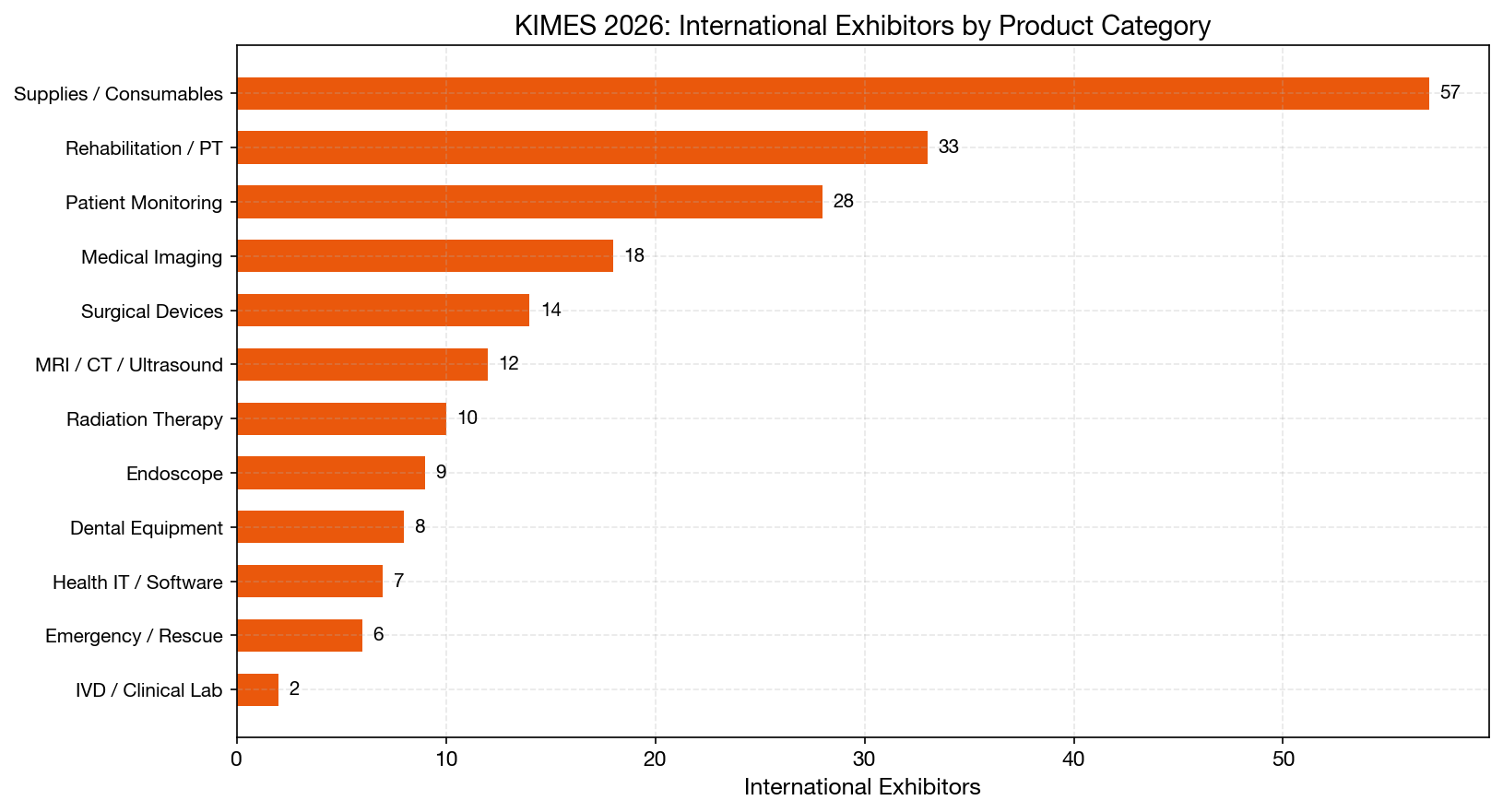
International exhibitors skewed toward hospital supplies/consumables, imaging, and rehabilitation equipment — categories where China has strong manufacturing cost advantages. Domestic Korean companies dominated the surgical devices and radiation therapy categories, where Korea has established export strength through companies like Lutronic, Jeisys Medical, and Stryker Korea.
Booth Size as a Proxy for Market Presence
Booth size (measured in booth units) provides a proxy for company scale and investment in the Korean market:
| Booth Size | Exhibitors | Share |
|---|---|---|
| 1-6 units (Micro/Small) | 507 | 89.9% |
| 7-12 units (Medium) | 37 | 6.6% |
| 13-24 units (Large) | 17 | 3.0% |
| 25+ units (Enterprise) | 3 | 0.5% |
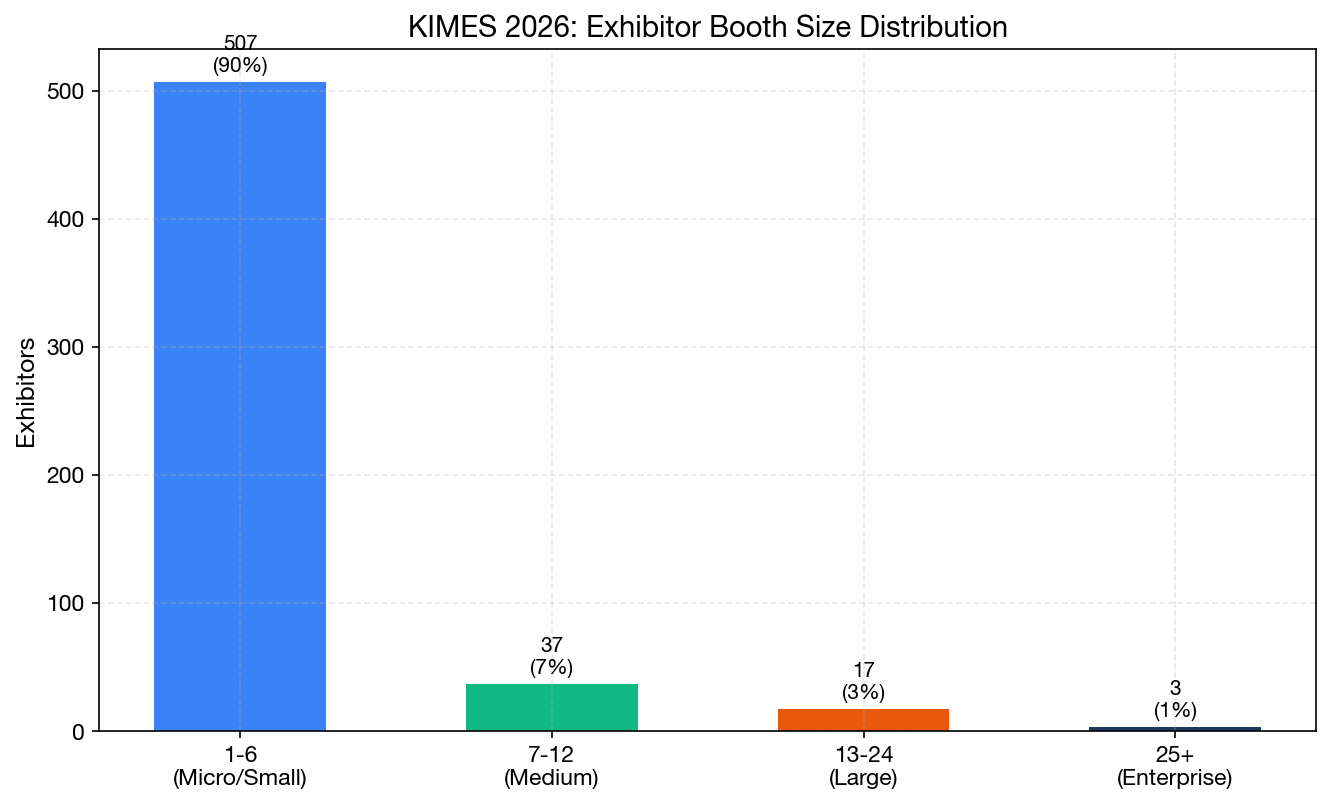
The overwhelming prevalence of small booths (89.9%) reflects KIMES's role as a platform for mid-size and emerging companies. The three enterprise-scale exhibitors (25+ units) are likely major Korean conglomerates or multinational subsidiaries with comprehensive product lines.
Export Readiness: English Descriptions
A strong indicator of export orientation is whether Korean exhibitors maintain English-language company descriptions on their KIMES profiles:
| Category | Count | Share of Korean Exhibitors |
|---|---|---|
| Korean exhibitors with English description | 716 | 94.1% |
| Korean exhibitors without English description | 45 | 5.9% |
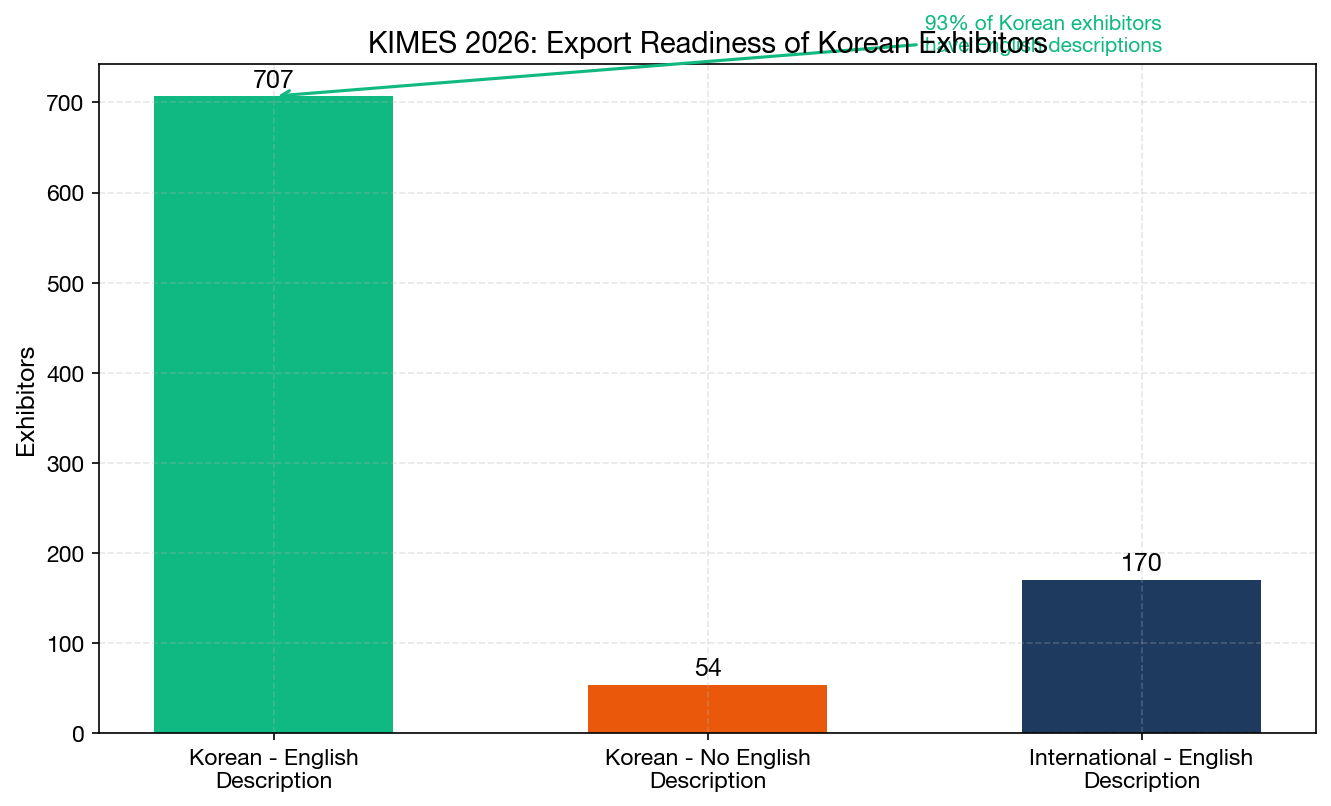
This 94.1% English-readiness rate is remarkably high and signals that KIMES exhibitors are not just targeting the domestic market — they are actively positioning for international partnerships, distribution agreements, and regulatory approvals abroad. This aligns with Korea's broader medtech export growth: Korean medical device exports have grown steadily in recent years, with the US, EU, and ASEAN as primary destinations.
Korea's Medtech Export Positioning
The KIMES 2026 exhibitor data reveals several patterns about Korea's medical device industry and its export trajectory:
1. Surgical Aesthetics and Energy Devices: Korea's Export Sweet Spot
With 173 exhibitors in laser/energy devices, Korea has built a globally competitive cluster in aesthetic and surgical energy devices. Companies like Jeisys Medical (exporting to 70+ countries), Tentech (medial aesthetics), and Classys have made Korea the world's second-largest exporter of aesthetic medical devices after the US.
2. Rehabilitation and Aging: A Growing Domestic and Export Category
Korea's 191 rehabilitation exhibitors reflect both domestic demand (Korea became a "super-aged" society in 2024, with over 20% of the population aged 65+) and growing export capability in robotic rehabilitation, AI-based gait analysis, and physical therapy equipment.
3. IVD and Diagnostics: Competitive but Fragmented
The 111 IVD exhibitors represent a fragmented landscape — many are small to mid-size Korean companies competing in clinical chemistry, immunoassay, and point-of-care testing. This fragmentation creates opportunities for consolidation and for international distribution partnerships.
4. China as Both Competitor and Customer
China's 81 exhibitors at KIMES reflect a dual dynamic: Chinese companies are simultaneously competing with Korean manufacturers in third markets (particularly ASEAN, Middle East, and Latin America) and seeking Korean distribution partnerships. For Korean companies, this means KIMES is not just a sales venue but a competitive intelligence opportunity.
5. Digital Health Convergence
While Health IT had only 79 exhibitors, the presence of AI-based diagnostic companies, connected device platforms, and EMR providers at KIMES signals the ongoing convergence of medical devices and digital health — a trend supported by Korea's Digital Medical Products Act (DMPA), which came into effect in 2025.
Implications for International Companies
For Companies Entering Korea
KIMES is the essential partner-finding event. With 763 Korean domestic exhibitors, it offers direct access to potential distributors, import license holders, and co-development partners.
Korean distributors expect export-grade documentation. The 94% English-readiness rate means Korean companies are experienced in international regulatory requirements.
Plan 6-12 months ahead for MFDS registration. Korea's Ministry of Food and Drug Safety (MFDS) requires foreign manufacturers to appoint a Korean import license holder and complete device registration before market entry.
For Companies Monitoring Korean Competition
Track the surgical devices category for emerging Korean competitors in your therapeutic area.
Watch the rehabilitation category for Korean companies targeting the aging population opportunity in your markets.
Use KIMES exhibitor data as a leading indicator of which Korean companies are preparing for international expansion.
Method Notes
Exhibitor count: 977 companies with fetched detail profiles. The official KIMES figure of 1,447 includes co-exhibitors and brands sharing booth space.
Category data was parsed from the
detail.onlineDisplayCategoryListJSON field. Exhibitors selecting multiple categories were counted once per category.Domestic vs. international classification used the English address field (
detail.onlineInfo.onlineInfo.addrDefaultEng), checking for "Korea" in the address. Companies without an English address were default-classified as Korean (appropriate for KIMES's primarily domestic exhibitor base).English-readiness was measured by presence of a non-empty
detail.onlineInfo.introduceInfo.descEngfield with length > 20 characters.China exhibitor count combines entries with addresses containing "China", "P.R. China", "Shenzhen", "Hebei", "Zhejiang", or "Hunan".
Data source: KIMES 2026 exhibitor directory, source organizer Korea E&EX / KMDIA; analysis by MedDeviceGuide, run date 2026-06-06. Official event statistics from kimes.kr.