
IVD Specimen Stability: Matching the Claim to Collection and Transport
Support IVD specimen stability claims under 21 CFR 809.10 and EU IVDR Annex II by aligning labeled collection, additives, hold times, and transport with verified study configurations.

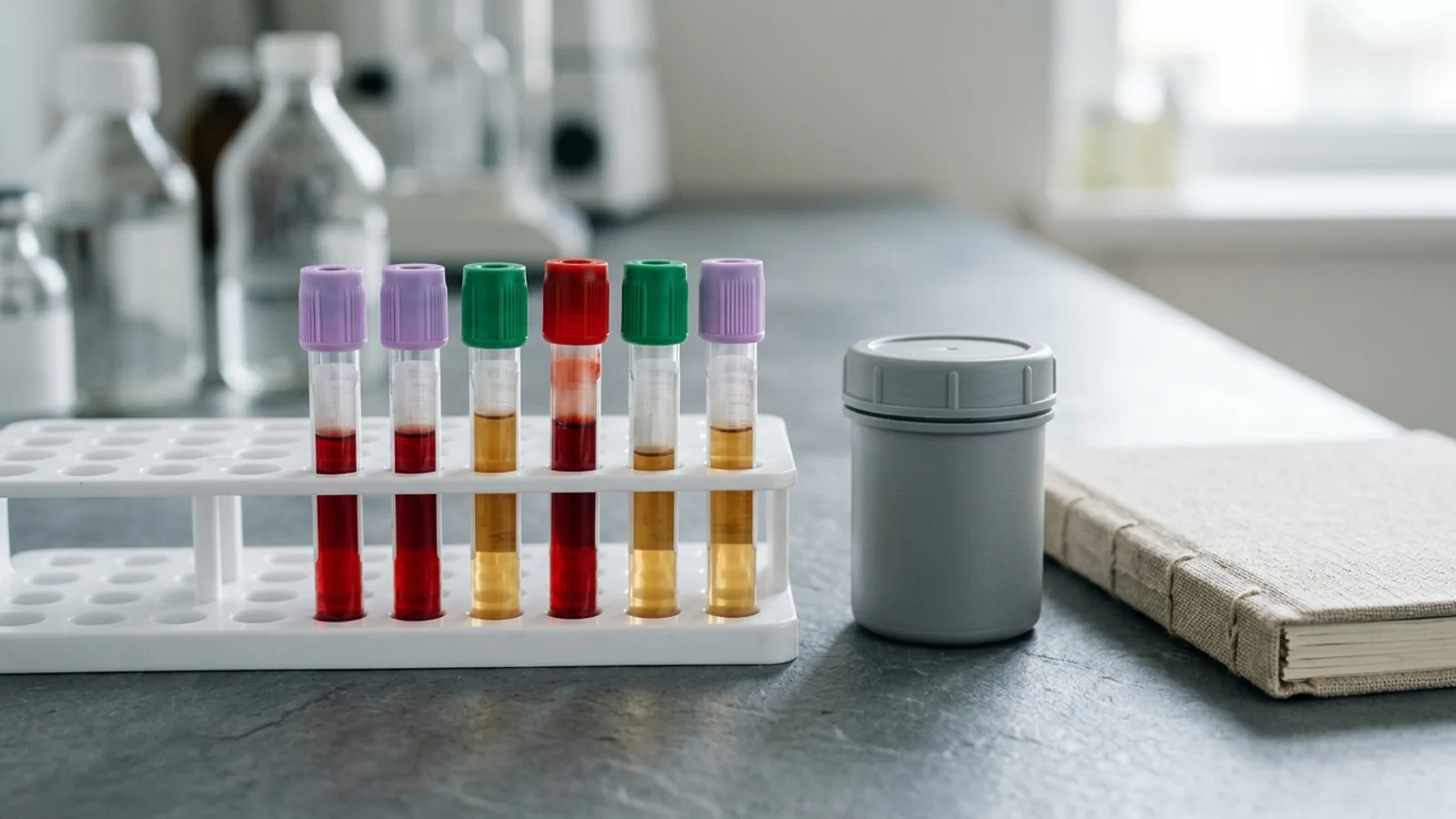
Match One Labeled Sentence to One Study Row
Suppose an in vitro diagnostic (IVD) package insert says: collect whole blood in a named tube, centrifuge within a stated time at a stated force, and store the separated plasma for a stated number of hours at 2°C to 8°C or for a stated number of days frozen. That sentence is an illustration of how to read an instruction, not a recommended protocol and not the labeling in any particular clearance. Each word that names a matrix, receptacle, additive, processing step, duration, or temperature is a configuration the study has to have run if the instruction is going to say it.
The reader is a manufacturer or regulatory team supporting that labeled claim. Write the instruction from the study row, one configuration at a time. A laboratory follows the finished instructions for use when it handles a patient specimen.
Three operational clocks are easy to collapse into one stability section. They answer different questions and belong in different parts of the file.
Patient-specimen storage and transport. This interval starts at collection and runs through handling, transit, separation, and storage before the specimen is introduced into the assay. In the United States, 21 CFR 809.10(b)(7) requires the labeling to state special collection precautions, the additives or preservatives needed to maintain specimen integrity, known interfering substances, and recommended storage, handling, or shipping instructions for specimen stability. In the European Union, IVDR Annex II section 6.1.1 requires a description of the specimen types that can be analysed, including their stability.
Reagent and device stability. This interval tracks the kit: unopened shelf life, stability after first opening or while on board an instrument, and shipping conditions that protect the product. IVDR Annex II section 6.3 is titled stability excluding specimen stability. Separate paragraphs of 21 CFR 809.10 require storage instructions for the reagent product and point to test methods such as 21 CFR 211.166. CLSI EP25 and ISO 23640 are voluntary standards used inside that product-stability scope. They do not measure how long the patient's specimen remains fit for the assay.
Post-reaction read window. 21 CFR 809.10(b)(8)(iv) requires a statement of the stability of the final reaction material and the time within which it must be measured. That clock starts after the analytical reaction. It is not the hold time between collection and testing.
Using a reagent-stability guideline, or a collection-tube monograph, as the evidence for the patient's specimen hold time puts the wrong object in the specimen file. The workable record is a direct match between the words in the instructions for use and the configuration the study actually ran: the same matrix, receptacle, additive, processing sequence, duration, and temperature.
What the US and EU Files Must Contain
The United States and the European Union both expect the labeled specimen conditions to be described and supported. They organize that evidence differently. Neither text publishes a universal bias limit, a universal donor count, or a universal two-hour separation rule.
United States labeling under 21 CFR 809.10
21 CFR 809.10(b)(7) requires specimen collection and preparation information. The paragraph has four elements, and the insert states those that apply to the test system:
Special collection precautions. Special precautions regarding specimen collection, including special preparation of the patient as it bears on the validity of the test. The paragraph does not require the insert to recite order of draw, venipuncture technique, or personal protective equipment.
Additives and preservatives. Additives, preservatives, or similar materials necessary to maintain the integrity of the specimen. A named anticoagulant, clot activator, or stabilization medium is this kind of claim.
Known interfering substances. Substances known to interfere with the test. Hemolysis, icterus, lipemia, a drug, or material from a stopper or gel belongs here only when that interference was evaluated for the assay, not as a standing list copied from a general text.
Storage, handling, and shipping. Recommended storage, handling, or shipping instructions for the protection and maintenance of stability of the specimen. The regulation requires the instructions. It does not prescribe which temperature bands, freeze-thaw counts, or shipper types every assay must claim.
21 CFR 809.10(b)(8)(ii) requires a list of materials required but not provided, with sizes, numbers, types, and quality. When the kit does not include the collection tube, that tube is the usual entry. The paragraph does not itself name a centrifuge model or a pipette brand.
Product storage is a different paragraph. 21 CFR 809.10(a)(5), for the immediate container of a reagent, and 21 CFR 809.10(b)(5)(iv), in the accompanying labeling for a reagent, require storage instructions adequate to protect the stability of the product. Where manipulation such as reconstitution is required, storage of the reconstituted product is included. The basis for those instructions is determined by reliable test methods such as those described in 21 CFR 211.166. Those sentences are about the reagent, not the patient specimen.
On 24 September 2024, a Center for Devices and Radiological Health webinar on IVD labeling said that 809.10(b)(7) is intended to ensure specimens are collected and prepared under conditions validated as suitable for that test system. The slides use named conditions. One example is formalin-fixed paraffin-embedded tissue, with warnings that other fixatives should not be used and that specimens should not be decalcified. Another, for an AAV5 total-antibody companion diagnostic, is whole blood collected in a 3.2 percent sodium citrate tube, frozen at −10°C or below, and shipped on dry ice. Those tube names and temperatures belong to the labeling illustrated on the slides. Another assay uses the same words only when its own study ran that configuration. The webinar is an educational transcript, not a regulation or a special control, and it does not publish a percent difference.
European Union technical documentation under the IVDR
Regulation (EU) 2017/746 places specimen handling inside analytical performance and then splits specimen stability from device stability in the technical documentation.
Annex I section 9.1(a). Analytical performance includes determination of appropriate criteria for specimen collection and handling, together with control of known relevant interference. That is a performance requirement, not a statistical protocol.
Annex II section 6.1.1. The technical documentation describes the specimen types that can be analysed, including their stability, such as storage, applicable specimen transport conditions and, for time-critical methods, the timeframe between taking the specimen and its analysis, and storage conditions such as duration, temperature limits, and freeze/thaw cycles.
Annex II section 6.3. The heading is stability excluding specimen stability. It covers claimed shelf life, in-use stability, and shipping stability of the device. Shelf-life testing uses at least three different lots manufactured under conditions essentially equivalent to routine production. Those lots need not be consecutive. Accelerated studies or data extrapolated from real time may support an initial shelf-life claim, and real-time studies follow. In-use stability, which may include open-vial or on-board stability, is studied on one lot reflecting routine use. Shipping stability is studied on one lot, under real or simulated conditions, including extremes such as heat and cold. The shipping conclusion is a recommended shipping condition for the device. It is not the patient's specimen hold time.
The three-lot rule and the permission to start from accelerated or extrapolated data live in section 6.3.1, the device shelf-life section. They are not a method for extending a specimen hold time past the last time point the specimen study tested. Section 6.1.1 still has to describe the specimen conditions the user is told to use.
MDCG 2022-2, issued in January 2022, says the manufacturer should verify every specimen type and sampling condition indicated in the intended purpose, including applicable collection devices and the indicated storage and transport conditions. The analytical performance report should give the timeframe from collection through storage to analysis, including duration, temperature limits, and the recommended number of freeze/thaw cycles, especially for time-critical methods. The same guidance says the indicators in Annex I section 9.1 and Annex II section 6.1 are weighted case by case, and that omissions are outlined and justified. A specimen-stability section is not a demand to run every time and temperature for every measurand when the intended purpose does not claim those conditions. The document states that it is not legally binding. The binding text remains the regulation.
Configuration, Claim, and Evidence Class
Before the instruction is locked, the file should be able to answer which of these words were in the study and which were not. Not every assay claims every row. An omitted condition that the intended purpose does not claim can be justified. A condition the instruction does name needs a row or a documented bridge.
Matrix. Whole blood, plasma, serum, urine, swab eluate, or another named specimen type.
Collection device and additive. The named tube or receptacle and its additive, such as spray-dried K2-EDTA, liquid K3-EDTA, lithium heparin, sodium heparin, buffered sodium citrate, or a clot activator.
Separator. Whether a gel or other barrier was present, and which one. A serum gel tube and a heparin gel tube are different configurations.
Fill. Nominal fill versus a short draw, where the additive-to-specimen ratio is part of the claim.
Time to processing. Elapsed time and temperature before centrifugation or other processing.
Centrifugation. Force, time, and temperature when the instruction states them.
Storage after processing. Duration and temperature band for the separated specimen, stated as the band the study used.
Transport. The shipping condition the instruction names, including temperature and coolant if those words appear.
Freeze and thaw. If the label states a freeze, a thaw, or a cycle count, that count is its own row. If the study did not cycle the specimen, the instruction does not invent a cycle count.
Acceptance rule. The pass-fail rule written in the protocol before testing, and the instrument or method used. The legal texts reviewed here require the condition to be described and supported. They do not fix one percent difference for every analyte.
The public worked example is FDA's decision summary for 510(k) K033727, the Nichols Advantage Bio-Intact PTH (1-84) immunoassay. It is a labeling-change file for one parathyroid-hormone assay. Its hours, tube names, and results belong to that file. They are not a template for other analytes.
What K033727 actually separated
The submission purpose in the summary is labeling changes and a modified indications for use. The intended use in the summary measures parathyroid hormone in serum, EDTA plasma, and heparinized plasma. The summary says the collection, preparation, and storage instructions were established from the studies and included in the labeling. Those instructions do not give every matrix one clock.
| Configuration in K033727 | What the labeling in the summary says | What that statement does not support |
|---|---|---|
| EDTA whole blood | May be stored refrigerated at 2°C to 8°C before centrifugation, with or without a gel separator, or centrifuged promptly and the plasma stored refrigerated. Testing is completed in less than 48 hours after collection. Refrigerated EDTA whole blood may be centrifuged immediately before testing or any time within 48 hours of draw, and the plasma is assayed immediately. | A pre-centrifugation hold for heparinized blood, or a 48-hour whole-blood hold for a different analyte. |
| Heparinized blood | Centrifuged promptly after collection. Separated plasma may be stored refrigerated. Testing is completed in less than 48 hours after collection. | Copying the EDTA instruction that allows whole blood to wait refrigerated before spinning. |
| Heparinized gel separation tubes | Have not been tested and are not recommended. | A conclusion that every gel tube is untested. The EDTA instruction names whole blood with or without a gel separator, and the matrix comparison included a serum separator tube. |
| Serum | Processed rapidly and frozen within 2 hours of collection. Frozen serum is thawed rapidly and tested promptly. | Using the EDTA 48-hour refrigerated whole-blood window as the serum window. |
| Frozen plasma and repeat thawing | Plasma may be frozen at −20°C or colder in a non-defrosting freezer for longer-term storage. Samples should not be subjected to multiple freeze-and-thaw cycles, preferably not more than one. Multiple frozen aliquots are preferred if repeat testing is needed. | A stated number of months, or a three-cycle or four-cycle allowance. The summary does not print a month limit for that freeze. |
| Room temperature during testing | EDTA plasma and heparin plasma may be exposed to room temperature for up to 6 hours during ordinary laboratory operations for testing. | A 6-hour room-temperature claim for whole blood, for serum, or for another assay. |
The matrix comparison is a separate experiment from those hold-time instructions. Blood was drawn from 27 adult volunteers into named Becton Dickinson Vacutainer tubes: a red-top tube with a silicone-coated interior and no additives; an SST gel separator with clot activator and a silicone-coated interior; 15 percent K3-EDTA with a silicone-coated interior; 15 percent K3-EDTA with no interior coating; and sodium heparin, 143 USP units, with no interior coating. Blood was processed in a refrigerated centrifuge, placed on ice, and serum or plasma was aliquoted and frozen at −70°C. In every case serum or plasma was frozen within 2 hours of venipuncture. At the 95 percent confidence level there was no significant difference in Bio-Intact PTH results among those tube types.
That 95 percent statement is comparability under the conditions tested, including a freeze at −70°C within 2 hours. The stability studies and the final instructions keep different clocks for EDTA whole blood, heparinized blood, and serum. The labeled long-term plasma freeze is −20°C or colder. The matrix-comparison freeze was −70°C. Those temperatures come from different parts of the same file.
The summary also describes stability studies on whole blood held refrigerated without centrifugation. Results in that file stay with this PTH assay. They are not a pass-fail percent for other tests.
graph TD
  A["Split the labeled sentence into configuration words"] --> B{"Is that tube, additive, time, and temperature in a study row?"}
  B -->|Yes| C["State only the condition that row tested"]
  B -->|No| D{"Is a documented bridge in the file?"}
  D -->|Yes| E["Limit the words to what the bridge supports"]
  D -->|No| F["Do not claim it. State the limitation"]
  C --> G["Keep reagent shelf life and the read window in their own files"]
  E --> G
F --> GStandards That Govern a Different Object
Voluntary standards are useful inside the scope printed on them. Complete FDA recognition of a reagent standard does not move patient specimens into that scope. Publication of an ISO standard is not legal adoption under the IVDR.
CLSI EP25 2nd Edition
CLSI EP25, Evaluation of Stability of In Vitro Medical Laboratory Test Reagents, provides recommendations for establishing and confirming shelf-life and in-use stability of reagent kits, calibrators, control products, and sample diluents. The second edition is dated 26 April 2023 and replaces EP25-A, published in 2009. There is no edition designated EP25-A3. Citing that label as a specimen-stability method cites a document that does not exist.
The second edition changes the reagent study, not the specimen study. The CLSI page says the edition revises power analysis so that some reagent drift is assumed, designs the test to show that drift stays within an allowable limit, and drops the custom of using a non-significant regression-slope t-test, P greater than 0.05, as a reason to pass a stability assessment. The page says that custom tends to reward an underpowered study. It also drops a requirement that a confidence interval sit inside the acceptance criteria before a claim is stated. Those are rules for reagent claims.
FDA recognition number 7-318, list 061, date of entry 18 December 2023, recognizes EP25 2nd Edition completely. The scope on the recognition sheet, and the same sentence on the CLSI page, states that the guideline does not cover instrument systems, laboratory equipment, software, or patient specimens. Products, for this guideline, mean reagents, calibrators, controls, diluents, and similar materials. If a manufacturer cites EP25, the citation belongs with the device-stability evidence for shelf life and in-use life. It is not the method for the patient-specimen claim in 809.10(b)(7) or Annex II section 6.1.1, and recognition is not IVDR harmonisation.
ISO 23640:2011
ISO 23640:2011 applies to reagents, calibrators, control materials, diluents, buffers, and reagent kits. It can also be applied to specimen collection devices that contain substances used to preserve samples or to initiate reactions in the collection device. That second use is a stability evaluation of the collection device, for example whether the preservative product still meets its own specifications. It does not, by itself, establish how long a named analyte in a patient's specimen remains acceptable for a particular assay.
The public scope covers four uses: reagent shelf life, including transport conditions that keep product specifications; in-use stability after the first opening of the primary container; monitoring of reagents already on the market; and verification after modifications that might affect reagent stability. On 26 September 2026 the ISO page showed ISO/DIS 23640 as the draft that will replace the 2011 edition. This article does not describe the draft's contents. Publication of the 2011 standard, and the existence of a draft revision, are not adoption under IVDR Article 8. Whether an EN edition is cited in the current Official Journal list of IVDR harmonised standards has to be read from that list. This article does not make that determination.
CLSI PRE04
CLSI PRE04, Handling, Transport, Processing, and Storage of Blood Specimens for Routine Laboratory Examinations, is a first edition dated 3 August 2023. It replaces GP44-A4, published in 2010. The scope is handling, transport, processing, and storage of whole blood, serum, or plasma for routine laboratory examinations, so that users can judge specimen integrity. The change summary says suitability criteria should consider each measurand, and that a condition unsuitable for one measurand may remain acceptable for another. Detailed measurand information stays in other CLSI documents.
PRE04 is a laboratory practice guideline. The public page does not present it as the manufacturer's legal method for an assay claim. A short general hold time copied from an older blood-handling guide is the wrong reading of the current edition. It can suggest questions the assay protocol should ask. It supports the assay sentence only when the assay file tests that configuration or documents a bridge to it.
Vendor Tables, Transport Devices, and Kit-Stability Panels
Three common substitutes describe a different object from the assay's specimen sentence. Each can be useful in its own file. None of them automatically supports the hold time printed for the assay.
The collection tube's own file
MDCG 2024-11, October 2024, explains that a specimen receptacle is an IVD when its manufacturer intends it for primary containment and preservation of a human specimen for in vitro examination. Blood collection tubes and urine or stool containers are the guidance's examples. Article 2(2) and Article 2(3) are the definitional hooks. When more than one receptacle is used across collection, transport, and storage, each receptacle manufacturer needs its own IVDR evidence. The guidance states that it is not legally binding.
A tube vendor's analyte table, clearance, or CE marking is evidence for that tube. It can suggest which configurations are worth studying. It does not transfer to the assay manufacturer's measurand, time, or temperature. The assay file still has to test that configuration or document a bridge to it. K033727 shows the labeling consequence when the bridge is absent: the untested heparinized gel tube is named and not recommended.
Kit-stability panels that use specimens as inputs
WHO Technical Guidance Series TGS-2 (2018) is about establishing stability of the IVD for WHO prequalification. Section 5.6 says that if serum, plasma, whole blood, saliva, or other types are claimed in the instructions, the stability plan must be designed so the IVD meets claims such as sensitivity, specificity, the proportion of valid runs, and precision for each claimed specimen type across the claimed shelf life, including transport to users, unless an alternative approach is justified with a documented rationale. Section 5.7 says the panel members themselves must be stable. The specimen is a controlled input. The question being answered is whether the kit still performs. The sections do not set how long a fresh clinical specimen may wait before testing.
CDSCO guidance CDSCO/IVD/GD/Stability/02/2022, section 4.6, uses the same panel logic for Indian IVD product-stability studies: specimens in the panel reflect the performance claims, and claimed types such as serum, plasma, whole blood, and saliva are included so the IVD's claims hold for each type. That guidance is not an FDA or IVDR requirement, and section 4.6 is not the assay's patient-specimen storage claim. TGS-2 is not EU or US law either. Both documents tell the reader to keep the panel members stable so that a change in signal can be attributed to the device. They do not establish the patient's hold time.
A framework that is still a project
On 26 September 2026, the Medical Device Innovation Consortium specimen-stability page said the project will develop a best-practices framework for short-term specimen stability recommendations, using the 2023 CLSI EP25-Ed2 reagent guideline as a model. The recommendations are described as addressing study design, specimen types, storage conditions, durations, and data analysis. The working-group list on that date names Abbott, Fujirebio, NowDx, Roche, Thermo Fisher, and FDA. The page does not publish the framework, a decision table, or acceptance criteria. Modeling EP25 is not adoption of EP25 for patient specimens, and a working-group roster is not a recognized method. A submission cannot cite the unfinished project as the study design.
When the Tube, Time, or Temperature Changes
After launch, a customer may ask for a new tube, a longer ambient hold, or a different stopper. The file consequence is one of three outcomes: a new study row that uses the new configuration, a documented bridge to a configuration already studied, or an instruction that stops at the conditions tested. K033727 is the public pattern. Heparinized plasma was added with its own prompt-centrifugation instruction. The two-hour matrix comparison was not reused as the hold-time claim. The heparinized gel tube that was not in the stability protocol was excluded in the labeling.
A new additive is a new configuration. Switching from K2-EDTA to lithium heparin, or from a plain tube to a gel tube the file has not tested, changes the words in 809.10(b)(7) and in Annex II section 6.1.1. K033727's matrix comparison used 27 adult volunteers and specific Becton Dickinson tubes, then still kept separate stability instructions. That donor count is a description of one PTH comparison. It is not a required sample size for the next assay.
Gel has to be the gel that was tested. In K033727, EDTA whole blood with or without a gel separator is inside the EDTA instruction, a serum separator tube was included in the 27-volunteer comparison, and heparinized gel separation tubes are expressly not recommended. Naming “gel tubes” as a class hides that split.
A longer time needs a row at that time. The labeled duration stops at the condition the study ran. For respiratory viral panel multiplex nucleic acid assays, FDA's 9 October 2009 class II special controls say 510(k) results should show acceptable performance under the collection, transport, and storage conditions recommended in the labeling, including an assessment of aliquots stored or transported under the recommended times and temperatures. Projecting a longer specimen hold from a shorter time point is a different claim. The device shelf-life permission to use accelerated or extrapolated data, followed by real-time studies, is Annex II section 6.3.1. It does not move into section 6.1.1.
Acceptance criteria stay in the protocol
The protocol states the acceptance rule before testing. 21 CFR 809.10 requires the labeling statements and does not set a sample size or a numeric bias limit. IVDR Annex II requires the specimen description and the supporting performance evidence and does not set a universal percent difference. For the respiratory-panel device type only, the 9 October 2009 special controls say the sponsor should state acceptance criteria for the specimen-stability parameters. The same guidance says banked clinical specimens need data showing that storage and transport have not affected assay results. Those sentences do not publish one percent, one cycle-threshold shift, or one low-positive multiple for every analyte, and they are not a protocol for chemistry or immunoassay methods.
The rule the protocol writes has to fit the assay's precision and the risk of a wrong result for that measurand. A limit copied from a reagent-stability design, or from a different analyte's recovery table, is not that rule. K033727's mean results stay in K033727.
Whether a study that uses human specimens needs an application or a notification is covered in the IVDR performance-study guide under Article 58 and Article 70. This page does not classify a specimen-stability protocol as one of those pathways.
Sources
Primary texts for the specimen-stability claim, and for the neighboring files that do not answer it, are:
21 CFR 809.10, Labeling for in vitro diagnostic products. Specimen collection and preparation, including storage, handling, and shipping for specimen stability; materials required but not provided; stability of the final reaction material; and separate storage instructions for the reagent product.
CDRH webinar transcript, Labeling Requirements for IVD Products under 21 CFR 809.10(b), 24 September 2024. Explains 809.10(b)(7) as conditions validated as suitable for the test system. Not current authority for laboratory-developed-test duties after the 2025 vacatur.
90 FR 45134, Medical Devices; Laboratory Developed Tests; Implementation of Vacatur, 19 September 2025. Removes the phrase the 6 May 2024 rule had added to 21 CFR 809.3(a), after the 31 March 2025 vacatur.
Regulation (EU) 2017/746 on in vitro diagnostic medical devices. Annex I section 9.1(a); Annex II section 6.1.1 on specimen stability; Annex II section 6.3 on device shelf life, in-use stability, and shipping stability.
MDCG 2022-2, Guidance on general principles of clinical evidence for IVDs, January 2022. Analytical performance report expectations for specimen type, storage, and transport, including justified omissions. Not legally binding.
MDCG 2024-11, Guidance on qualification of IVDs, October 2024. Specimen receptacles are IVDs in their own right. Each receptacle manufacturer keeps its own evidence.
Class II special controls: respiratory viral panel multiplex nucleic acid assay, 9 October 2009. For that device type, assess labeled collection, transport, and storage conditions and state acceptance criteria. Not a universal percent.
FDA recognized consensus standard 7-318, CLSI EP25 2nd Edition. Complete recognition, list 061, entered 18 December 2023. Scope excludes patient specimens.
CLSI EP25, 2nd Edition, 26 April 2023. Reagent, calibrator, and control stability. Replaces EP25-A (2009). Does not cover patient specimens.
CLSI PRE04, 1st Edition, 3 August 2023. Laboratory handling of blood specimens. Replaces GP44-A4 (2010). Suitability is measurand-specific.
ISO 23640:2011, Evaluation of stability of in vitro diagnostic reagents. Reagent stability, with a possible application to preservative collection devices. ISO/DIS 23640 was the draft revision shown on 26 September 2026.
510(k) K033727 decision summary, Nichols Advantage Bio-Intact PTH (1-84). Distinct instructions for EDTA whole blood, heparinized blood, and serum, and a negative statement for untested heparinized gel tubes.
WHO TGS-2, Establishing stability of in vitro diagnostic medical devices (2018). Section 5.6 puts claimed specimen types in the panel that challenges the kit. Section 5.7 requires the panel members themselves to be stable.
CDSCO IVD stability guidance, CDSCO/IVD/GD/Stability/02/2022. Section 4.6 is the kit-stability panel, not the patient-specimen hold time.
MDIC Specimen Stability project page. As of 26 September 2026, a framework still to be developed, using EP25-Ed2 as a model.