
Argentina ANMAT: Medical Device Registrations Surged 43× Since 2017
23,060-record ANMAT analysis: Argentina medical device registrations surged 43× from 2017 to 6,237 in 2025. Class I–II dominates; imaging and IVD lead the most-registered categories.


Executive Summary
Argentina's medical device market has quietly become one of Latin America's most active regulatory environments. Our analysis of the complete public register maintained by the Administración Nacional de Medicamentos, Alimentos y Tecnología Médica (ANMAT) — 23,060 finalized registration records across 1,324 holder firms — reveals a regulator processing workloads that dwarf anything in its recent history:
Registration activity exploded from 144 finalizations in 2017 to 6,237 in 2025 — a 43-fold increase — driven by the HELENA digital submission system, streamlined low-risk pathways, and a wave of post-pandemic modernization under MERCOSUR alignment
Class I–II devices account for 10,879 records (47.2% of the register), while higher-risk Class III–IV devices account for 4,312 (18.7%) — a mix that reflects Argentina's two-track system where low-risk products enter through a Declaration of Conformity and high-risk products undergo full technical review
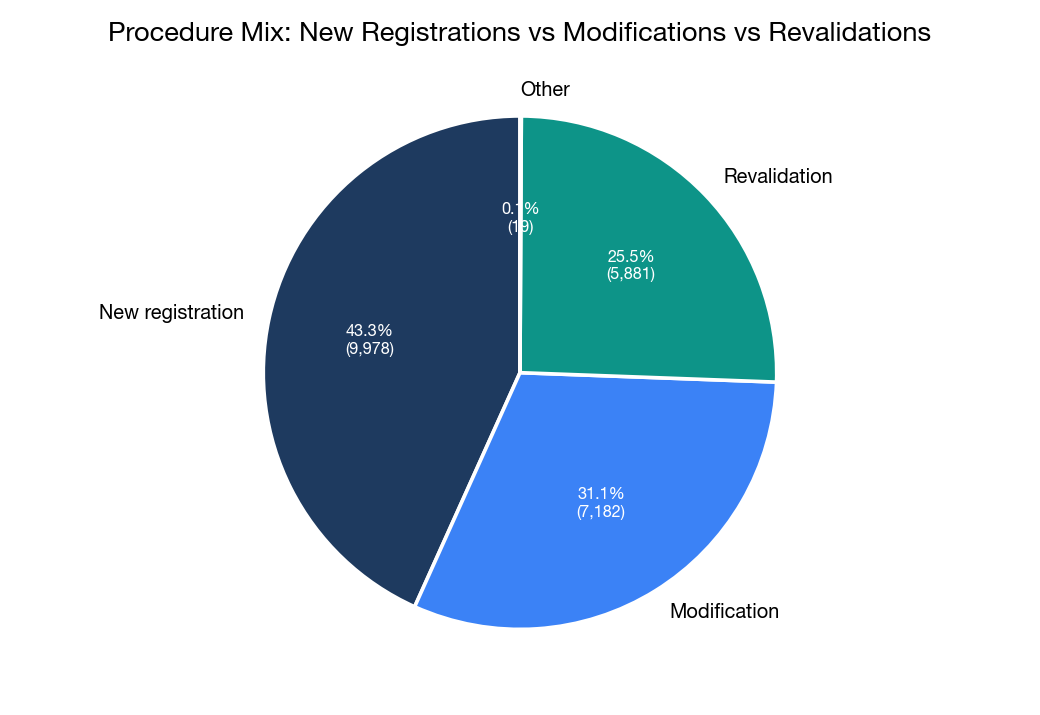
New registrations (43.3%) now only slightly outnumber modifications (31.1%) and revalidations (25.6%), indicating a register that is increasingly dominated by portfolio maintenance rather than first-time entries
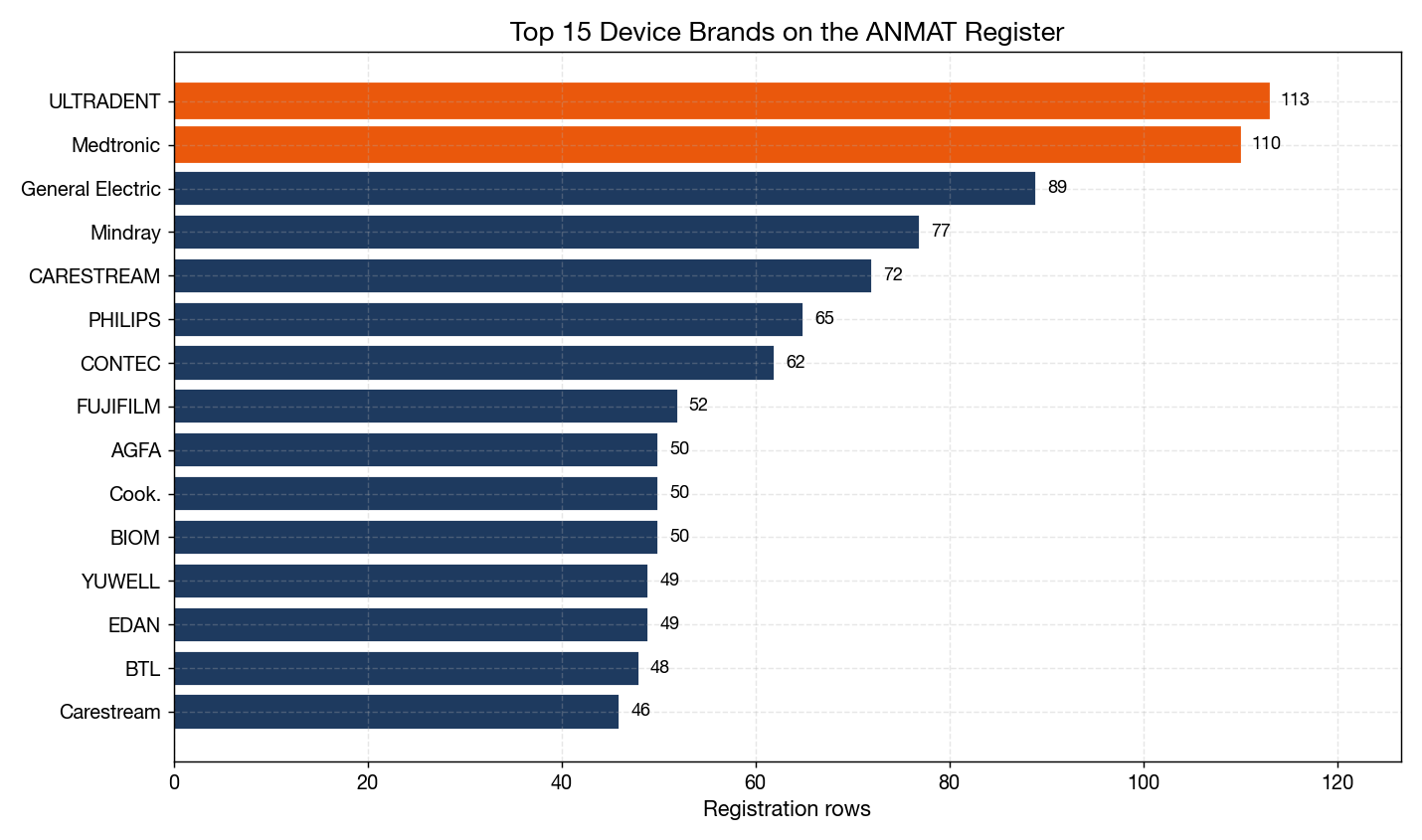
Imaging systems, contact lenses, and wound-care products are the most-registered device categories, with Medtronic, General Electric, Mindray, Philips, and Carestream among the leading brands by registration volume
In vitro diagnostics are a fast-growing segment, with 2,381 IVD records split between Group A–B (1,708) and the higher-risk Group C–D (673)
Regulatory Context: ANMAT and the 2025–2026 Modernization
Medical devices sold in Argentina must be registered in the Registro de Productos Médicos y Tecnología Médica (RPPTM) maintained by ANMAT's Instituto Nacional de Medicamentos. Argentina classifies non-IVD devices into four risk classes (I–IV) following Global Harmonization Task Force (GHTF) principles, and IVDs into four groups (A–D). Registration is valid for five years and must be revalidated before expiry (Pure Global, 2026; OMC Medical, 2026).
The register's recent growth is not accidental. Several regulatory changes converged in 2025–2026:
Provision 9688/2019 and Provision 64/2025 updated registration, modification, and renewal procedures, prompting firms to refresh legacy registrations
Disposition 8799/2025 introduced simplified approval for Class I/II devices and IVD A/B, allowing businesses to operate in declared facilities while awaiting inspection — a change that visibly accelerated low-risk throughput
Disposition 4446/2025 (effective August 6, 2025) eliminated per-shipment import authorization for Class I/II devices, replacing it with a 48-hour sworn-statement notification. ANMAT estimates this affects roughly 70% of all medical product imports (MedDeviceGuide, 2026)
Disposition 224/2026 (effective February 2, 2026) created a new framework for importing used and refurbished medical devices
Two review tracks shape the register's composition. Class I/II devices enter through a Declaration of Conformity pathway typically resolved within roughly 15 business days, while Class III/IV devices undergo a full technical review that can take up to 110 business days (RegDesk, 2026). Foreign manufacturers must appoint an Argentine Authorized Representative (AAR) to hold the registration. All submissions flow through the HELENA platform and must be digitally signed by the legal representative and technical director, with documentation in Spanish.
Market Size and Official Fees
Argentina's medical device market is estimated at approximately $0.9 billion, with an IVD segment of roughly $0.35 billion (Pure Global, 2026). Government registration fees are denominated in Argentine pesos (ARS) and set by class under the official ANMAT schedule: Class I devices at 215,000 ARS, Class II at 276,800 ARS, Class III at 367,200 ARS, and Class IV at 513,000 ARS; IVD Group A/B at 194,700 ARS and IVD Group C/D at 241,200 ARS (RegDesk, 2026). Because ARS fees are adjusted periodically and the peso-dollar exchange rate has been volatile, manufacturers should treat these as the official tariff basis rather than a fixed USD cost and confirm the current figure before budgeting. Government fees are separate from AAR, translation, dossier-preparation, and GMP-audit costs.
Data Source and Method
Source: ANMAT public register of medical products and medical technology (RPPTM), medical-device extract
Analysis sample: 23,060 finalized procedure records
Fields analyzed: Procedure type (
trámite), finalization date (fecha_fin), holder firm (razón_social), device name (nombre), brand (marca), models (modelos), registration/PM number (pm)Run date: 2026-06-14
Method: All figures computed by MedDeviceGuide analysis of the public-register extract. Class and procedure type are derived from the
trámitefield, which records the regulatory action (new registration, modification, or revalidation) and the device class. A single device registered across multiple models counts as multiple records. Registration numbers (pm) are unique to a registered product; the register contains 16,691 distinctpmnumbers.
Registration Volume: A 43-Fold Increase
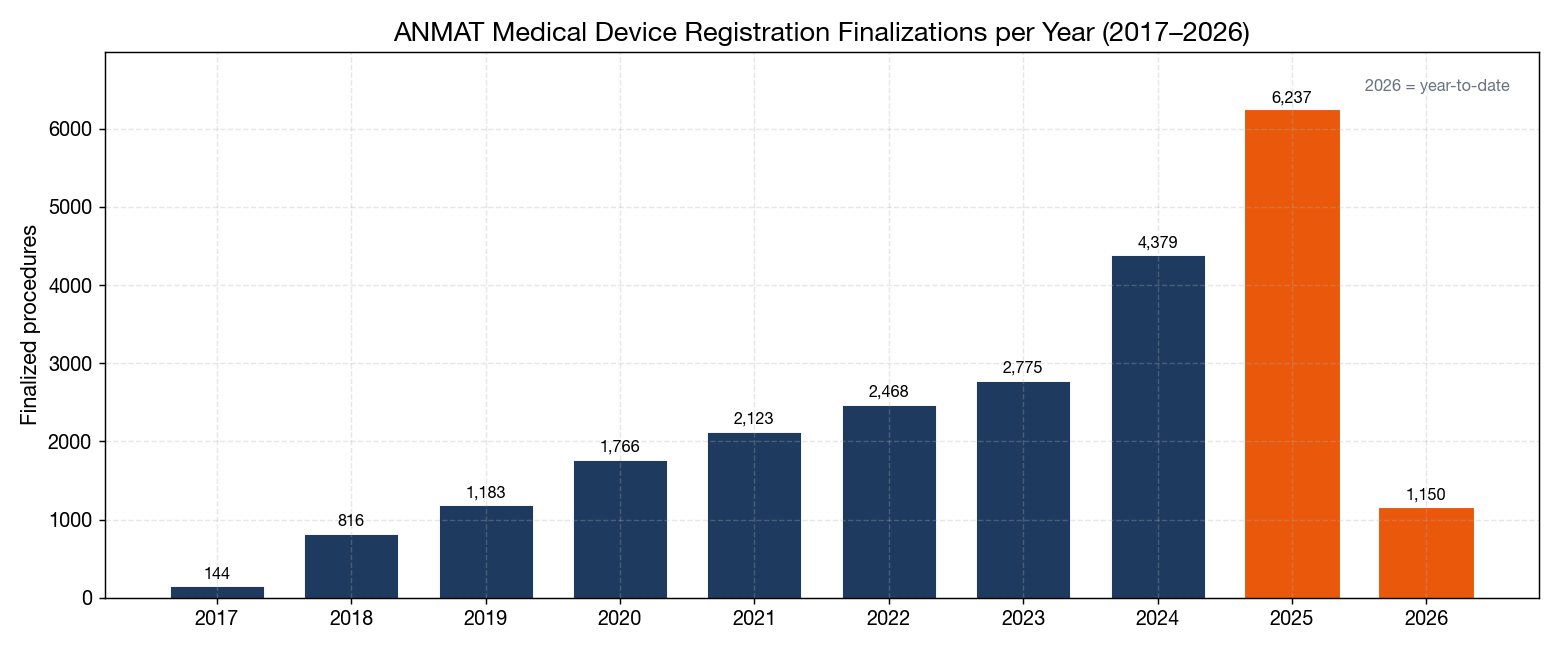
The single most striking pattern in the ANMAT register is the speed of its acceleration:
| Year | Finalized Procedures | Change vs. Prior Year |
|---|---|---|
| 2017 | 144 | — |
| 2018 | 816 | +467% |
| 2019 | 1,183 | +45% |
| 2020 | 1,766 | +49% |
| 2021 | 2,123 | +20% |
| 2022 | 2,468 | +16% |
| 2023 | 2,775 | +12% |
| 2024 | 4,379 | +58% |
| 2025 | 6,237 | +42% |
| 2026 (YTD) | 1,150 | — |
The 2024–2025 jump aligns with the roll-out of Disposition 8799/2025 and the digital HELENA workflow maturing into full production. For manufacturers, this means ANMAT review queues are now processing several years' worth of historical backlog plus a surge of new filings — so realistic timeline planning must account for a regulator that is busier than its own pre-2023 norms suggest.
Risk Class: Low-Risk Devices Dominate
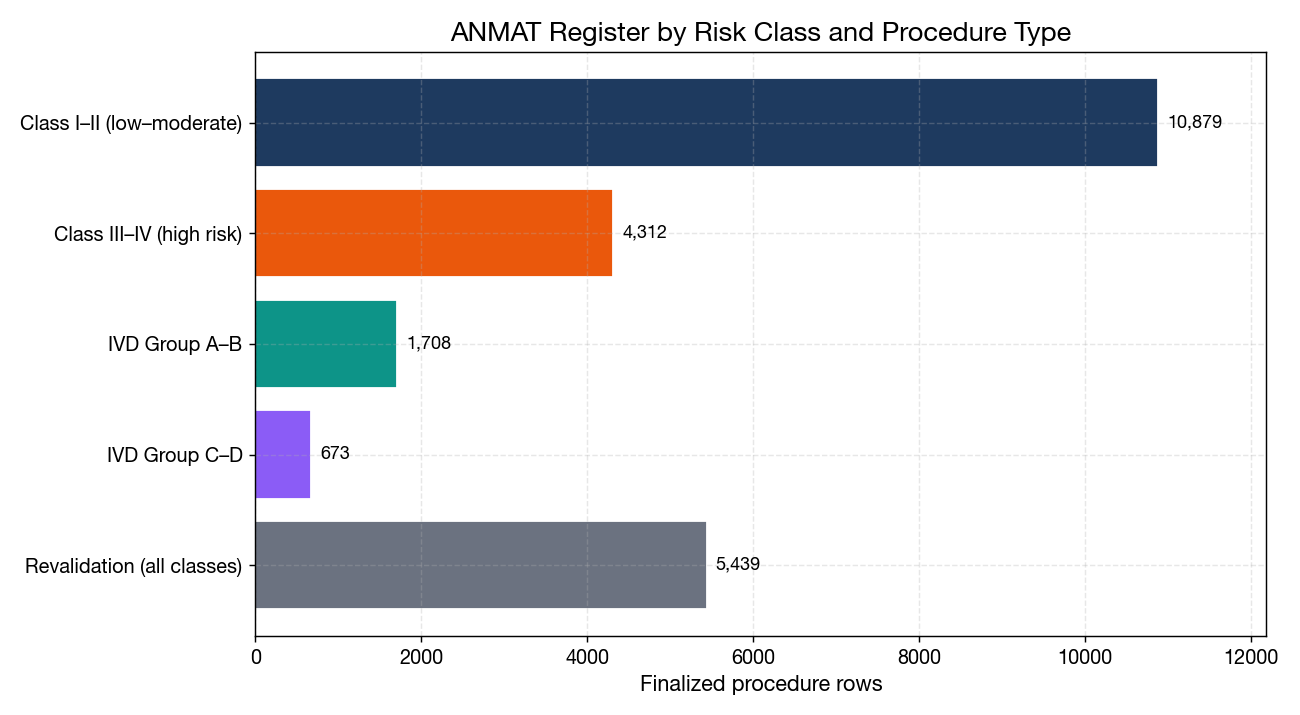
Argentina's two-track system produces a register that skews heavily toward lower-risk products:
| Class / Group | Records | Share of Register | Typical Pathway |
|---|---|---|---|
| Class I–II (non-IVD) | 10,879 | 47.2% | Declaration of Conformity |
| Class III–IV (non-IVD) | 4,312 | 18.7% | Full technical review |
| IVD Group A–B | 1,708 | 7.4% | Simplified / notification |
| IVD Group C–D | 673 | 2.9% | Full technical review |
| Revalidation (all classes) | 5,439 | 23.6% | Renewal before 5-year expiry |
Class I–II devices dominate because the Declaration of Conformity pathway lets manufacturers self-attest conformity with limited ANMAT scrutiny — an attractive route for the wound dressings, consumables, and basic monitoring devices that fill out the long tail of the register. The Class III–IV segment (18.7%) is where regulatory effort concentrates: every record there represents a full safety, performance, labeling, and risk-management dossier reviewed by ANMAT, typically over a three-to-five-month window.
The 5,439 revalidation records (23.6%) are a reminder that the five-year registration clock is a recurring cost — established manufacturers spend roughly a quarter of their ANMAT bandwidth simply keeping existing products alive.
Procedure Mix: Maintenance Is Catching Up to New Entries
| Procedure Type | Records | Share |
|---|---|---|
| New registration (Registro) | 9,978 | 43.3% |
| Modification (Modificación) | 7,182 | 31.1% |
| Revalidation (Reválida) | 5,900 | 25.6% |
A register where new registrations still lead is a sign of a growing market, but the gap is narrowing. Modifications alone account for nearly a third of all activity — these are changes to an existing registration (new models, new manufacturing sites, labeling updates, expanded intended use) that still require ANMAT sign-off. For a manufacturer with an established Argentina portfolio, expect that maintaining and modifying existing registrations will consume as much regulatory effort as launching new products.
Top Brands: Imaging and Multinationals Lead
| Brand | Registration Rows | Category Focus |
|---|---|---|
| Ultradent | 113 | Dental |
| Medtronic | 110 | Cardiovascular, neuro, diabetes |
| General Electric | 89 | Diagnostic imaging |
| Mindray | 77 | Patient monitoring, ultrasound |
| Carestream | 72 | Dental and medical imaging |
| Philips | 65 | Diagnostic imaging |
| CONTEC | 62 | Patient monitoring |
| Fujifilm | 52 | Diagnostic imaging |
| Agfa | 50 | Medical imaging IT |
| Cook | 50 | Interventional devices |
The brand leaderboard is dominated by diagnostic imaging (GE, Philips, Fujifilm, Carestream, Agfa) and patient monitoring (Mindray, CONTEC) — categories with rapid model turnover that generate many registration variants. The strong showing of Chinese brands (Mindray, CONTEC, Yuwell) reflects a broader LATAM trend of Chinese imaging and monitoring equipment gaining ANMAT market access. Dental (Ultradent) and cardiovascular/neuro (Medtronic) round out the top tier.
Most-Registered Device Categories
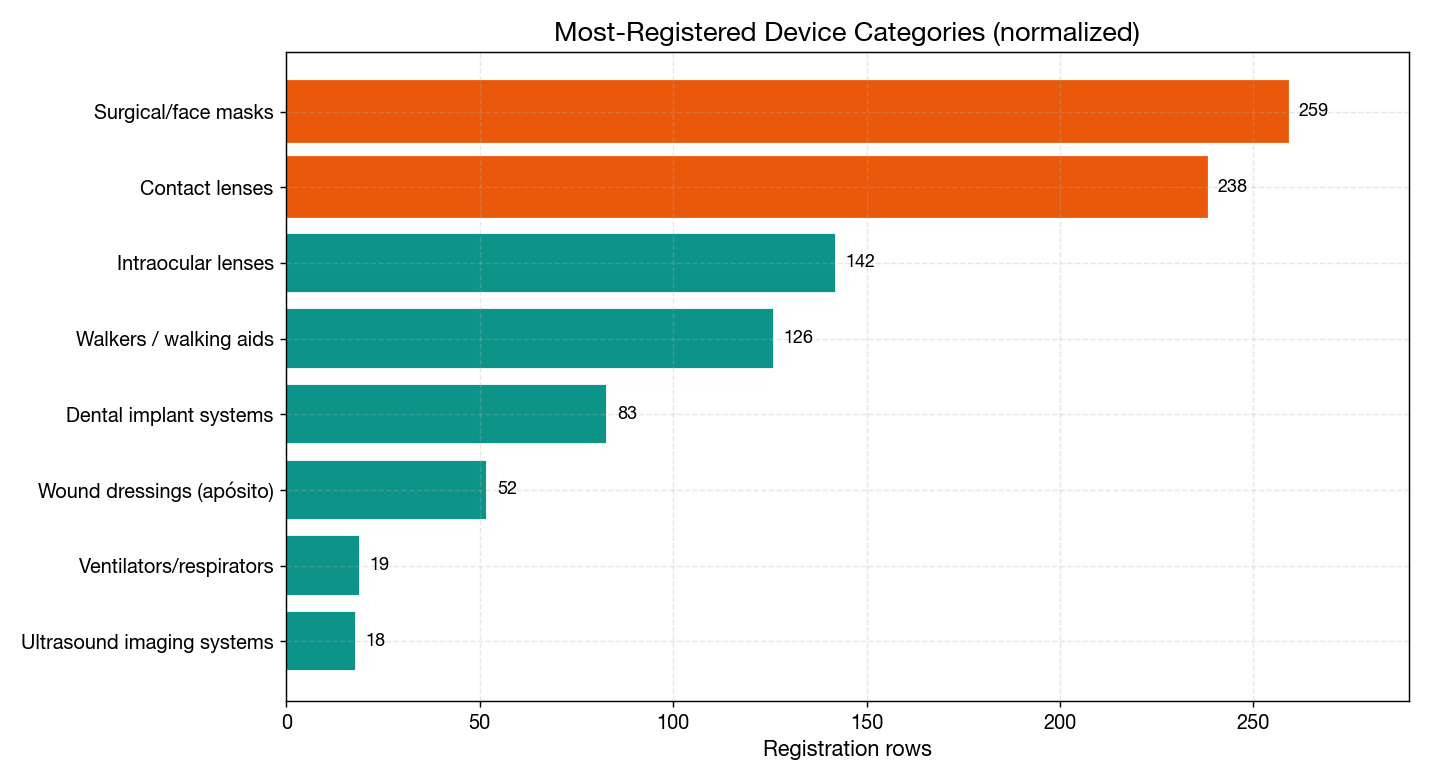
Normalizing the free-text device-name field reveals where ANMAT's workload concentrates:
| Device Category | Records |
|---|---|
| Ultrasound imaging systems | 127 |
| Contact lenses | 92 |
| Walkers / walking aids | 77 |
| Wound dressings (apósito) | 49 |
| Dental implant systems | 45 |
| Intraocular lenses | 32 |
| Surgical / face masks | 31 |
Ultrasound is the single most-registered device category on the ANMAT register, consistent with the imaging-heavy brand list. The presence of contact lenses, walkers, dressings, and masks — all lower-risk, high-volume products — confirms the Class I–II skew. Notably absent from the very top are implantable cardioverter defibrillators, coronary stents, and other Class III hardware; these appear further down the register because each model family is registered individually rather than in the high-variant-volume pattern seen with imaging systems.
Practical Implications for Market Entry
1. Plan for a Faster but Busier Regulator
The Declaration of Conformity pathway for Class I/II devices can resolve in roughly 15 business days, but the 2024–2025 volume surge means ANMAT's review queues are longer in practice than the nominal timelines. Manufacturers entering now should submit clean, complete Spanish-language dossiers digitally signed by both the legal representative and the technical director — incomplete HELENA submissions are the most common cause of delay.
2. Choose an AAR With Active Portfolio Experience
Because modifications and revalidations now make up more than half the register's activity, your Argentine Authorized Representative should be judged not only on first-time registration capability but on their track record managing modifications, model additions, and five-year revalidations at volume. The 25.6% revalidation share means an experienced AAR is worth a premium.
3. Low-Risk Devices: Use the Simplified Pathways
If your product qualifies as Class I/II non-sterile without a measuring function, the affidavit-based notification route (rather than full approval) may apply, and Disposition 4446/2025 eliminates per-shipment import authorization in favor of a 48-hour notice. This affects roughly 70% of medical product imports and substantially lowers the operational cost of maintaining an Argentina presence for consumables and basic devices.
4. Imaging and Monitoring: Expect Crowded Categories
The concentration of ultrasound, patient monitoring, and diagnostic imaging registrations means new entrants in these categories face a crowded register and well-entrenched competitors (GE, Philips, Mindray). Differentiation should lean on predicate novelty, clinical evidence in Spanish, and post-market surveillance readiness — ANMAT's post-marketing surveillance directorate requires registered firms to maintain active vigilance systems.
5. IVD Manufacturers: The Group C/D Window
IVD Group C/D products (673 records, 2.9%) are still a comparatively under-penetrated segment relative to their global market weight. Manufacturers of higher-risk IVDs — molecular assays, companion diagnostics — face less register congestion but must prepare full technical dossiers. This is a genuine entry opportunity for IVD firms willing to invest in the Class III/IV-style review.
6. Budget for the Five-Year Cycle
Every registration must be revalidated before its five-year expiry, and the request must be filed at least 30 days before expiration. The 5,439 revalidation records in the current register show this is not a one-time cost. Budget regulatory spend on a recurring five-year cycle, not just at launch.
Data Source and Method Notes
Primary data: ANMAT public register of medical products and medical technology (RPPTM), medical-device extract.
Analysis: MedDeviceGuide analysis of the public-register extract. All figures are computed directly from the dataset; none are estimated.
Class derivation: Device class and procedure type are derived from the
trámite(regulatory action) field rather than a dedicated class column. "Class I–II" aggregates records labeled Registro Clase I–II and Modificación de Registro Clase I–II; "Class III–IV" aggregates Registro Clase III–IV, Modificación … Clase III–IV, and the Ágil (expedited) variants. IVD groups are derived from the IVD-specifictrámitelabels.Registration numbers: The
pmfield is the product/registration number. The register contains 16,691 distinctpmvalues across 23,060 rows, because modifications and revalidations create additional rows for the same underlying registered product.Brand and device-name analysis: Brand (
marca) and device-name (nombre) fields are free-text and normalized here for category aggregation (e.g., multiple Spanish-language variants of "ultrasound system" are grouped).Limitations: The register does not expose a clean manufacturer-country field, so country-of-origin analysis is not reported here. Firm-level (
razón_social) counts in the public extract appear pagination-limited, so this analysis relies on brand-level and device-name-level counts, which are not subject to that limit.
Data source: ANMAT public medical device register (RPPTM). Analysis by MedDeviceGuide, run date 2026-06-14. Regulatory context from RegDesk (2026), Pure Global (2026), OMC Medical (2026), and MedDeviceGuide's Argentina ANMAT registration guide.