
MedDeviceGuide — IVD & Medical Device Knowledge Base
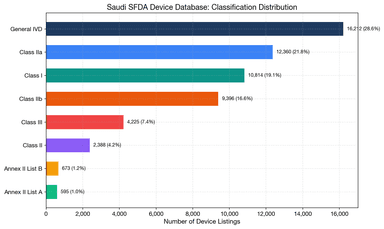
Saudi SFDA AR Concentration: 1,608 ARs, 35% in 20 Hands, 13,700 Expiry Cliff
Saudi SFDA 56,737-row device database: 1,608 ARs, top-20 concentration at 35.4%, and 13,717 devices expiring 2026-2027. Data-driven AR selection insights.
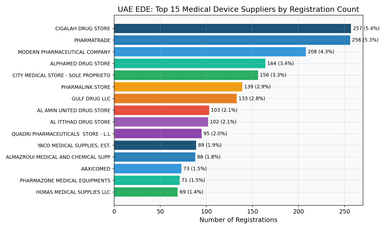
UAE EDE: 10 Suppliers Control a Third of All Medical Device Registrations
UAE EDE data shows 10 suppliers control 33.7% of 4,793 medical device registrations. Cigalah, Pharmatrade lead. US tops country of origin at 16%. Dubai holds 63.5% of registrations.
FDA 510(k) Application: Submission Components and Format Requirements
Every section of an FDA 510(k) application explained — cover sheet, indications for use, device description, SE discussion, testing, labeling, software, and the eSTAR template structure.
FDA 510(k) K-Number: How to Decode It, Find It, and Use It for Regulatory Intelligence
What the 510(k) K-number means, how the format encodes the year and sequence, and how regulatory professionals use K-numbers for predicate research, competitor tracking, and submission management.
ISO 13485 Audit Findings: Most Common Nonconformities by Clause and How to Prevent Them
The ISO 13485 clauses most cited in audit findings — root causes and corrective actions for document control, CAPA, design controls, suppliers, internal audits, and process validation.
FDA 510(k) Consultants: How to Choose, Vet, and Work with a Clearance Partner
How to select, evaluate, and engage an FDA 510(k) consultant — fees by device complexity, engagement models, red flags, due diligence checklist, and when hiring one makes financial sense.
FDA Adverse Event Monitoring System (AEMS): What Replaced MAUDE for Medical Devices
FDA replaces MAUDE with AEMS — unified adverse event dashboard, migration timeline, data limitations, and reporting changes for device manufacturers.
Medical Device Software Verification vs Validation: FDA and IEC 62304 Requirements
Software verification vs validation for medical devices — FDA expectations, IEC 62304 activities, documentation, traceability, and the design control process.
FDA 510(k) Clearances: Tracking, Timelines, and Decision Data
Track FDA 510(k) clearances, understand review timelines, interpret SE/NSE decisions, use the 510(k) database, and apply clearance statistics to your 2026 regulatory strategy.
FDA 510(k) Guidance Documents: Device-Specific Requirements and Special Controls
How to find and use FDA 510(k) guidance documents, Class II special controls, device-specific submission requirements, and the CDRH FY 2026 guidance agenda to prepare stronger premarket submissions.
FDA Medical Device Registration: Step-by-Step Process from Classification to Market
Step-by-step FDA medical device registration — classification, 510(k)/De Novo/PMA pathways, establishment registration, device listing, FY 2026 fees, and post-market obligations.
Dermal Fillers vs Cosmetics vs Medicines: Hong Kong Borderline Classification After GN-00
How Hong Kong classifies injectable dermal fillers at the borderline between medical devices, cosmetics, and medicines — and why the May 2026 GN-00 update matters for your product.
eDHR for Medical Devices: QMSR, Part 11 & Digital Manufacturing (2026)
eDHR implementation guide for medical device manufacturers: QMSR requirements, 21 CFR Part 11, MES integration, ISO 13485, paper-to-digital migration, and inspection readiness.
NAMs for Medical Device Biocompatibility: FDA, EU & ISO 10993 Guide (2026)
NAMs for medical device biocompatibility: FDA roadmap, EU phase-out plan, ISO 10993-5/-10/-23 in vitro alternatives, chemical characterization, and regulatory strategy.
Hong Kong Dermal Filler MDACS Listing Strategy: LRP, Docs, Importers, Procurement
Guide to listing injectable dermal fillers under Hong Kong MDACS after the May 2026 GN-00 update: LRP, technical dossier, importer controls, adverse event reporting, and procurement.
Hong Kong MDACS GN-00 Update: Why Injectable Dermal Fillers Are Now Medical Devices
On 13 May 2026, Hong Kong MDD updated GN-00 to classify injectable dermal fillers as medical devices under MDACS. What changed, why it matters, and what manufacturers must do.
RPM Device Regulatory Pathway: FDA, CMS Reimbursement & EU MDR (2026)
RPM device regulation: FDA classification, CMS 2026 CPT codes (99445, 99470), reimbursement rates, SaMD, EU MDR pathway, and commercialization strategy for connected monitoring devices.
Abbott Libre Duo CE Mark: Dual Glucose-Ketone CGM Strategy (2026)
Abbott Libre Duo CE mark analysis covering the first continuous glucose-ketone sensor, dual-analyte regulatory strategy, CGM competition, FDA pathway, and wearable convergence.
EU Digital Product Passport for Medical Devices: ESPR, Batteries, and UDI
Guide to EU Digital Product Passport requirements for medical devices, including ESPR scope, battery passports, UDI/EUDAMED links, standards, and timelines.
Liquid Biopsy and Multi-Cancer Early Detection (MCED) Tests: FDA, IVDR Regulatory Pathway
Regulatory guide to liquid biopsy and MCED tests, including FDA pathways, Breakthrough designation, companion diagnostics, EU IVDR classification, clinical evidence, and key market players.